COMM-ORG Papers 2006
Beyond Polarities:
Collaboration and Conflict in Community Health Partnerships
Deborah Lynn Marois
debmarois@sbcglobal.net
Contents
Chapter One: Introduction
Why Community Development as a Health
Improvement Strategy?
Background and Purpose
Organization and Overview
Chapter Two: Literature Review
Authentic Participation
Collaboration as a
Structure for Authentic Participation
Asset-Based
Collaboration
Collaboration and Community Conflict
Power Differentials
as a Source of Conflict
Ideology, Identity,
and Discourse: Sources of Power, Conflict, and Social Change
Blurred Boundaries
and Multiple Identities
Communication
Conflicts
Transforming Conflict Through Participatory,
Authentic Collaboration
Balancing Power
New Roles for
Professionals and the Grassroots
Summary
Chapter Three: Methodology
Research Goals and Questions
Sample Selection
Sample Overview:
General Characteristics of Community Health Partnerships
Data Collection
Document Review
Interviews
Characteristics of
Interview Participants
Participant
Observation/Site Visits
Participatory Approach and Reciprocity
Data Analysis
Chapter Four: Structure, Membership, and Outcomes
General Partnership Characteristics
Membership and
Leadership
Community Engagement
Governance and
Decision Making
Meetings and Other
Communication
Collaboration for What? The Bottom Line
The Value of
Grassroots-Institution Collaboration
Who Participates? Locating the Grassroots
in Health Partnerships
Distinguishing
Grassroots Community and Institution Representatives
Grassroots at the
Intersection of Geography, Class, and Ethnicity
Commitment and
Personal Investment
Ambiguous Identities
Crossing Boundaries
Wearing Multiple Hats
The Role and
Function of Integrators
Institution Leaders
as Integrators
Shifting
Representations: Resisting and Becoming “Institutionalized”
The Representation Continuum: A Summary
Chapter Five: Sources of Conflict in Community Partnerships
Defining and Reframing Conflict
Primary Conflict Triggers
Climate
Historical Mistrust,
Social Inequality, and Accrued Resentment
Scarcity and
Competition
Constant Change and
Inconsistent Participation
Emotionally Painful
Issues
Culture Clash:
Social Norms of Communities and Institutions
Organizational
Structures: Differing Norms and Expectations
Differences in
Discourse: Communication Style and Language
Role and Identity
Conflict
Differing
Expectations for Roles and Responsibilities
Identity and
Representation: Constraints and Conflict
Grassroots or
Astroturf? Representation as a Source of Conflict
Lack of Shared
Vision
Philosophical
Differences
Disconnection and
Lack of Participation
Decision Making and
Prioritizing
Influence and Control of Decisions
Summary
Chapter Six: Handling Conflict in Community Partnerships
Positionality and Responses to Conflict
Common Responses to Conflict
Avoid
Deny and Sweep
Shutting Down and Holding Back
Stalling and Withdrawing
Recognize and Call It
Diplomacy
Defend and Justify
Take a Stand/Advocate for Position
Blasting
Threats
Contain and Freeze
Out
Accelerate/Crank it up
Common Methods to Prevent and Resolve Conflict
Equalizing Power through Asset-Based Community Engagement
Socioeconomic
Support and Culturally Appropriate Communication
Empowerment through Leadership and Employment Skills Development
Inclusivity: Having a Voice, Being Heard
Focus on Assets
Building and Strengthening Relationships
Dialogue and
Responsive Action
Create Clear Agreements and Clarify Expectations
Focus on Collective Vision and Goals
Listen, Validate,
and Respond
Learn to Navigate Cultural Norms
Speaking a New Language
Third Party Interventions
Conflict Outcomes
Learning
Stronger Partnerships and Better Decisions
Broader Community Change
Summary
Chapter Seven: Conclusion
References
Appendix A: Partnership Descriptions
Appendix B: Request for Snowball Sample
Appendix C: Interview Guide
Notes
Acknowledgements
About the Author
Abstract
Community development strategies such as grassroots participation and collaboration are increasingly relied upon to improve health and quality of life, in part as a response to increasing complexity, shrinking budgets, and funding mandates. Current literature indicates that conflict is an inevitable part of the collaborative process and the ability to transform conflict is strongly associated with overall success. This research investigates the conditions that cause conflict and how conflicts are handled in thirteen community health partnerships comprised of grassroots and institution representatives. Findings indicate that many partnership members are difficult to categorize as either grassroots or institutions representatives. These members act as integrators; they use the power and influence of the institution and knowledge of grassroots culture to advance community goals, bridge differences, facilitate communication, and foster innovation and compromise. The five primary conflict triggers identified include: a complex climate characterized by mistrust, inequity, constant change, competition, and scarcity; culture clash; identity and role; a lack of shared vision; and decision making. Constraints created by bureaucracy can be observed in each of these conflict situations. Successful strategies to handle these conflicts include: equalizing power through asset-based community engagement; strengthening relationships through dialogue and responsive action; and learning to navigate the different cultures of communities and institutions. Though the majority of partnership members attempt to avoid conflict whenever possible, they consistently report that conflict ultimately enabled them to learn, create stronger partnerships, make better decisions, and achieve broader policy and systems change.
Chapter 1: Introduction
"Holding each other close across differences, beyond conflict, through change, is an act of resistance." ~ bell hooks
The aftermath of Hurricane Katrina unfolded while I endeavored to write my findings that detail how collaborative groups comprised of institution and grassroots representatives handle conflict. In the midst of this national crisis, the intersection of community development and public health is particularly relevant. The public health field has long recognized the interrelated political, economic, and social structures that contribute to poor health, most notably poverty and social inequities based on race, class, and gender (Hofrichter, 2003; Minkler, 1997). Current research increasingly emphasizes the link between social conditions arising from global capitalism, increased income disparity, and health status (Rafael, 2003; Eitzen and Baca Zinn, 2003; Ambert, 1998). The transformation of economy has changed the nature of work, family life, food production, mobility, and social cohesion. The stresses arising from these changes – for example, greater job insecurity and unemployment, increased poverty and social exclusion, and the disruption of social networks resulting from demographic changes such as migration, the influx of women into the workforce, and an increase in single parent families – impact both economic and health status (Eitzen and Baca Zinn, 2003).
The images of the most vulnerable – the young, elderly, poor, and sick – stranded in the midst of urban collapse highlights the social inequity that reigns in American culture. Most who remained in New Orleans were poor, African American, and without access to transportation out of the city. Decades of industrialization and the excesses of modern consumer capitalism contributed to the toxic soup that submerged the long-neglected urban infrastructure. The citizens of New Orleans must now mobilize to heal, clean up the environmental mess, and rebuild community. To solve these complex problems, local residents, community based organizations (CBOs), and institutions must collaborate. This will be no small task, especially given the fertile ground for conflict. The courageous people accept this challenge may be heartened by the stories of community collaboration happening throughout California.
The story is one of ordinary people coming together to cooperatively solve problems and the conflicts that inevitably arise under conditions of scarcity, fear, and competition. Despite the material wealth of the U.S., a significant segment of our population lives in poverty. Economic inequities affect health in a myriad of ways from the inability to maintain optimal hygiene practices to the increased risk of infections and accidents arising from unsafe and overcrowded housing. Chronic stress arising from poverty, inequity (position in a hierarchy) and social exclusion correlate with higher death rates, increased susceptibility to infectious disease, compromised immunity, retarded growth in early childhood, and increased rates of conditions such as cardiovascular disease and diabetes (Wadsworth, 2000; Brunner and Marmot, 2000; Shaw, et.al., 1999; Wilkinson and Marmot, 1998). Research by Kawchi, Kennedy and others (1997, 1998) concludes that income inequality coupled with reduced social cohesion and the erosion of social capital leads to increased total mortality, cardiovascular and infant mortality, and death from violent crime.
Through community health partnerships, everyday people take collective action to address the conditions that contribute to poor health. Heroically, they come together as social change agents despite seemingly enormous global forces that shape local conditions. Their stories of collaboration and conflict are immersed in the historical, political, and economic structures of our society. By combining community development with public health approaches, people are discovering innovative ways to improve quality of life.
Why Community Development as a Health Improvement Strategy?
As a comprehensive approach to social change, community development seeks to improve the social and economic status of people within a defined geographical region. This is no easy task in an era of globalization characterized by urbanization, fragmentation, specialization, bureaucracy, and spatial flexibility (Davies and Herbert, 1993). As a process grounded in values, there is considerable variation in accepted definitions. Generally, community development is characterized by attention to inequities in the distribution of wealth, resources, opportunities, and power as well as a concern for sustainable solutions. Sustainable approaches acknowledge the interrelation of social, environmental, and economic issues and they support development that will persist over time without degrading the social or physical environment (Wheeler, 1998; Christenson, et. al., 1989).
Community development brings diverse constituencies together to work towards common goals. For many community development practitioners, the means are as important as the ends. There is a prominent focus on participation and empowerment of people living in poverty, especially in decision-making. Practitioners attempt to engage local residents in activities to define a common vision, plan strategies to address issues of concern, and mobilize action on their own behalf. Community building occurs by connecting individuals, associations and institutions in new relationships that focus on common goals and build on assets (Rubin and Rubin, 2001; Green and Haines, 2001; Checkoway, 1995; Hester, 1985; Kretzmann and McKnight, 1993). These activities serve as a mechanism to increase individual and collective capacity – participants build skills, develop leadership and strengthen social connections. This outcome often is characterized as increased social capital, which refers to the stocks of trust and norms of reciprocity and mutual obligation that exist among networks of people (Rubin and Rubin, 2001; Putnam, 2000).
Twenty-first century health promotion efforts recognize good health as an essential component of development – both as an outcome of development efforts as well as a means to achieve it. In a statement on urban health, the World Health Organization (WHO) Regional Office for Europe declares, “Poverty is the single largest determinant of health, and ill health is an obstacle to social and economic development” while WHO’s Regional Director for Africa has argued that “…health and development are interrelated and indeed, health is a prerequisite for development” (Toure, 1994). WHO’s Healthy Cities project has evolved into a global movement for public health and asserts, “There can be no progress on health without socially and environmentally sustainable economic development” (World Health Organization, 2002: 3, 6).
Health improvement efforts that use a community development approach focus on improving the lives of the most marginalized in society by engaging diverse people to plan, implement, and evaluate strategies designed to create a healthier community. The goal is to achieve changes in the community conditions that affect health through broad based, collective action. A commitment to equal partnership and a focus on assets and capacities are frequently the stated values. Because health problems are more prevalent among marginalized or socially excluded people, these efforts often emphasize the inclusion of the “grassroots,” especially low-income people, minorities and those affected by particular health issues (e.g., disabled, uninsured, HIV/AIDS).
By imposing constraints on the material conditions of every day life, poverty and social exclusion limits access to the fundamental building blocks of health, such as adequate housing, good nutrition, education, and opportunities to participate in society. As a concept, social exclusion goes beyond the definition of poverty as a lack of material resources and refers to the process of being shut out from any of the social, economic, political, or cultural systems that determine the social integration of a person in society (Shaw, et. al., 1999). Exclusion from participation in decision-making and political activities, access to employment and material resources, and integration into common cultural practices combine to create acute forms of marginalization that manifest spatially in particular neighborhoods (Byrne, 1999). Thus, social stratification is reflected in the built environment as multidimensional disadvantage and stigma become concentrated in segregated locales, affecting not only individuals, but also whole communities (or segments thereof).
Chronic health conditions such as diabetes, heart disease, obesity, asthma, and HIV/AIDS often are connected to environmental conditions prevalent among socially excluded populations. Traditional medical prescriptions are not available to cure the health problems associated with polluted air and water, unsafe neighborhoods, dilapidated housing or long-term unemployment. Individual behavior modification – such as advice to eat five fruits and vegetables a day – is extremely difficult to implement if one lives in an area without a grocery store that carries affordable, fresh food; lack of transportation imposes an additional barrier. Daily exercise such as walking may be a life threatening activity in a neighborhood that lacks sidewalks and streetlights or is under siege from gun violence. Increasingly, there is greater understanding that health is produced by people within a social context rather than being a commodity dispensed by health care systems (Wallerstein and Duran, 2003; McKnight, 1995).
Consequently, public health improvement efforts have shifted from a primary focus on disease treatment and individual behavior change to community organizing and advocacy for policy changes that promote social justice and eliminate disparities. While individual behavioral change and access to medical services is important, there is a significant and growing consensus among multidisciplinary practitioners that improvements in population health require interventions that address root causes arising from complex social and economic structures rather than simple curative technologies. Legislative mandates and funding guidelines further influence the use of participatory, community development approaches to health improvement (Thompson et al, 2003; Chavis, 2001; Minkler, 1997; Wandersman, et. al., 1997).
Background and Purpose
The problems of poverty, social exclusion, and poor health require comprehensive solutions that include collective action, the mobilization of local resources supplemented by external support, and policy change. Decades of experience with community development and public health theory and practice provide evidence that community participation and collaboration are effective means to achieve improved health and quality of life. However, collaborative efforts are often dominated by service providers and challenged by conflict. Collaborative groups must have skills for managing conflict if they are to maintain the partnership and attain shared goals. Indeed, the ability to resolve conflict is one characteristic of successful collaborations (Cohen and Gould, 2003; Shortell et. al., 2002; Chavis, 2001; Mizrahi, 1999; Winer and Kay, 1994). This research explores how this is managed in collaborative groups that include both grassroots community members and representatives of helping institutions such as public health departments, social service agencies, schools, and law enforcement.
This research was initiated under the assumption that there are differing perspectives and levels of power between collaborative group members that inevitably lead to conflicts. Collaboration does not necessarily come “naturally” to citizens in a capitalistic society that emphasizes individualism and competition. Because “genuine partnerships” are rarely observed (McKnight, 1996), understanding this critical process may serve useful to a broad range of development efforts. Moreover, in diverse partnerships that include marginalized grassroots members, the strategies for handling conflict may be quite different than those used in “inter-agency” collaborative groups.
I entered the research field with a strong foundation of knowledge and experience related to community collaboration. For several years, I served as the coordinator for a children’s health collaborative as part of Sierra Health Foundation’s Community Partnerships for Healthy Children (CPHC) initiative. Through this work, I learned about asset-based community development (ABCD), civic engagement, coalition building, policy advocacy, and innovations in health, education, and social services from cutting-edge thinkers.
Later, I joined the Public Health Institute’s Center for Collaborative Planning (CCP) where I provided statewide training and technical assistance. Grounded in ABCD theory and practice, our organizational philosophy rested on the belief that people have the capacity to solve their own problems; every person is gifted; and in the quest for social change to improve health, we need the valuable contributions of our most marginalized community members and support from institutional resources. We advocated grassroots engagement in health improvement efforts because “expert” help too often resulted in misguided interventions that further dashed the hopes of flailing communities.
Working closely with John McKnight and John Kretzmann, CCP founded the California ABCD Institute and I became a lead trainer. Through work with hundreds of leaders and policy makers from the grassroots, health, education, philanthropic, and government sectors, I witnessed the amazing transformation of individuals and communities that occurs when people mobilize around a common vision. The contacts and relationships that grew from this work enabled me to carry out this research.
At the turn of the millennia, I joined the Skills for Change Radical Therapy Collective. For three years, our training group met monthly to learn how to apply conflict resolution skills in our professional and personal lives. The primary theoretical concepts of radical therapy1 complemented my understanding of asset-based community collaboration. Radical therapy principles maintain that all people are essentially good, have value, and can resolve their own problems when connected to and supported by community. These principles demand that people respect each other as equals and avoid categorizing those with less power solely as victims. However, real inequalities arising from structural and material conditions such as class, race, gender, and sexual orientation are examined to understand how power shapes conflict in relationships. Like asset-based community development theory, radical therapy emphasizes understanding how structural and internalized oppression imprisons people and limits their ability to change.
Radical therapy principles outline the necessary conditions for equal relationships where conflict is resolved and both parties achieve maximum satisfaction. Key to this process is the willingness to cooperate and develop power without infringing on others. “Rescue” is a central concept in the analysis of conflict. Defined as doing more than your fair share or agreeing to something you don’t want to do, rescue usually occurs when people perceive others as less capable. However, this “victim” identity is eventually rejected, resulting in conflict as the “one-down” person retaliates against the rescuer. Asking for “100% of what you want 100% of the time” is the primary means of handling conflict that arises from rescue. Another key tool to resolve conflict is validating intuitions. This is based on the premise that people are not crazy; their feelings and intuitions arise from some kernel of truth. Conflicts are more rapidly resolved when people validate the other’s truth before denying, defending, or explaining why the other is mistaken.
Through my study and practice of collaboration, ABCD, and radical therapy, I began to wonder how collaborative groups handle conflict when the membership is comprised of both grassroots and institution representatives. What happens when people come together with the desire to forge a partnership in which all members are equally valued and a conflict arises? How do the inequalities arising from social class, race, and gender influence collaboration and conflict? How are disagreements resolved? Can power really be shared? While radical therapy provides useful tools for navigating individual relationships, the practice offered limited avenues for applying the concepts to larger social organizations in which hierarchal structures dominate. I wondered if some of the concepts could be applicable in a collaborative setting since participants intend to share power and value everyone as equals.
My familiarity with the world of community collaboration was both a benefit and a challenge. I recognize that my experiences shape my perceptions and analysis and other interpretations are possible. I am a White, college-educated woman, feminist, and social justice advocate who envisions a world in which inequality and exclusion are rare events. Though I have enjoyed many privileges as a result of my demographics, I’m no stranger to social marginalization, poverty, and the accompanying health consequences. Thus, I could easily navigate conversations with people from diverse perspectives, understand the lion’s share of acronyms, and follow complicated explanations of group structure and funding streams. But since I didn’t bring the fresh eye of a newcomer, my vision is clouded by preconceptions and limited by blind spots. Most notably, I entered the field with a polarized, dualistic assumption: grassroots versus institution. What I discovered is a false dichotomy and a third way that represents integration. The process of collaboration and conflict is dialectical, dynamic, and evolving. Power is not a static energy.
Organization and Overview
In the next chapter, I explore the literature pertinent to understanding community participation and collaboration as tools for community health improvement. The literature review also examines conflicts in the context of collaborative efforts, especially those that arise from ideology, power differentials, identity, and communication. Finally, the concept of transforming conflict is examined. Chapter three explains the methodology used to investigate the primary research questions related to conflict in community health partnerships. Chapter four is divided into three subsections. Each reports on significant findings in terms of partnership structure, membership and outcomes; conflict triggers; and common methods for handling conflict. The final chapter provides conclusions and implications for community development and public health practice.
Chapter Two: Literature Review
As society grows ever more complex and single agencies prove unable to unilaterally resolve problems, collaboration is necessary to appropriately address a wide range of seemingly intractable community issues such as poverty, poor health, and violence (Mays, 2002; Chavis, 2001; Bradshaw, 2000; Wandersman, et.al., 1997; Gray, 1989). Changes in the structure of the welfare state also influence the collaboration trend. Devolution at the federal level provides states and in turn, local governments (cities, counties) greater authority and flexibility in designing health improvement programs (Sabol, 2002, Sherraden et al., 2002). However, this increased freedom is coupled with a climate of ever shrinking budgets and an expectation to maximize resources. As a result, collaboration often is required in order to receive funding from both public and private sources (Thompson et al, 2003; Chavis, 2001; Minkler, 1997; Wandersman, et. al., 1997).
Legislation as well as private philanthropic grant guidelines usually require local jurisdictions to collaborate with representatives of various social welfare agencies, along with the private sector and affected community residents to plan services and allocate funds. These trends create benefits such as the ability to tailor programs that more effectively address local conditions as well as challenges such as how to share power with the people most affected by the problems. Collaboration provides an opportunity for diverse sectors of a community to plan and implement a shared vision. However, policy and funding trends can also force people to work together out of necessity rather than a commitment to common goals.
Funding guidelines for a variety of social welfare programs not only require collaboration, but community participation as well.2 In part, this is a legacy from the 1960s when War on Poverty and civil rights advocates sought “maximum feasible participation” of community residents typically left out of decision-making. Specifically, this meant that “consumers, especially the poor and minorities served by the programs, would participate in the institutional decision-making process” (Koff, 1988: 32). The requirements also result from the realization that in order to improve social conditions (and perhaps achieve lasting change), the people most affected by the problem must be involved in developing solutions.
Community participation and collaboration are particularly relevant strategies for addressing processes of social exclusion that result in poor health. Current thinking posits that in order to adequately address health inequities and the systemic causes, local community members must be engaged in the social change process. The concept of community participation in health development and promotion is not necessarily new. What is new is how the concept is defined and practiced.
Authentic Participation
The essence of community participation as a strategy to improve health is “based on the premise that participation is a prerequisite of democracy” (Koff, 1988: 82). Meaningful participation is “key for democratic decision making” and balances power between citizens and their government. It “provides a check on the power of local elites – the role of influentials” (Kearns and Gesler, 1998: 253). Broad participation is thought to lead to better quality decisions that serve the public good (as opposed to solely the elite) as well as create commitment to implement plans (Koff, 1988: 82).
Authentic participation is conceived as a proactive role where community members are positioned as equal partners with the formal sector (government, health experts, researchers, etc.) and act as “an agent for health and development, rather than a passive beneficiary” of health programs. Rather than a mechanism to lend support to externally led health development efforts, a participatory approach involves “a commitment to promote better health with people and not merely for them.” This is a radical departure from simply seeking consultation and advice from community members. Explicit in this approach is the “obligation of the formal sector to share power rather than merely to foster cooperation” (Kahssay and Oakley, 1999).
Some theorists describe participatory approaches to social change as a shift necessitated by postmodern society. In our diverse, complex world, problems cannot be solved with a top-down, expert-driven approach. Consequently, inclusive and collaborative approaches are required for goal attainment in virtually every sector – business, education, public health and social services. A participatory perspective is one that involves a new way of thinking, experiencing, and acting; it recognizes that people and communities are co-creators of the world in which we live.
“The emergent worldview has been described as systemic, holistic, relational, feminine, and experiential, but its defining characteristic is that is participatory: our world does not consist of separate things but of relationships that we coinvent” (Bradbury and Reason, 2003: 206).
Ultimately, a participatory worldview is rooted in democratic principles and is about power – the power to know, decide, act, and shape our lives. At its best, participatory planning brings together a diverse constituency in a democratic, visionary, and consensus-community building process that empowers participants.
Central to the discussion of participation is the question, “Who participates and to what end?” Community participation is a tool to reclaim decision-making from the “expert” realm and provides a means to achieve creative approaches to problem solving based on local assets. Inclusive, authentic participation occurs when community residents, especially those from traditionally marginalized groups, share the power to define problems, develop solutions, and make decisions with institutional representatives. “To be anything other than tokenism, participation must involve the sharing of power” (Hart, 1987: 227). Diversity is achieved by including a variety of perspectives reflective of differences in culture, ethnicity, socioeconomic status, education level, gender, sexual orientation, religion, political affiliation, and age. That is, all affected groups participate and citizens are treated as constituencies; they take part in naming the problem and selecting the issue; and resources are made available to enable the full participation of less powerful groups (Labonte, 1997). Innes and Booher (2004) refer to this equitable, inclusive approach where dialogue is a central feature as “collaborative participation.”
This type of collaboration operates at the upper rungs of Arnstein’s ladder of participation, or as what Labonte defines as “true participation.” Citizen participation occurs along a continuum that begins with manipulation and progresses toward more meaningful involvement where citizens ultimately have decision-making power and control (Healy, 1997; Labonte, 1997). McKnight defines this as a genuine partnership – a “relationship of equal power between two parties with distinctive interests. Each preserves its authority, distinct capacity, and integrity but gains power through partnership” (1996: 10-11). As in consensus organizing, power is built and change achieved by bringing all potential partners together, identifying common interests, and developing relationships of mutual trust and respect. Participants share power to gain power (Eichler, 1995).
Citizen participation is not without its critics. Despite legislative and policy mandates to engage community participation, actual practice often falls short of the ideal (Innes and Booher, 2004; Hester, 1999; Krause, 1977). In practice, collaboration typically involves professional representatives (government, nonprofit, business) and perhaps a few token parents or clients to meet grant or statutory requirements. Because action takes place within the existing institutional framework and involves political ideology, power can be skillfully exerted to prevent significant change (Krause, 1977). Some so-called participatory processes are easily manipulated to exclude or override contributions of marginalized people or may reproduce existing power structures. The result is cooptation or tokenism rather than citizen empowerment. In these relationships, the community serves the system as an advisor or volunteer; the institution locates within the community to assure access to clients; powerful interests dominate the planning process; and polarization among competing special interest groups occurs (Innes and Booher, 2004; Hester, 1999; McKnight, 1996; Krause, 1977).
Communities and professionals alike have learned a great deal about the realities of public participation in community health improvement efforts during the last few decades. While there are still plenty of examples of inauthentic community participation, there also are a growing number of successful efforts. Private philanthropic foundations often provide the seed money and technical support for innovative approaches coupled with the requirement to evaluate and learn from the process. Over time, these lessons are brought to bear on subsequent community health improvement efforts that seek to engage citizen participation. And, the Federal government continues to play a role in promoting community participation and collaboration, especially with the recent emphasis on eliminating health disparities.
Collaboration as a Structure for Authentic Participation
Collaboration can be thought of as one form of community participation that provides the structure to engage local residents in planning, decision-making, and implementation of solutions. Collaboration is a process to reach goals that cannot be achieved acting singly or, at a minimum, cannot be reached as efficiently. While coordination or cooperation may involve joint activity, a mutual commitment to a shared vision and high level of trust distinguish collaboration. This new conceptual meaning of collaboration goes beyond a simple strategy for achieving a particular goal. Gray (1989) defines collaboration as an emergent, dynamic process “through which parties who see different aspects of a problem can constructively explore their differences and search for solutions that go beyond their own limited vision of what is possible.” Chrislip and Larson (1994:13) emphasize the revival of participation in civic life and democracy that occurs through collaboration. They characterize collaboration as a powerful way of “doing business around public issues,” which results in a new norms that makes communities and regions stronger and more effective:
“When collaboration succeeds, new networks and norms for civic engagement are established and the primary focus of work shifts from parochial interests to the broader concerns of community. Collaboration…not only achieves results in addressing such substantive issues as education, health, and children’s services; it also builds ‘civic community’”3.
A host of research highlights key factors that contribute to a successful collaboration (or partnership, coalition, or consortium). These generally include a common purpose; shared leadership; broad institutional support; participation of diverse stakeholders; trust; shared, informed decision-making; effective communication; the ability to resolve conflict; and sufficient resources (Thompson et al, 2003; Wanderman, et.al., 1997; Chrislip and Larson, 1994; Gray, 1989). Successful partnerships also “actively encourage diversity through grassroots involvement of consumers and target populations” (Zukoski and Shortell, 2001). This growing body of research supports the conclusion that collaboration is an effective vehicle for achieving both short-term goals and longer term health outcomes (Thompson et al, 2003). For example, collaboration can result in greater self esteem and empowerment of participants; increased individual and organizational capacity; learning and the generation of new knowledge; stronger social networks; system and policy change; innovations and new community projects; and the leveraging of resources (Innes and Booher, 2004; Thompson et al, 2003; Sherraden et al., 2002; Wanderman, et.al., 1997; Chen et al., 1997; Chrislip and Larson, 1994).
Collaboration characterized by inclusive, authentic participation of diverse stakeholders can be contrasted with typical “interagency” collaborative groups that include token representation from grassroots residents whose participation is limited to advice or consultation on a pre-determined agenda. While “inter-agency” collaborations may achieve changes in the way services are delivered, they are not usually forums for community building. As such, their work does not result in increased resident leadership, nor does it build the capacity of residents to shape their own destiny. Since community ownership isn’t achieved, all too often when the funding stops, so does the collaborative effort, resulting in frustration and the belief that collaboration doesn’t work. In that scenario, residents’ restricted ability to influence decisions results in reduced participation and agency, ultimately affecting community level outcomes. In contrast, when grassroots residents participate authentically in decision-making, solutions are more likely to be effective, appropriate to local conditions, and sustained over time.
Asset-Based Collaboration
The trend toward community collaboration in health improvement efforts is in part informed by the asset-based community development (ABCD) framework described by John McKnight and John Kretzmann. Asset-based community collaborations are structured so that residents and institutional representatives work together in partnership and share power. Ongoing participation that makes full use of members’ skills and capacities is essential for successful collaboration. As defined by Kretzmann and McKnight, an asset-based approach requires inclusive, authentic participation:
“In a community whose assets are being fully recognized and mobilized, these [marginalized] people too will be part of the action, not as clients or recipients of aid, but as full contributors to the community-building process” (1993: 6).
Asset-based community development theory does not presume that communities have everything necessary to address conditions of poverty without external resources. Rather, an asset-based approach stresses the “primacy of local definition, investment, creativity, hope and control” (Kretzmann and McKnight, 1993: 9). Consensus organizing shares some similar principles; both point to the potential of these approaches to unleash creativity, build capacity in low-income communities, and serve as an antidote to ever shrinking resources (Eichler, 1995; Kretzmann and McKnight, 1993).
As a community development strategy, an asset-based approach begins with what is already present; “the capacities of its residents and workers, the associational and institutional base of the area” rather than with what is absent, problematic, or deficient. Instead of focusing on problems and expecting outside experts to solve them, marginalized community residents are mobilized to create solutions that build on existing resources. For example, rather than conduct needs assessments, residents undertake a systematic process to identify or map community assets, especially the skills and talents of individuals, potential contributions of voluntary citizen associations, and the hidden resources of formal institutions. Once identified, these assets can be used for community development (Kretzmann and McKnight, 1993).
This internally focused, relationship driven approach requires the constant building and rebuilding of relationships among local citizens, their associations, and institutions. Community building occurs as these new connections develop in ways that multiply their power and effectiveness (Kretzmann and McKnight, 1993). As community assets are identified, connected, and used to implement solutions, social networks increase and new community norms emerge (e.g. trust, reciprocity, interdependence). The result is neighborhood regeneration and a community rich in social capital – outcomes that also could be characterized as a healthier community and improved quality of life.
An asset-based approach contrasts sharply with the traditional focus on identifying a community’s needs and deficits, most especially in the results and consequences for local residents and their communities. The approach used affects how problems are defined, what solutions are created, where resources are directed and ultimately, how the community and residents themselves are characterized. The table below encapsulates differences discussed by Kretzmann and McKnight (1993).
Table 1: Comparison of Community Improvement Approaches
|
Asset-Based |
Deficit-Based |
|
Research initiated to discover local assets (capacity inventory, asset-mapping) |
Research initiated to discover extent of problems (needs assessment) |
|
Skills, capacities and talents of residents identified |
Needs, deficiencies and problems of residents identified |
|
Funding directed to local residents to implement solutions |
Funding directed to professionals and institutions to implement solutions |
|
Citizens are empowered to produce community solutions |
Clients are served to solve their individual problems |
|
New resources are awarded to support local efforts – success results in more investment. |
New resources are awarded to the “neediest community” – success results in loss of funding. |
|
Community relies on internal relationships to solve problems |
Community relies on relationship with outside experts to solve problems |
|
Media highlights successes |
Media highlights problems |
Collaboration and Community Conflict
Before turning to a discussion of the sources of conflict in collaborative groups, it is useful to examine the concept of social conflict in general. Sociology, psychology, communications studies, and business management perspectives inform multiple theories about the causes and consequences of conflict. Conflict is typically defined as the perceived incompatibility of values, interests, or goals between interdependent people (Folger, et al. 1997; Dukes, 1996). Traditionally, conflict has been conceived as a negative outcome of dysfunction and something to avoid due to its destructive consequences. However, contemporary theorists suggest that not only is conflict normal and inevitable, it is necessary to catalyze social change and maintain a strong democracy. In this conception, conflict is a transformative, creative force that can help raise awareness of injustice, mobilize participation, and foster leadership (Coy and Woehrle; 2000; Dukes, 1996). In contrast to the highly polarized, “win-lose” nature of destructive conflict, “productive” conflict results from a “sustained effort to bridge the apparent incompatibility of positions” and attain mutually satisfactory solutions that produce “a general feeling that the parties have gained something.” (Folger, et.al, 1997).
Conflict is a predictable element in participatory planning and the ability to resolve conflict is one factor influencing collaborative success (Cohen and Gould, 2003; Shortell et.al., 2002; Chavis, 2001; Mizrahi, 1999; Winer and Kay, 1994). Though the “norms to get along dominates many coalitions (Chavis, 2001), the tendency to avoid or suppress conflict may exacerbate it and make it more destructive (Dukes, 1996). There are numerous reasons conflicts occur – from a lack of shared vision and competition over scarce resources to determinations about who participates and how decisions are made. Regardless of the specifics, conflict seems to center on issues of power and control; identity and representation; and communication (Jones, 2001; Coy and Woehrle, 2000; Gardner and Cary, 1999). Additionally, “the history of individual or group relations (i.e., previous conflicts or reasons for loss of trust) can significantly influence the emergence and later escalation of conflict situations” (Coy and Woehrle, 2000: 2).
Though there is abundant research that describes the conditions that enhance or limit community participation in collaborative efforts, there is surprisingly little that describes how groups successfully handle conflicts rooted in power differentials between grassroots community residents and institutional representatives (Chavis, 2001; Hastings, 1999). Research on mediation and alternative dispute resolution exists but these practices are generally employed in highly structured negotiations of rights and interests between organized stakeholders. Instead, an examination of power, discourse, and identity is more useful to further our understanding of conflict dynamics in the routine functioning of community partnerships.
A few recent studies focused on collaborative efforts to improve health examine power and conflict. One study of substance abuse prevention coalitions observed that the most intractable type of conflict occurs between grassroots and agency professionals. These conflicts resulted from the different environments and organizations typical of each sector, exacerbated by a history of racial and social inequities. The goals of service provider organizations tended to conflict with those of the grassroots. In turn, this influenced conflicts over how the problem of substance abuse was defined and how to best address it (Lindholm, et al, 2004). Nelson and others (2001) also found that establishing common goals and the strategies to achieve them is a challenge due to divergent priorities among diverse stakeholders that include marginalized people. Both studies identify situations in which professionals and grassroots people conflicted over the use of a service delivery approach versus a model that would result in greater empowerment of marginalized people.
Other findings illuminate the conflicts that arise when power is used to control discourse. In a study of how power operates in a community collaboration to raise awareness of HIV, conflict arose when women of color and lesbians challenged the project agenda set by dominant White leaders. White leaders showed little awareness of the dynamics of power based on race and class privilege and without realizing it, used “power over” to complete the agenda despite protests from women representing marginalized groups. Concerned with the ability to meet deadlines and accomplish tasks, “the facilitator silenced dissenting voices by insisting that the group stay on track.” As a result of “not feeling heard” many of the women from non-dominant groups ceased participation (Champeau and Shaw, 2002). Scarcity of time also influenced the climate of this partnership, contributing to conflict.
Power Differentials as a Source of Conflict
Sociologists, feminists, social justice advocates, community organizers and public health practitioners have long debated and theorized about power dynamics in relation to community change. The prevalent notion of power involves a repressive ability to dominate or control; that is, “power over” someone or something exercised along a continuum ranging from brute force to subtle, silent, and indirect means that are embedded within our social systems and structures. Power derives from status and rank achieved within a competitive hierarchy mediated by factors such as class, race, gender, age, and educational status. In this perspective, power is conceived as a possession, a zero-sum game where the only way to increase power is to take it from someone else (Wallerstein and Duran, 2003; Champeau and Shaw, 2002; Gardner and Cary, 1999; Hill, 1991). Conflict arises as differently positioned individuals and groups in a community vie for limited resources, including the power to participate and decide.
Defining all the dimensions of power is a somewhat elusive task but certainly some aspects can be found in the organizations people create in order to take social action. Many theorists contrast the power derived from community organizations with the dominant power inherent in bureaucratic institutions. For example, in his classic community organizing manual, Saul Alinsky states, “Change comes from power, and power comes from organization. In order to act, people must get together. Power is the reason for being of organizations” (1971: 113). Alinsky influenced generations of organizers with a social change model predicated on traditional concepts of power. Emphasizing the power inherent in high-profile public conflict to win a place at the bargaining table, Alinsky calls upon organizers to “…rub raw the resentments of the people of the community; fan the latent hostilities of many of the people to the point of overt expression” (116). His approach centers on gaining collective power by building strong local organizations that can challenge established institutional power. Self-interest provides the motivation for participation. Professional organizers work with indigenous leaders, though there is strict division between their roles (Stall and Stoecker, 1998).
Building on the work of de Toqueville, McKnight describes a slightly different conception of power that arises when citizens within a democratic society form associations. In these small, self-appointed groups, members assume the power to determine problems, decide solutions and take action. As an expression of care, each person participates voluntarily and makes unique contributions towards a common vision (McKnight, 1994). McKnight maintains that as the consumer/client model of capitalist and social welfare systems expands, the power of community associations declines. Like Alinsky, this reflects the traditional conception of power as a zero sum game.
But postmodern, feminist, and critical theorists have introduced alternative conceptions where power is framed as relational and mutually transformative rather than unidirectional and repressive. Power is the ability to act, a capacity available to all regardless of institutional rank. For example, marginalized people have the power to resist oppression by refusing to accept identities imposed by those more powerful (Wallerstein and Duran, 2003; Champeau and Shaw, 2002; Hill, 1991). Discourse and identity are key aspects of relational power absent from traditional notions. In this view, power is a role or self-image which is constructed collaboratively and negotiated through discourse (Diamond, 1996).
Ideology, Identity, and Discourse: Sources of Power, Conflict, and Social Change
The ability to change minds and shape social reality constitutes one of the most effective uses of coercive power. Higher ranking community members exercise dominance in discourse and establish hegemony when they are able to convince those with less power to interpret the world from their perspective (Mumby and Clair, 1997; Diamond, 1996). Once hegemonic power and its accompanying ideologies are established, it “makes people act as if it were natural, normal, or simply a consensus” (Van Dijk, 1997: 19). Thus, hegemonic ideologies influence how people experience and interpret their everyday life, identity, and roles within society. Shared ideologies contribute to solidarity and the accomplishment of cooperative tasks by ensuring that group members will “generally act in similar ways in similar situations” (Van Dijk, 1997: 26). Consequently, dominant ideologies rooted in class, race, and gender disparities define the limits of acceptable behavior, thought, and speech. Thus, the use of power to maintain social benefits for one group over another often happens subtly, rather than by force.
In the postmodern world, the systems world of bureaucracies increasingly dominates the landscape of our lives, eclipsing the associational life of communities (Wallerstein and Duran, 2003; McKnight, 1994). “Professionalism as an ideology attempts to create a monopoly on a set of roles and functions to which one group has exclusive claim” (Mizrahi, 1999). One manifestation of the hegemonic power of consumer capitalism and social welfare bureaucracies is that marginalized people feel deficient, inferior, alienated, and powerless to act. Well-intended, privileged professional helpers or researchers may unconsciously wield power based on race, class, gender, or education level when trying to partner with grassroots communities. An unstated sense of ‘I know better’ pervades the attitudes and behaviors of many in the health and human services and academic fields. Deep down, well-educated professionals are loath to give up control to people who ‘know less.’ As a result of this hegemony, “people begin to define themselves by their role within systems” as clients and consumers rather than productive citizens of a democratic society (Wallerstein and Duran, 2003: 32). McKnight (1994) also views this identity shift as a primary negative consequence of hegemonic power that limits the regenerative capacity of communities. The chart below draws on his work to outline the major elements that distinguish the systems and community worlds.
Table 2: Systems and Communities: Structural & Ideological Comparisons
|
Systems |
Communities/Associations
|
|
|
Decision making structure |
Hierarchy, control (triangular) |
Collaboration, consent, consensus (circular) |
|
Incentive to participate |
Money, security |
Shared vision, creativity |
|
Focus of work |
Mass production, standardized outcomes |
Individualized response, care |
|
Values |
Order, efficiency |
Flexibility, diversity |
|
Knowledge Base |
Data collection, research studies |
Stories |
|
Role of community residents |
Client/consumer |
Citizen/leader |
Blurred Boundaries and Multiple Identities: Conflicts in Representation and Discourse
Though theorists identify bureaucracy and everyday life as two distinct social contexts, the boundary between institutional and community roles or identities is not always clear. The complexity of modern life causes individuals to differentiate distinct roles within different settings, for example family and work. This process of “role segmentation” includes the reconstruction of traditional roles as well as the creation of new ones (Callero, 2003: 63). Thus each individual in modern society experiences “a number of subject positions” that may be “lived as complementary.” However, the boundaries between these positions can conflict and result in “members experiencing contradictory identities” (Jackson, 1999: 48). In describing this ambiguity as it relates to tenants in low-income housing and their participation in a collaborative social change effort, Jackson (1999: 45) states:
“The bureaucracy as a system distinct from the world of everyday life is a common element of our experience. Neither tenants nor managers can plausibly be said to be on one side or the other of a boundary conceived mechanically like a line drawn on a map, but the Tenants’ Forum in this study can be seen as continuous negotiation of a boundary or boundaries. In so far as it meets the criteria of a ‘public space,’ it has ‘liminality’…the quality of altering structures or systems without destroying them”
According to Esteva and Prakash (1998:3), the ambiguous term “grassroots” is identified with “movements and initiatives that come from ‘the people’: ordinary men and women, who autonomously organize themselves to cope with their predicaments.” They describe “the people” as those who comprise the two-thirds social majority in a global society; the “have nots” marginalized from the wealth generation of the modern global economy. Concerned with the common good, the grassroots exist independently from and antagonistic to the state and its formal structures. Yet, who represents the grassroots in collaborative groups can be difficult to determine. For some “grassroots” people employed by institutions, the bureaucracy is everyday life. The daily routines, ways of behaving and thinking, and presuppositions about social interactions required by the hierarchy becomes ingrained (embodied) in a person’s language and identity – the bureaucracy becomes part of the self. We see this in collaborative groups when an individual member identifies both as an employee of a bureaucratic institution as well as with grassroots community groups or constituencies. This is commonly referred to as “wearing multiple hats.”
How individuals negotiate these conflicting multiple identities within a collaborative setting and during conflict is a central question that ultimately can determine a group’s long-term success. Group members shape their social identities, exercise power, and negotiate conflicts through discourse, often reproducing power relations found in the larger society (Mumby and Clair, 1997). “People adapt what they say – and how they say it, and how they interpret what other say – to at least some of their roles or identities, and to the roles of other participants” (Van Dijk, 1997: 12). Thus, how an individual responds and reacts to conflict is in part a function of what “hat” they are wearing; that is, who or what identity they represent. Multiple roles can cause conflict for an individual “torn between incompatible loyalties and allegiances” (Coser, 1956: 76) and this may be observed through speech and other behaviors. For example, Jackson (1999: 52) observes that “interdiscursive ambivalence” arises from the attempt to maintain conflicting subject positions and may result in an “undecidable subject position.” This may explain why people don’t speak up at times or have trouble formulating their comments - they’re conflicted over their role and which identity to speak from.
Because identity influences discussions and decisions related to planning community change (e.g., problem definition, vision and goals, and solutions) questions of representation are critical considerations. For example, who “represents” the grassroots community in collaborative groups may reproduce dominant power relations and thus lead to conflict. Though they aren’t elected, these representatives may be expected to “make decisions on the basis of how they conceive the common (best) interest of the collectivity.” When a person tries to simultaneously represent both an institutional and grassroots community perspective, the “best interests” of the community may not be constructed accurately, especially if the representatives do not
“possess the knowledge and authority to influence such a construct. There is a strong possibility that community representatives will find themselves committed to a view of ‘best interests’ not shared by significant sections of the community, opening up the very real possibility of a ‘gap’ developing between the representative and the represented” (Atkinson, 1999: 69).
This gap was observed in a study of health partnerships when Jewkes and Murcott (1998) found that “community representatives” generally had little dialogue with, let alone a mandate from, the groups they were supposed to represent.
Communication Conflicts
From the identification of community issues to the development of proposed actions and the evaluation of success, discourse forms the nexus of collaborative work. For those that seek to achieve social change and bridge the divides created by the fragmentation and inequities that characterize postmodern society, “the ability to communicate, not only within one’s own group, but also between different specialist groups and between experts and lay people, is absolutely vital if society is to function properly” (Gunnarsson, 1997: 285).
Effective communication is not so easy to achieve however. Shared ideologies (values, beliefs and identity) are expressed through language. Though people with different view points share the same language, the same words can evoke vastly different meanings though this often is not noticed. During conflict, this polarization becomes clearer because “the same words are mobilized in different ways, with different meanings and intentions, by differently located speakers, and so come to embody ‘the clash of live social accents’. This in turn, can further heighten conflict and in so doing make a profound impact on processes of social change” (Collins, 1999: 76). For example, in one study of health partnerships, researchers identified 28 different definitions of “community.” The use of these multiple and conflicted meanings inevitably resulted in tensions (Jewkes and Murcott, 1998).
Conflict also can result when expressions lack politeness, polarize social groups through the use of pronouns such as “we, they, us or them” or when negative, biased evaluations about another group are made (Van Dijk, 1997). Negative (particularly ethnocentric) attributions can cement stereotypes that increase intergroup conflict. This process is fueled by an emotional climate of contempt and anger. Contemptuous behavior displays “superiority over the other” and “challenges the legitimacy of the other as a person deserving of respect.” Displays of disrespect or intentional demonstrations of perceived superiority spark anger, which in turn escalates conflict (Jones, 2001:96).
Transforming Conflict Through Participatory, Authentic Collaboration
When people immersed in the “systems world” interact with “others” who do not share a similar worldview within a collaborative partnership, both conflict and the opportunity for social change occur. Several theorists and researchers maintain that collaboration can transform conflict from a potentially destructive situation to one that is productive, integrative, and results in positive social change (Chavis, 2001; Nelson, et al; 2001; Gardner and Cary, 1999; Hill, 1991). For example, Chavis (2001) argues that collaborative groups hold great potential for transforming community conflict because difference among diverse representatives form the basis for participants to work together. In a study of 86 substance abuse coalitions, he concluded that the ability to transform conflict into a process of positive change is a major contributing factor to, and strong predictor of, goal attainment.
The transformation of conflict requires conceptualizing collaboration as a dialogic, public space that is open to multiple perspectives, shared power, and creative solutions. The concepts of “hot housing” social change, “balancing,” and “perspective taking” are particularly relevant for thinking about the function of collaborative groups in resolving conflict and creating change. These ideas consider the effect of diverse identities on discourse and conflict.
Similar to Alinsky’s view of organizational power built on self-interest, Mumby and Clair (1997: 182) describe organizations as “sites of struggle where different groups compete to shape the social reality of organizations in ways that serve their own interests.” Yet, it may be argued that collaborative partnerships serve as a site for disparate groups to struggle to discover how they can work together to serve their mutual interests. Building on Fairclough’s idea that social change is constituted in part through changes in linguistic practices, Hastings (1999: 93) argues that partnerships are a “form of governance capable of ‘hot-housing’ social change…at least among those who participate in them.” By bringing together people with different cultures, perspectives, and attitudes, the social and communicative space in which partners operate is altered.
As discussed, individuals bring diverse perspectives based on their multiple roles and identities. Coser (1956: 76-77) refers to the pattern of “multiple group affiliations” characterized by conflicting interests and values and the institutional channels for handling conflict as “balancing mechanisms.” Destructive conflicts and a total breakdown in consensus are less likely to occur due to interdependency between groups and a lack of convergence along any one line of conflict, such as those based on class, gender, and ethnicity. In so far as institutions increasingly rely upon collaborations to plan, implement, and evaluate community improvements, they may constitute a balancing mechanism for conflict. More recent research also supports the idea that multiple roles allow individuals to mediate conflict. For example, in one study of social service administrators, “daily confrontations with conflicting roles forced individuals to be open to different points of view, to be more flexible, and to expand their sources of information” (Gardner and Cary, 1999).
The resolution of the tension between differing worldviews often takes place through language – through a process of inquiry and learning, ongoing discussions enables group members to establish trust, produce new knowledge, and resolve conflict. As one component of constructive conflict, “perspective taking” is the ability to understand another’s orientation, view it as legitimate, and recognize the significance of that perspective to the other. This skill may act as a moderating variable in group conflict by reducing the potential for destructive emotional expressions (Jones, 2001: 96). Additionally, Hill (1999: 497) maintains it is important that “reconceptualized power employ languages of cultures previously excluded from public discourse.” Ultimately, the vital discussions and learning that take place within partnerships create the conditions for the establishment of a new group ideology that can influence social change.
Balancing Power
The resolution of conflict in a collaborative setting can be defined not as one side dominating another or by compromise but rather by “a creative integration of different needs and solutions” (Gardner and Cary, 1999). That is, instead of either/or hierarchical or market driven solutions, “collaboration uses synthesis to invent third alternatives.” They go on to state that “without conflict among diverse perspectives, no synthesis occurs and decision quality suffers.” In contrast, dominant power creates a win/lose environment where the integration of multiple perspectives is not valued. Their research finds that greater distancing, distrust, and attributions of negative qualities to the other result when both parties use coercive or dominant power during conflict. In contrast, the use of “goodwill” power that emphasizes mutual respect and assumes noble intentions results in less distancing, more trust, greater cooperation, and de-escalation of conflict. They conclude that the overuse of dominant (formal) power during conflict can escalate it and decrease collaborative efforts (Gardner and Cary, 1999).
In order to transform conflict into increased capacity for community change, inequities in power must be addressed (Champeau and Shaw, 2002; Chavis, 2001; Nelson, et.al., 2001; Gardner and Cary, 1999; Hill, 1991). According to Nelson and others (2001), “when there is a power imbalance between two groups, efforts to strengthen the power of the disadvantaged group facilitates power sharing between partners.” These researchers identify several ways to achieve this in collaborations between professionals and marginalized grassroots groups. Members must learn to “work together across difference.” While professionals need to unlearn “dominator habits,” grassroots people need to actively participate and develop a strong voice. Rotating leadership, meetings chaired by grassroots people, and the development of separate organizations operated by and for marginalized people also help to balance power (Nelson, et al; 2001).
Decisions about how resources are allocated are also important to examine (Thompson, et al; 2003; Chavis, 2001; Nelson, et al; 2001). Providing material support and incentives restores some equity and enables low-income people to participate more effectively in partnerships. Training, education, jobs, child care, and transportation assistance are particularly effective in this regard. Additionally, Kretzmann and McKnight (1993) call for a shift in how funds are directed so that resources are leveraged to support community-driven development. Other strategies institution members of coalitions can use to equalize relations include: engaging grassroots representatives at the beginning of an effort, identifying shared values, sharing information, providing training and consultation, sponsoring participatory research, and employing self-reflective process evaluation (Champeau and Shaw, 2002; Chavis, 2001; Nelson, et.al., 2001; Gardner and Cary, 1999).
New Roles for Professionals and the Grassroots
“Effective collaboration requires knowledge beyond one’s role” that can be applied in the larger systems context. Understanding the “big picture” or “whole” system and using networking skills to effectively integrate subsystems are key competencies for collaboration” (Gardner and Cary, 1999). While Gardner and Cary discuss the importance of one’s ability to “integrate expert perspectives,” the integration of community perspectives may be equally important to resolving conflict in collaborative settings. According to Dukes (1996), the transformation of conflict in part depends on an engaged citizenry and responsive governance. Institutions are viewed not as directive of the public, but as potential channels that encourage active, meaningful, and sustainable public participation in decisions made on their behalf. By insisting on inclusion and participation, a transformative practice moderates powerlessness and alienation. Additionally, it establishes “a standard of public discourse that empowers people to articulate their needs freely and to explore their differences fairly” (Dukes, 1996: 172-173).
This transformation is not easy to achieve, especially given the hegemonic power that influences collaborative dynamics and individual and collective identities. In collaborative groups that have established a sense of “we-ness,” the construction of a collective identity “may come at a high price for those members whose salient identities are forced to shift to meet group norms” (Woehrle and Coy, 2000: 5). The changing role of professionals who must learn to share power and equally value grassroots perspectives is a major identity shift. Likewise, grassroots people adopt new roles as leaders, change agents, and advocates rather than consumer, client, or victim. This shift in identity can alienate people from their communities once they are “indoctrinated” into the institution’s culture (Minkler and Pies, 1997). However, there are some strategies that can help people resolve conflicts that result from these transitions.
Nelson and others maintain that “working in partnership with oppressed people requires a readiness to enter into an uncomfortable zone, a zone in which social and cultural norms may differ from that of professionals.” Unable to rely on usual custom and unquestioned assumptions, dominant group members are likely to have “unsettling experiences that may threaten professional and personal identities.” They identify three factors that can help professionals cope effectively with these challenges: a supportive and safe organizational climate, peer support, and a strong sense of self-esteem to help accept criticism constructively (Nelson, et al., 2001). Likewise, unlearning internalized oppression is a primary challenge for marginalized grassroots representatives. Intentional education efforts for both sectors are necessary in order to “understand the dynamics of power and learn to act in ways that do not reproduce experiences of domination and subordination” (Champeau and Shaw, 2002).
The transformation of conflict in collaborative groups depends greatly on how social change professionals approach their work. A participatory, assets (or strengths) based approach requires new roles for employees of institutions (Mizrahi, 1999; Pilisuk, et.al., 1997; Dukes, 1996; McKnight, 1994; Kretzmann and McKnight, 1993). Redefining expertise according to an assets framework means that everyone is considered an expert and recognized as having something to contribute (Mizrahi, 1999; Kretzmann and McKnight, 1993). As part of this redefinition, the role of the “client” must be reconstructed from that of victim in need of repair to partner in problem solving. Kretzmann and McKnight (1993) urge professional helpers to return to the idea of “public servant,” a role that emphasizes support rather than control. A primary function of professionals then is to use their skills, connections, and resources to enhance local leadership and magnify their capacities. This requires a respect for community wisdom and the ability to supply useful information that community members need to analyze problems and develop solutions (McKnight, 1994). A first step is to employ active listening in order to understand how community members perceive problems and discover potential bridges between subgroups. Relinquishing control over the problem and its definition gives grassroots people an opportunity to contribute their unique perspective, which in turn creates a more thorough understanding of an issue and potential solutions (Pilisuk, et.al, 1997).
However, the reconstruction of identity and roles for institution and grassroots community representatives should not be confused with “anti-professionalism,” which denigrates the value of social change professionals and can undermine collaborative efforts. As Labonte (1997) asserts, this attitude “reinforces a we/they polarity and ignores the formative role that respectfully delivered, useful, and usable services have often played in developing new community organizations and overcoming the isolation of society’s most marginalized or oppressed.”
Summary
This literature review explores participatory, authentic collaboration between grassroots and institution representatives as a tool for community development efforts that focus on improving health. I also described the primary sources of conflict within community partnerships – power, identity, and communication – and methods for handling such conflicts.
In collaborative processes, people who represent a myriad of organizations and cultures come together to engage in problem-solving discourse where the goal is to understand issues and formulate actions. Each individual carries ideologies from the specific group (or groups) they represent and this influences the direction of the discussion and action. In authentic community partnerships, the emergent ideology based on principles of inclusive citizen participation and asset based community development challenges existing power relations in order to ‘hot-house’ social change. This new ideology promulgated by funders, legislative mandates, and social justice advocates requires that institutional representatives share power with the grassroots community – especially those members who represent the “target population” for health improvement efforts and are typically excluded from decision-making. Conflicts occur as representatives from collaborative groups both adopt and resist this new ideology, at times due to confusion resulting from the multiple roles or identities of individual representatives. The following chapters focus on the specific research questions and findings of this study.
Chapter Three: Methodology
To explore the dynamics of conflict within collaborative groups that include both grassroots and institution representatives, I chose a qualitative research approach that would allow both flexibility and consistency within the data collection process. Methods included semi-structured, in-person confidential interviews, participant observation, and document review.
This methodology seemed most applicable to this exploratory style of research and is based upon ethnographic methods of developing grounded theory. The grounded theory method stresses discovery and theory development, allowing theory to be constructed from the data. Data collection is shaped from analytic interpretations and discoveries while emerging ideas are investigated by the collection of further data (Charmaz, 1983). For example, I applied this process early in my research when I discovered that participants varied in their definition of “grassroots community member.” Therefore, who is considered “representative of the grassroots” became a subject of inquiry. In following a tradition of qualitative research that does not use operational definitions (Carspeken, 1996), meaning developed from the research process.
I sought to develop theories based upon practice that “takes a set of events that occur, seeks to find a common pattern among them, provides for generalizations concerning relationships, and allows repeated investigation of the same phenomenon” (Andranovich and Riposa, 1993). Rather than use a case study methodology, I opted to extend my query to a diverse sample of community health partnerships and sought to understand commonalities across groups. Exploratory research emphasizes breadth in order to develop more information and identify the basic characteristics of the phenomenon (Andranovich and Riposa, 1993). This type of “extensive research” is well suited to mapping the characteristics of a population (Stoecker, 2005). In following the tradition of applied research or what Stoecker terms “project based research,” I wanted to explore a subject that could potentially be useful to those working in community health partnerships.
Research Goals and Questions
My initial goals for this project were to:
Understand how different types of power operate in collaborative groups and their influence on conflict and its resolution (e.g., power as a result of knowledge, education, position, race, ethnicity, gender, role, class).
Identify the types, patterns, and causes of conflict that arise in collaborative groups that seek to improve community health through authentic community participation.
Discover “best practices” for handling conflict.
To
explore characteristics of genuine partnerships and determine the
best practices (formal and informal) for resolving conflict in
collaborative groups that seek authentic participation from community
residents, I developed the following key questions:
How is the community defined and what constitutes grassroots participation?
What causes conflict in collaborative groups that include both grassroots and institution representatives?
How do collaborative groups that represent “genuine partnerships” between grassroots community residents and institutional representatives handle conflict?
In order to gain a broad view of partnership dynamics, I sought a diverse sample in terms of geographic location, mission, group structure, and membership. However within this diversity, I wanted the partnerships to share certain characteristics indicative of “success.” While many groups may disband due to conflict, I wanted to examine how groups sustain themselves despite experiences with conflict, especially when there is a diversity of perspectives represented by members. Therefore, groups selected for the sample met the following criteria:
Included both members from agencies or institutions and grassroots representatives (i.e., not solely interagency groups).
Established a minimum of two years.
Worked to improve some aspect of community health (e.g., nutrition, child health, violence prevention, environment, school readiness, housing, etc.).
Interacted in-person on a regular basis.
The assumption is that after two years, a group must be experiencing some level of success because community participation would cease otherwise. While agency representatives may continue with an unproductive coalition, it’s highly unlikely that community volunteers would do likewise.
Between April and June 2004, I used snowball sampling to identify collaborative groups from throughout California (see Appendix C for referral request). To establish a population from which I could select a sample, I conducted outreach to people in the fields of public health, education, community development, and philanthropy via personal contact and by posting inquiries on electronic listservs. I also conducted an internet search, using key words such as “California community health partnerships,” which resulted in the identification of thousands of groups.
I narrowed this population to 115 groups and began to contact group leaders, starting with groups for which I received multiple referrals and direct responses. If a group expressed interest in participating, I conducted an initial telephone conversation with the partnership’s coordinator to determine if the group met the above mentioned criteria. This conversation also provided an introduction to and overview of the partnership. I selected an initial sample of 13 groups based on the group’s willingness and availability to participate, geographic location, and how well they seemed to match the initial criteria. Two groups initially selected later declined to participate, citing limitations on their time and in one case, concern over the research process (they believed they should tell their own story of conflict). These groups were replaced with alternates. The selected collaborative groups are located in 11 California counties. Nine groups operate in highly urbanized cities or surrounding suburbs; four of the sites are rural.
Table 3:
Partnership Geographic Distribution
|
Southern CA (6 partnerships) |
Northern CA (7 partnerships) |
|
San Diego (3) |
San Francisco Bay Area (3) |
|
Los Angeles (1) |
Mountains (3) |
|
San Bernardino (1) |
North Coast (1) |
|
Ventura (1) |
|
Sample Overview: General Characteristics of Community Health Partnerships
The sample represents collaborations between nonprofit community-based organizations (CBOs), citizen associations, residents, and local institutions such as health departments, hospitals, schools, and law enforcement. The selected partnerships focus on a wide variety of health issues including: a broad mission to create healthy communities for children and families, addressing health disparities in African American communities (e.g., cancer, diabetes), prevention (e.g., HIV/AIDS, violence, injury, substance abuse), school readiness, and child health. The partnerships have different functions that include: planning services and developing innovative solutions to health problems; making recommendations for disbursement of public health funds; organizing and leadership development; and providing a forum for networking, communication, and coordination of community services. Most have a shared vision, defined mission and goals, and an annual plan. Many also evaluate their efforts, often as part of grant requirement.
Partnership longevity ranged between two and 10 years – the average length of existence for these partnerships was six and a half years, though almost half the sample had sustained the partnership for 10 years. Most groups initially formed in response to a funding opportunity or as a result of cooperative efforts by area health and human service providers to coordinate services. Two groups started through the efforts of grassroots community members interested in addressing a specific issue of concern. Two other groups function as official county planning bodies, one of which is mandated through federal legislation.
All of these partnerships receive funding from multiple sources in the form of grants and service contracts. Many participate in statewide health improvement initiatives launched by private and public funders such as The California Endowment, The California Wellness Foundation, the California Department of Education and First Five/California Commission for Children and Families. Four groups receive funding based on participation in national initiatives to improve health sponsored by philanthropic organizations or the federal government. Many groups also receive financial support from local institutions (e.g., hospitals, businesses, community foundations) and city or county governments. For a brief summary of each partnership, see Appendix A.
Table 4:
Summary of Partnership Attributes
|
Partnership Name (pseudonyms) |
State Region |
Area Type |
Priority Issues |
Longevity |
Grassroots Estimate4 |
|
Southern |
County: Urban, rural, suburban |
Health disparities, HIV, cancer, diabetes |
2 years |
50% |
|
Southern |
Urban |
Healthy children and families |
10 years |
15% |
|
Southern |
Suburban |
Healthy children and families |
10 years |
5% |
|
Southern |
Urban |
Child asthma clean air |
5 years |
25% |
|
Southern |
Suburban |
Kindergarten readiness |
3 years |
30% |
|
Southern |
Urban |
Youth development, asthma |
5 years |
25% |
|
Northern |
Suburban (county) |
Cancer, health disparities |
9 years |
80% |
|
Northern |
Rural |
Drug prevention, youth development |
3 years |
55% |
|
Northern |
Rural (county) |
Child health, poverty, access |
10 years |
1% |
|
Northern |
Rural (county) |
Healthy children and families, substance abuse prevention |
10 years |
1% |
|
Northern |
Urban |
HIV/AIDS prevention |
10 years |
95% |
|
Northern |
Rural |
Highway safety, senior and youth health |
5 years |
90% |
|
Northern |
Urban |
Violence prevention, youth development |
4 years |
70% |
Data collection included document review, in-person interviews, and participant observation during site visits.
Document Review
Prior to interviews and during site visits, I collected background material and documents about the group’s history, mission, and membership. When available, I reviewed sources such as membership rosters, bylaws, brochures, fact sheets, community assessments, strategic plans, surveys, evaluation reports, websites, or other promotional materials.
Interviews
I developed an interview guide and conducted two pilot interviews in the spring of 2004. I then revised the question guide and used it to direct subsequent interviews (Appendix C). Between June and December 2004, I interviewed 56 collaborative group members, typically three or four from each partnership. Interviewees usually consisted of the group’s coordinator or director (the day-to-day lead person) as well as one representative from the community and one from a local agency. A two year history with the partnership was preferred. I worked with the group’s coordinator to identify interview candidates and once I arrived in the field, additional members often expressed interest in participating. These confidential interviews typically averaged 90 minutes, were conducted face-to-face, and digitally audio recorded. Interviews took place in a variety of locations including: public health departments, family resource/community centers, coffee shops and restaurants, parks, homes, churches, schools, and hospitals. The semi-structured interviews explored such themes as:
Group history and membership.
Identity and representation: Who are the grassroots?
Strategies that encourage participation from people typically marginalized or excluded from public decision-making process.
Influence, power, and decision making within the partnerships.
Examples and outcomes of conflict.
Differences in how agency and grassroots representatives handle conflict.
Accomplishments of which the participants were most proud.
Characteristics of Interview Participants
Interview participants represented the following perspectives: Partnership coordinators/directors, volunteer mothers, evaluators, academics, residents, community outreach workers, public health and hospital officials, probation and school representatives, family resource center employees, nonprofit and community group leaders, faith community leaders, and representatives from local businesses and community development corporations. Though there is some overlap (see findings), half of the interview sample represented local institutions and half represented a grassroots community perspective.
The majority of interviewees worked for the partnership, including those who worked for partner institutions where a substantial part of their responsibility included participation in the collaborative effort. However, because some institutional representatives volunteer and some grassroots community members are employed by the partnership, the employment status of interviewees does not necessarily correlate with a grassroots or institutional perspective. The following tables describe the characteristics of the fifty-six interview participants.
Table 5: Community Perspective of Interview Participants
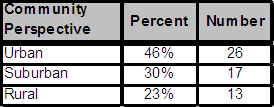
Table 6: Geographic Characteristics of Interview Participants

Table 7: Gender Characteristics of Interview Participants
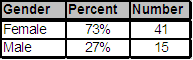
Table 8: Ethnicity Characteristics of Interview Participants
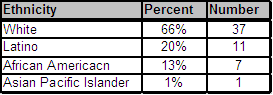
Table 9: Volunteer Status of Interview Participants
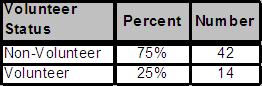
Table 10: Employment Characteristics of Interview Participants
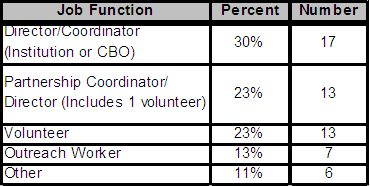
Participant Observation/Site Visits
When
possible, I scheduled site visits and interviews at times that
corresponded with partnership meetings or other group sponsored
events. In total, I attended 14 meetings or events related to the
work of the health partnerships. I observed six regular collaborative
group meetings in Southern California. I toured seven family resource
centers in both urban and rural communities; visited two churches
located in urban barrios, one of which hosted a community meeting
attended by approximately 50 people (mostly local residents); and two
celebratory events hosted by partnerships. I also attended a
county-wide training for local First5 grantees, observed a press
conference focused on advocating new legislation in which a
partnership participated, and served as a proposal reviewer for a
partnership tasked with recommending funding allocations for health
improvement efforts. Following site visits and interviews, I wrote
field notes to reflect on my observations and impressions.
Participatory Approach and Reciprocity
While this study cannot be categorized as “participatory action research,” it does incorporate certain principles of this approach (Stoecker, 2005). For example, while in the field, I looked for opportunities to “give back” to the partnership such as offering to provide typed notes of a meeting I attended, taking digital pictures at partnership events, and connecting partnership members with other people who shared similar interests. I offered all interviewees an opportunity to review and provide feedback on their transcripts and the thesis draft. Several participants expressed appreciation and approximately 25% requested these items. I also committed to creating a brief, user-friendly report based on the findings within which all participating partnerships would be acknowledged for their contributions (with their permission).
Data Analysis
Data analysis is an ongoing process in the grounded theory approach. Each interview informs subsequent data gathering as themes begin to emerge. Grounded theory develops through a process of “systematically and intensively analyzing data often sentence by sentence…of the field note, interview or other document; by constant comparison, data are extensively collected and coded” (Strauss, 1987). The bulk of analysis took place once the interviews were complete. With the exception of one audio that was corrupted, all interviews were transcribed. I transcribed the majority of interviews by listening to the audio and speaking aloud what I heard. By using Dragon Naturally Speaking™ voice transcription software, my speech was then converted to electronic text. Assistants transcribed the remaining interviews. During the transcription process, I made notes of areas of particular interest that later informed the development of relevant themes and categories developed through data coding.
Codes operate as conceptual categories that define and delineate properties of the phenomena such as definitions, conditions, explicit causes, strategies and consequences (Charmaz, 1983; Strauss, 1987). Coding is the process of categorizing and sorting the data in a method that serves to organize, label, separate, summarize and synthesize many observations made of the data. “Researchers use codes to pull together and categorize a series of otherwise discrete events, statements, and observations which they identify in the data” (Charmaz, 1983). Coding typically takes place in stages. The initial stage of “open coding” is done by closely scrutinizing the document with the goal of producing concepts that seem to fit the data (Charmaz, 1983; Strauss, 1987; Emerson, Fratz, and Shaw, 1995). During the process of initial coding, the researcher is advised to ask questions of the data to look for patterns, processes, contradictions, inconsistencies, consequences, and everyday meanings (Charmaz, 1983; Strauss, 1987; Lawrence-Lightfoot and Hoffmann Davis, 1997; Emerson, Fratz, and Shaw, 1995). Through these questions, the researcher often discovers that an “original idea of what the study was about may not turn out to be that at all” (Strauss, 1987).
I began coding by reading transcripts and developing broad categories related to community participation, conflict causes and solutions, decision making methods, and roles of members. I also began to discover “in vivo” codes, which are highly descriptive terms used by research participants that are useful in developing analytical categories (Strauss, 1987; Charmaz, 1983). In vivo terms evoke vivid imagery, akin to the resonant metaphor – that is, “words or phrases that resonate with meaning and symbolism, sometimes representing the central core of institutional culture or the dominant dimension of a life story” (Lawrence-Lightfoot and Hoffmann Davis, 1997).
Once the transcripts were transcribed, I imported the electronic files into NVivo 2.0, a software program designed to analyze qualitative data. Content in the transcripts was divided into sections that corresponded to the interview guide and automatically sorted. From this first sort, I then created more refined categories and themes; searching for what Strauss calls a “core category.” Core categories contain several key features such as centrality that accounts for a large portion of the variation in a pattern of behavior, frequency, relatedness to other categories, and allows for maximum variation within the analysis (Strauss, 1987). Charmaz calls this stage focused coding, which is used to “build and clarify a category by examining all the data it covers and variations from it.” In this way, category properties and subcategories emerge. Rather than treat categories separately, the researcher connects themes to demonstrate complexity and the relationships between categories to help explain the issues and events investigated (Charmaz, 1983). This process resulted in the findings described in the next chapter.
Chapter Four: Partnership Structure, Membership, and Outcomes
Before delving into issues of conflict between the grassroots and institution representatives, it is useful to understand how community partnerships generally operate. Who participates and represents the grassroots community is a central question in this exploration.
General Partnership Characteristics5
Though the health partnerships in this sample are diverse in geographic location and mission, they share many commonalities. They are among the most “successful” in the state in terms of sustainability and community engagement. Across the sample, partnerships generally report success in obtaining funding from a multitude of sources. Since so many funding agents require collaboration, the partnership itself is a key factor in that success. Funding drives many of their activities – from who they involve to the type of public health improvement strategies employed. Most partnerships in the sample were initiated in response to a funding opportunity that required community engagement. However, a few collaborations arose through a convergence of interests and shared goals. For example, Action for African American Health formed when African American community members and health systems agency representatives partnered to conduct targeted outreach to churches to address disparities in cancer rates.
Membership and Leadership
In most partnerships, membership and representation is ambiguous due to the groups’ multilayered structure. Groups typically encourage fluid participation to avoid excluding potential contributors. Therefore, how members participate and what role they play usually varies based on the group’s current activities as well as individual interests, available time, and funding. Consequently, determining overall partnership membership presents challenges. While inconsistent participation is an expected operating norm that allows these partnerships to remain flexible and inclusive, it can also create conditions for conflict. For example, those who are involved more regularly typically exert greater influence on decisions and partnership direction.
Across the sample, the majority of active members are involved based on their employment in local institutions such as health departments, schools, law enforcement, hospitals, universities, and CBOs that provide a range of social services. Estimates of the percentage of grassroots members in these partnerships range from 1% – 95% and average about 30-40%. Many interviewees describe their partnership as a “tight knit” group. Some members are involved in the day-to-day work of the partnership or the ongoing work of committees, action teams, or work groups. Others limit their participation to attendance at monthly meetings or partnership sponsored events. Often there is a large group of people that simply receive communications from the partnership in order to be kept “in the loop.” Women, especially those who are “middle-aged with kids,” comprise the majority membership in these health partnerships. The preponderance of women may reflect gender influences on employment in the helping professions as well as on who volunteers.
All of the partnerships have coordinators or directors that are usually employed by a participating institution or nonprofit organization that serves as a lead agency. Action for African American Health is the only partnership in this sample with an unpaid, volunteer coordinator, though they are working to change that. Only two partnership directors in this sample are male. The partnership coordinator (or director) plays a pivotal role in group maintenance. As key leaders, they help establish a climate of trust and inclusivity. Generally, they are dedicated individuals with multiple skills related to outreach, organizing, fundraising and administration. Though highly energetic individuals, several report “running out of energy” after years of hard work due to the wide ranging set of responsibilities held. Two coordinators left their positions within the year following our interviews.
Most coordinators assume a welcoming demeanor that serves to engage multiple sectors. Partnership members generally hold coordinators in high esteem and describe them as “good at holding people’s trust,” “a powerhouse,” “fosters an environment for creativity,” “welcomes everybody” and “amazing.” A youth member from the African American Health Disparities Collaborative describes how the group’s coordinator captured his attention when she arrived at his neighborhood church and showed her “serious” commitment by conducting approximately 50 surveys on her own and specifically inviting his participation. Demonstrating commitment is a primary quality coordinators exhibit. An institution representative from the Safe Streets Partnership says that the group’s coordinator not only “listens and is resilient” but he will “hang in there during a period when they're distrusting him, which I really have to credit because that's not a nice feeling at all. To have somebody thinking you’re some White person who has no clue and have to prove yourself over and over and over. But he does it and he never gives up.”
Community Engagement
All partnerships in the sample employ strategies to engage community members from diverse sectors. Job and funding requirements combined with personal interest motivate many professional service providers to participate. In addition to funding, the opportunity to make a difference, achieve a goal, and gain access to other resources such as information, prestige, and social networks makes partnering attractive to many institutional players. They also may become involved in the partnership as a form of reciprocity, for example, the director of a nonprofit community development corporation became involved in the Healthy Town Community Collaborative because two of the groups members served on her organization’s board.
While the majority of members participate as a function of their job, most partnerships also attempt to engage the most marginalized of grassroots residents such as those living in poverty, immigrants, people of color, youth, or people suffering from a variety of health ailments (e.g., drug abuse, AIDS). However, three of the four partnerships that originated as service provider collaborations do not emphasize this type of recruitment. Rather than involve marginalized people directly in the partnership, they gather input through focus groups, town hall forums, or surveys. While all partnerships commonly use these methods, the majority in this sample also seek to actively engage marginalized residents in the ongoing work of decision making, committees, community projects, and advocacy.
Interviewees that represent the grassroots report they become involved in partnership activities because they care about the community in general, their family and children in particular, or a specific health issue. Interviewees commonly described motivations such as spiritual beliefs, the desire to “give back,” or aspiration to personally develop and improve the lives of their children or grandchildren. The opportunity to develop job and leadership skills also is a powerful motivator.
Grassroots engagement is most successful when done from the beginning of an effort. Many partnerships begin by tapping existing networks and groups in neighborhoods, schools, and churches. Eight partnerships in the sample employ outreach workers from the community to inform and recruit participants. These critical staff leverage their knowledge of the community and existing relationships to spark interest. Word-of-mouth and personal invitations are particularly effective in attracting members who might otherwise not feel welcomed or comfortable. An outreach worker from the African American Health Disparities Collaborative explains that creating “buy-in” often “comes down to relationships and a name.”
Governance and Decision Making
A steering committee, executive committee, or advisory board comprised of five to twelve members usually guides the process and oversees major decisions. This smaller core team typically is comprised of institution leaders, staff, and partnership coordinators with one or two seats reserved for “community members.” Several groups select co-chairs; one represents the community and the other a lead institution. All of the partnerships establish standing or ad hoc work groups, action teams, or subcommittees to plan and implement specific projects or activities.
While a few of the partnerships remain loosely structured, the majority have developed by-laws or other documents that outline policies, procedures, roles, and responsibilities. Groups tend to use some form of consensus building combined with voting to make decisions. Decisions usually entail defining partnership mission and policies; developing annual action plans; applying for grants; planning events; supporting emerging community issues related to the group’s mission; and creating partnership products (such as community assessments). Additionally, one partnership must decide and recommend funding priorities to the local health department.
In general, once the partnership is established and structured, many decisions are shifted from a leadership or steering committee to work teams. Conflicts or issues raised in large meetings often are delegated to committees. In these smaller groups, people discuss and debate issues, gather additional information, develop potential solutions, and then present ideas to the larger coalition and/or steering committee for approval.
Meetings and Other Communication
Partnerships generally meet monthly and average 12-30 people. The agenda usually includes networking; information sharing and announcements of new programs, opportunities, events, data, and political developments; presentations on relevant community issues or programs; and discussions of partnership activities. Committees usually hold separate, regular meetings and update the general membership monthly. Meetings usually are facilitated by the partnership coordinator or chair who follows a pre-distributed agenda to guide group discussion. Several use Robert’s Rules of Order to conduct meetings and two partnerships in this sample are subject to the Brown Act, California’s open meeting law. Based on interviews and observations, most partnership meetings average two hours and strive to end on time.
Newspapers, radio, television, newsletters, phone calls, and email frequently are used to keep members informed, “get the word out” about collaborative efforts, and recruit participation. Communication in these partnerships is heavily facilitated by the use of email. Partnership coordinators routinely maintain email or mailing lists comprised of dozens, if not hundreds and even thousands of people. In one particularly successful undertaking, the Alliance for a Meth Free Community turned out one tenth of the entire population for a town hall forum in their small rural area by plastering the community with bilingual, brightly colored flyers. They posted full size copies in store windows and left quarter sized copies at grocery checkouts, the post office, and other local businesses. They also submitted an article to the local paper and relied on word-of-mouth through the school’s social network.
Collaboration for What? The Bottom Line
“I’m proud of the diversity of people in the partnership and their commitment and willingness to bring about a change. Programs come and go and if it’s a good program, people will remember it. But good people, that’s important.” ~Coordinator, Action for African American Health
So what are the outcomes of these health partnerships? When interview participants were asked to name their proudest accomplishment, a majority had difficulty naming just one. “We still exist” became a predictable mantra and evidence of success reported by 25% of interviewees from nine partnerships. This survival occurs despite “so many forces” from lack of funding to political pressures and conflicts that could interfere with sustainability. The director of the South Area Community Collaborative says:
“We're still here. I took the job with six months of funding. Watching other collaboratives struggle and disappear and somehow we just keep going. I'm proud of that.”
The partnership itself is a source of pride for 50% of those interviewed – from the diverse membership to the ability to forge new relationships and ways of doing business. Meeting people provides an avenue for learning, problem solving, leveraging resources, testing new ideas, and increasing personal support. Partnership members report that new communication networks exist, increasing their ability to influence change. For example, several members of the Healthy Town Community Collaborative describe the relationships and ability to “pick up the phone and call someone” as the greatest value of collaboration. Though a network of strong relationships is clearly one of the strongest outcomes of many partnerships, this often is overlooked in formal evaluations that focus on specific health outcomes.
About one third of interviewees report their proudest accomplishment is recognition from powerful decision makers such as local media, school district superintendents, funders, and elected officials from city, county, state, and federal levels. “Being known” brings a new level of power and influence because policymakers routinely consult with and involve partnership members, including those who represent marginalized grassroots communities. Partnerships are “invited to the table” by decision makers, recognized both for their effectiveness and authentic connection to the community. A hospital representative from the Family Resource Community Network describes the change:
“I'm proud of the clarity our group has about strengthening the public health system. They can speak a language now with the county and they have to see us as vital partners to execute their plan. We catapulted ourselves into the position of political power to a certain degree – to the point where our power and involvement is invested in by the higher-ups. We've been recognized by the Board of Supervisors and the California State Assembly.”
The coordinator of the Kids Breath Freely Coalition echoes this theme. Partnership members are thrilled that their city council and the state Senator and Assembly representatives “know our work and speak so highly of us.” The attention from these and other local major decision makers is critical because these are “people who can really affect the lives of kids with asthma.” Moreover, they “immediately connect us with the community. They call us to get parents out, to get people to testify.” By developing relationships and a high level of recognition and respect for their work, several of these partnerships enable the most marginalized of grassroots residents to have a voice in democracy.
The Value of Grassroots-Institution Collaboration
When grassroots representatives are included “at the table,” everyone learns. Agency staff gain new knowledge and perspectives that may have been “overlooked” and can greatly enhance problem solving. Likewise, institutions can offer the community “a ton of resources that are probably more difficult and maybe even impossible in some areas for the community to get.” A public health representative from the South Area Community Collaborative believes that through the collaborative relationships, “The community is getting a greater awareness of the county as a proponent, an ally instead of an adversary.” She explains that “the ideal collaborative” is one that successfully leverages “the flexibility and freedom of the non-institutionalized members along with the resources and capabilities that are inherent in organizational structures.” A youth representative from the African American Health Disparities Collaborative describes the value derived from grassroots and institution collaboration:
“I think we all learn from each other. For me to sit next to the university dean to hear his perspective, I'm like, ‘Word, I didn't know that.’ It's all kinds of people and it does more for us because every perspective in there is a learning experience. It's unblocking the unknown for us. The fact that we're all there and get to throw our ideas out and hear perspective and stories – that's better than going to school for me.”
Moreover, grassroots participation helps to spread awareness of the partnership throughout the community so that the group becomes “known.” By working together, partnership members successfully increase the financial resources available to address health concerns. A CBO director from the South Area Community Collaborative says, “Because the collaborative is here, we’re able to leverage hundreds of millions of dollars in resources in this community.” Unlike some efforts that bring in money but don’t directly benefit residents, these partnerships ensure that some of those resources reach the grassroots.
Through their work in the partnership, many grassroots women (and some men) gain new skills, expand their network of contacts, and subsequently obtain jobs with the partnership. In turn, this helps strengthen the authenticity of the collaborative group. The evaluator for the Family Resource Community Network considers their “most worthwhile” accomplishment is the creation of “mechanisms to bring people with no work experience and limited education into a conversation, develop their skills and abilities, and value it.” Though the partnership benefits, he says the more important outcome results when grassroots women become employed and reach a point where they “can be a lot more powerful.” He explains that this power derives from “learning English, understanding how the school system works and who’s at the collaborative meetings, or by going to City Council meetings and speaking up.” A grassroots parent representative and staff member from this partnership describes why she thinks the collaboration benefits from community involvement:
“Some of the agency people, they deal with their work, budgets and a lot of problems. The people from the community don’t deal with that, so I think we bring fresh ideas. The people from the community, they are eager to learn and willing to do a lot of things that the people from the agencies won’t do. Like promatoras, they educate a lot of families and the people receive it better because a community member is teaching them. So that’s the benefit of having the community involved.”
Elevating grassroots representatives to this new level of influence is another proud accomplishment cited by 29% of partnership members interviewed. Through participation in training programs for promotoras, resident councils, and other leadership development opportunities offered through the partnership, they learn to advocate for changes in local and state policy by telling their stories to lawmakers, public health officials, and foundation executives. In turn, they train other community residents in the skills necessary for health promotion, collaboration, leadership development, advocacy, and program replication. A grassroots community representative that now works for the Collaborative for Children’s Health describes her motivation for engaging and training other single moms on welfare:
“That's actually what I like to do the best – bring people to the meetings and let them realize that they can be part of the democratic process. And not only can they, they should. It’s their right to do that.”
Grassroots stories are compelling, stay with people, and can influence local and state policy. Several of the Latina mothers I interviewed described their experiences of testifying at legislative hearing in Sacramento, at city councils, and county boards of supervisors. In one example, grassroots representatives from the Family Resource Community Network convinced city officials to buy vacant land adjacent to a school and build a park.
While most people point to the relationships as the proudest accomplishments, there are also many examples of community changes that result from these collaborative efforts. In terms of community impact, successful partnerships are able to leverage relationships to influence policy and implement new programs to address community issues and bring about needed changes. Other “proudest” partnership accomplishments include:
Sharing best practices with other communities through trainings and media. For example, teen members of the Alliance for a Meth Free Community produced a documentary that features local youth discussing their experiences with substance abuse.
“Institutionalizing” the partnership so that funding and support are built into existing systems. For example, money for the Safe Streets Coalition is a line item in the city’s budget.
Increasing civic participation. For example, in the Family Resource Community Network’s “best year” volunteers contributed 10,000 hours at local schools. Many of them led adult education classes in haircutting, sewing and craft making. Residents in this partnership also organize voter registration, neighborhood clean ups, and visits to isolated seniors.
Increasing educational opportunities at multiple community-based locations including apartment complexes, CBOs, and Family Resource Centers. Topics include a variety of health issues as well as English language, job skills, and school readiness.
Increasing law enforcement for issues such as gang violence, illegal alcohol, drug and tobacco sales, and unsafe driving. For example, the Partnership for Rural Health’s work increased the number of highway patrol officers assigned to their area, increased speed limit signs and turning lanes and had a dangerous highway designated a “DUI corridor.” After three years, they achieved a zero fatality rate.
Developing regionalized public health data systems. For example, one public health department created a coordinated, county-wide data division and another is working to not only organize data by regions, but also make available zip code specific data relevant to community groups. Data is used to build arguments for policy change and funding as well as to educate the broader community about health conditions.
Who Participates? Locating the Grassroots in Health Partnerships
“Grassroots community? It depends what corner you're standing on.” ~Executive Director, Healthy Town Community Collaborative
Locating the grassroots in most community health partnerships proved more difficult than I first imagined. I assumed it would be easy to distinguish between institutional representatives and grassroots community members within community health partnerships. In my mind, the “grassroots” constituted people who experience the problems that the group is trying to address. Typically excluded or marginalized from community decision making processes, grassroots community members live in geographic areas targeted by health improvement efforts and are often poor, people of color, and/or immigrants. I also thought institutional representatives could clearly be identified based on their employment in local agencies and their representation of those agencies in collaborative efforts. Consequently, a genuine partnership would include grassroots community members alongside agency personnel in a collaborative setting where joint decision making, planning, and activities were accomplished together. I soon discovered that who actually represents the grassroots and who represents institutions is confusing and contested. Even within the same partnership, people may conceive these representatives differently.
In order to explore conflict related to the different positionality of group members, I asked interviewees to estimate the relative representation from institution and grassroots community members within their partnerships. This proved quite a challenge due to the ambiguity of membership and differing definitions of the term “grassroots” and “community.” Many interviewees were perplexed when asked to describe the grassroots community in their area and asked me to clarify what I meant by grassroots or community representative. I typically acknowledged the confusion with terms and urged them to help me understand their perceptions.
The Kids Breath Freely Coalition represents the most “ideal type” of a genuine partnership between institution representatives and local grassroots community residents in the entire sample. Their holistic definition of the grassroots community is geographic, mission driven, and takes into consideration a wide range of socio-economic factors including poverty, immigration status, and linguistic ability. Instead of defining the community solely by its needs and deficits, the assets and resources of grassroots individuals are recognized and valued. Because institutional representatives in this partnership are aware of power differentials, they take deliberate steps to engage marginalized community residents, share power, and partially compensate for inequities. The following quote from the partnership coordinator illustrates some of the common elements that define the grassroots as well as the confusion around the term itself:
“We did a select target zip code where we would pilot all of our programs based on where most of the asthma patients from the children's clinic come from. Mostly Latino, low income; closer the ports, refineries and freeways; old housing stock: poor quality and crowded. Poor access to health care in terms of a lot of uninsured. Very vulnerable population for many reasons… How to define grassroots, which is funny because they always ask us, “What is that word? Why do you say? What does grassroots mean?” And they ask us in Spanish. They thought that they were the dirt and the soil, and we considered ourselves more like the flowers, plants and trees - us being the agency folks. So it was kind of sad and it is just an odd word to use. And it's very odd for them, who are the grassroots folks. For us, it’s not just the folks who live with asthma day in and day out. All income levels have asthma, but it's more the folks who are disenfranchised, isolated, who haven't really fit into the system for various reasons, because they’re undocumented. But they exist in huge numbers and have incredible needs and have incredible resources and skills. So that's how we define our grassroots folks. We have a good ten or so at almost every meeting that are just very involved; eleven that we trained.”
This quote further demonstrates common conditions that often set the stage for conflict between grassroots and institutional representatives in partnerships: differing levels of power that arise from social inequities and misunderstandings in communication due to differences in language and culture. The garden metaphor and the idea of building capacity through training reveals perceptions of being one-up or one-down since the grassroots are often perceived as in need of training, education, and access – both by professionals as well as themselves.
Distinguishing Grassroots Community and Institution Representatives
“Who can really represent the community?” ~Executive Director, Healthy Town Community Collaborative
Grassroots representation is ambiguous in many partnerships because how people define themselves and how they are defined by others varies with context. Categorizing people as representatives of either grassroots or institution is problematic because people consider a multitude of factors when deciding who comprises the grassroots – from data driven definitions based on demographics to characteristics such as commitment, caring, and trustworthiness that are difficult to quantify. This ambiguity also is intricately connected to workforce diversification and the trend of hiring people from affected communities to work within institutions such as public health departments and schools.
When deciding whether or not a partnership member represents the grassroots, primary considerations include: geographic boundaries and place of residence; marginalized socioeconomic status; population identity characteristics such as age, ethnicity, or health condition; length of residence (old timer or newcomer); the amount of perceived investment in the community; and employer. Some draw clear distinctions between grassroots and institution representatives; many do not. If people don’t draw distinctions, they are likely to say “everybody” represents the grassroots community. For example, the executive director of the School Readiness Collaborative emphasizes interdependency and geography when she describes her community as “the schools, the city, family resource center, everybody. We can’t be complete without the other part. The agencies, they need the people and the people, they need the agencies. I would say the community is the people that live here.”
Despite initial confusion with terminology, interviewees nonetheless described a variety of qualities and characteristics that define grassroots communities across these partnerships. Two common replies stand out: “It depends” and “It’s diverse.” Interviewees repeatedly discussed high levels of community diversity based on socioeconomic status, race or ethnicity, age, and language spoken. There is no one grassroots community but rather multiple communities that represent a variety of perspectives. Consequently, representing the community is impossible and those that claim to do so often are viewed with suspicion and distrust. A partnership evaluator reflects a common attitude expressed by interviewees, “In my experience, the people who are walking around saying, ‘I speak for the community,’ they don't.” The difficulties of representation are one reason why diverse collaborations are necessary. Ultimately, a member’s standpoint serves to remind the group to include those who may otherwise be forgotten as the coordinator of the Partnership for HIV Prevention Planning states:
“It’s my contention that no one can represent a community. I can represent my own points of view, but I don’t know about all people who have my same ethnicity, gender, or sexual orientation. But I can make sure that their needs are addressed. I can make sure we don’t forget to talk about or include women.”
Grassroots at the Intersection of Geography, Class, and Ethnicity
Geography is a primary determining factor in most partnership definitions of the grassroots. For many, a grassroots representative is someone who lives in the neighborhood, zip code, county, or region. Grant requirements or community boundaries designated by city or county officials influence how partnerships define the grassroots community. A geographic or issue-oriented focus may cause partnerships to identify different segments of a community based on statistical demographics, for example the percentage of people who suffer with a particular health ailment. This can exclude others within a region from a community change effort. For example, a county representative from the Safe Streets Partnership explains they “had to focus on two communities. There were some other areas who were equally interested in participating but the numbers just didn't justify it.”
Despite the great diversity in socio-economic status and ethnicity that exists in partnership communities, they often are divided geographically along these lines. Additionally, growth patterns reflect the community’s physical and socio-economic infrastructure. Throughout California, income, race, ethnicity, and geography intersect to create low-income, grassroots communities that struggle to live healthful lives in poor quality housing typically located in undesirable neighborhoods separated from wealthier residents by freeways. The following quotes demonstrate how geography, race, class, and immigration shape different perceptions of the grassroots in one southern Californian urban area, close to the border with Mexico:
“We’re close to 80% Hispanic, Spanish speakers, a lot of single female-headed households, mostly from Mexico. We are close to a state prison, so we have a lot of families where the husbands are in prison. Low income and this is all the west side. If you go to the east side it’s all suburban and middle class and the housing is growing tremendously. Very different from the west side and separated by a freeway; it’s still high Hispanic, but definitely more White. They’re all working middle class. I’d say a lot of teachers and people that work in our school live in the east side.” FRC Coordinator, Family Resource Community Network
“Community residents – they have to live here. That's probably the overarching requirement. Ideally for us, it is the really the hard-to-reach residents of the community. Low income, immigrants refugees that don't get their voices heard very often. 49% of the community is Latino. The planning committee here is the entry point for all planning before it goes to the planning commission and the City Council, so it's supposed to be the resident voice around planning issues. It is predominantly White, English-speaking senior citizen property owners who don't like things like affordable housing. Not really reflecting the vast majority of this community.” Partnership Director, South Area Community Collaborative
Because social inequities provide the backdrop in which most partnerships operate, simply living in a geographic area may not be enough for someone to be considered a grassroots representative. Class and political ideology may trump geographic or ethnic identities, dividing people who are considered “part of the grassroots community” from other area residents. Many define the grassroots based upon marginalized socioeconomic status; for example, low income people, immigrants, seniors, youth, or those who suffer with poor health, homelessness, or other conditions of poverty. A director of a faith-based organization and member of the African American Health Disparities Collaborative explains how class differences can divide residents who share a common ethnic heritage and how the grassroots can be distinguished:
“We define community as the people who bring with them the short-term, medium-term, and long-term interests of residents who are marginalized in a number of systems and work together to create solutions to reduce and overcome the marginalization. There may be an African-American person who lives a half a block away in this neighborhood who we would not consider to be part of the community because of the ideological position that aligns them with the forces that we believe are not ultimately at the service of people in this neighborhood. So it's not just a question of the ethnic line but also has to do with economic class options. For example, if a free health care and education facility that serves neighborhood people is planned and if two or three people in the neighborhood oppose that because they’re aligned with certain political forces, they may be neighborhood residents, but they're not community. And they may end up bringing about antagonisms from some of the people in the neighborhood of their own race because of the positions they've taken which are anti-community.”
A public health official from the Kids Breathe Freely Coalition also emphasizes the importance of recognizing diversity within ethnic groups:
“The definition of the community member in our coalition is a Latina immigrant woman. While most people would have one picture of that woman, that woman can have little education to college education; kids, a lot of kids, no kids; from a poor background in Latin America to middle-class background. Yes they are immigrant Latina women and they speak Spanish, but that's basically where it ends.”
However, a common ethnic background also can unite people beyond class divisions explains one outreach worker from the African American Health Disparities Collaborative:
“You have your middle, upper-middle, and the bluebloods. The African American community is just as diverse as any other community, not only just educationally but socially and economically. But still at the core, the essence of an African American community is still the African American member, regardless. A person can be a millionaire or have one or two PhDs and still experience the same challenges that I face. It makes no difference.”
Commitment and Personal Investment
For many interviewees, caring, commitment, and willingness to take action on a common cause to bring about community change are arguably the most defining features of the grassroots. This commitment may revolve around a specific health concern and may have very little to do with the member’s job. Moreover, the commitment is long-term, voluntary, and based on personal investment. The following quotes reflect these aspects:
“When I think the grassroots, I always think of very informal, less structured, really the core of the heart of the community. These are the people that are in the trenches. They feel the impact, they lead the change. They will benefit, the community will benefit and they are determined. Something about grassroots, they don't have to do this but they are because they need a change.” Public health representative, South Area Community Collaborative
“There is a lot of isolationism that happens in rural areas. People choose to live there because they want a quiet life and privacy, but they still come out in full force when needed...I think the grassroots are the people that want to be part of the community by working on causes and things that will improve the community and help the world be a better place.” Parent representative, Alliance for a Meth Free Community
“I think commitment is the overriding factor. The citizens of the community, they're not being paid to participate in strategic planning. It boils down to commitment and a belief in an outcome that they so desire. All of them have different motives, but no one could ever say they have not been touched by cancer. So how do you measure their level of commitment? This room is never empty.” Partnership outreach worker, African American Health Disparities Collaborative
The coordinator for the Action for African American Health says, “I think the grassroots community is made up of people who are committed to making a change, committed to doing whatever is necessary to inform. Then, finding resources so you can plan and execute a program and holding people accountable who are in decision making positions.” Consequently, she poses the following questions to determine if a member represents the grassroots:
Do you live in the community?
How much time do you spend in the community?
Are you a member of a partnering congregation?
Do you have a personal investment?
Civic engagement serves as another indicator of caring and commitment. People who are viewed as grassroots community representatives often become well-known and respected by serving on a variety of boards, councils, and coalitions. These grassroots representatives build social networks among decision makers and residents and influence others to become involved with partnership issues. These networks help leverage the power of the grassroots to create change. Despite this ability, grassroots representatives often are characterized as having less power and influence than institution officials. A member of the Partnership for Community Health explains:
“I serve on the Commission on Aging and I am an advisory to the Board of Supervisors but I don’t have a lot of power or clout. I can bring issues to the forefront. For instance, we were responsible for getting an elevator into the courthouse because there wasn’t access.”
Ambiguous Identities
“A grassroots group might involve a lot of agency people because I think grassroots is defined as anybody who's willing to get down and dirty and work on anything together.” ~CBO Director, Partnership for Rural Health
Sometimes the distinction between a community and agency representative is very clear while other times it is clearly ambiguous. So, what is it about certain people’s roles or identities that create this simultaneous clarity and confusion? Why can one person who works for an institution be perceived as a grassroots representative while another is considered an agency representative? Employment trends, identity, and personal commitment are key factors.
A parent from the Healthy Town Community Collaborative describes a grassroots representative as, “Somebody that I perceive to have a lot of hands on involvement, a very deep local concern rather than a removed or detached concern.” This perspective can contrast sharply with that of representatives from institutions who are removed from direct experience with an issue and paid to be involved. Yet the majority of interviewees – whether they work for an institution or not – believe that though one may work for an institution, this does not necessarily disqualify the person from representing a grassroots perspective. As one health department official states, “I didn't surrender my membership card in the gay community when I took this job.” A CBO director from the Partnership for Rural Health describes why one’s employer is insufficient criteria for distinguishing a grassroots representative within a partnership:
“The people who are living in the community and living with the issues are the grassroots people. I used to define it by the people who were not being paid to address it. But I’m being paid to address it and I’m grassroots. So I think it's the people who live in the community, who care about the issues, who are going to advocate on their own behalf, and that's the difference. If you're advocating on your own behalf, you’re grassroots. If you're advocating on behalf of somebody else, you're probably the agency.”
As a result, people employed by institutions may continue to self-identify as grassroots representatives and also be viewed as such by others within the partnership. The Family Resource Community Network director explains why she considers herself a grassroots representative:
“When people start working for you do they stop being community? I just think it’s really fuzzy. I was a grassroots person because I was just the nurse here at the school. I have a bachelor’s degree, but I had no experience in community development or administration. I was just the nurse. When I started, that was grassroots because I certainly did it with no support from the school district. They’re much more involved now…So did that stop being grassroots and was it ever grassroots? Is it only grassroots if you are a community organizer and you go out to a church to get people from the community and you tell them they have to do it themselves?”
Others adamantly insist that authentic representation of the grassroots ultimately becomes impossible once an institution employs someone. Essentially, the attainment of education, employment, power, and influence separates them from the community such that they no longer experience similar conditions and therefore cannot “truly” represent the grassroots. The public health co-chair of the Kids Breathe Freely Coalition explains some differences:
“We have the community health worker, health educator, community outreach worker; there's a whole list of titles that have been created on which we tried that interface between us and the community. I will still differ with folks that say there's no difference between them. When we bring them in, we institutionalize them. We have a set of beliefs. It doesn't happen overnight but eventually, they will see the world as we see it. Is that a bad thing? Not necessarily. It is important to integrate, to bring community members into our fold. But that doesn't eliminate our responsibility to engage the community members who are not working for us. I've seen a few examples of community health workers who made it up to the leadership positions, but most of the leadership in public institutions is not made up from the affected community. Maybe we were the affected community when we were kids so that gives us some ability to say, ‘I remember when my parents lived in this poor neighborhood and I went to a poor school.’ But I'm not now. I understand a lot of the situation, but my current interests and living standards are not there anymore.”
Distinguishing grassroots representatives based upon employment is further complicated because employees of nonprofit CBOs represent the grassroots community in many partnerships. Still, people frequently question this representation. The Partnership for HIV Prevention Planning coordinator works for the health department and observes, “There’s the department and there’s the community and that means often, people working in community based organizations. But are they really the community?” The community co-chair of this group believes talking about CBOs and community is like mixing “apples and oranges” because though CBO employees may come from and advocate for the community, they frequently depend on financial support from local institutions. She explains:
“With an institution, what counts are the shot callers. People who work for the health department, it's less than 1%. But when you say institution being a community-based organization, I would say 99% come from an agency versus somebody who's just there like me. I'm not here representing my agency. I'm here representing my community.”
Further, some CBOs evolve to resemble institutions. A CBO’s grassroots identity may be forfeited if the agency has a large operating budget, engages in advocacy rather than providing direct services, or has an operational structure that rigidly adheres to rules. For example, a grassroots representative from the Partnership for HIV Prevention Planning explains why one nonprofit organization is no longer grassroots:
“The director makes $230,000 a year. That is no longer a community based organization. That is a Fortune 500. They’re getting funded to do a direct service project for a $1.2 million and they don’t do direct services very much anymore. They’re a lobbyist group.”
An institution representative from the Safe Streets Partnership also describes the perceptions of those in the “system” who are frustrated by the way some CBOs operate:
“Police officers and probation officers will often say that the community organizations don't do what they're supposed to. They say they're helping kids, but they're really just poverty pimps. They're not really providing any real services; they're just fakes or hustlers – especially when they’re advocacy oriented as opposed to service oriented. So the community organizations that will work with the kids tend to get a lot more respect from people in the system.”
Categorizing representatives from businesses as holding a grassroots or institution perspective also proves problematic. Small business representatives are largely missing from these partnerships but when present, they are usually considered community representatives. However, there is a distinction usually drawn between representatives of local business and those from large corporations. This may be especially true in rural areas as the director of the Collaborative for Children’s Health explains that, “in our county, the business world means prune farming not the corporate world.’
Crossing Boundaries Wearing Multiple Hats
Nearly two thirds of interviewees (65%) described some partnership members as representative of both an agency and the grassroots community. Many used the metaphor of “wearing two hats” (or many hats) to describe the phenomena. A parent representative from the Alliance for a Meth Free Community explains the benefits of members with multiple roles and affiliations:
“Everybody wears a number of different hats at the table and they all come up useful one time or another. More than one hat helps them not be so focused on just one thing. It gives them a more global perspective.”
Those who wear multiple hats cross traditional boundaries between agencies and grassroots communities and therefore are not easily categorized. People in these dual roles identify with some segment of the grassroots and also work for institutions. Many originate from marginalized sectors and loyally represent their community of origin (e.g., neighborhood, ethnic group) regardless of their employer. Based on a life circumstance that shapes an allegiance with the “grassroots community,” they remain aligned with marginalized constituencies such as poor people, immigrants, people of color, gay people, or people that experience the health issues of concern. They usually live in the community, frequently are bilingual and bicultural, and in their institutional role, work directly with grassroots members to provide services and leadership development opportunities. About half of the grassroots community representatives in this sample fit this description. For example, one grassroots community representative used to be drug addicted and on welfare. Now she’s “a voice for the people” that works for as an advocate for the partnership.
However, some hard-to-categorize partnership members work in leadership roles within an institution, do not live in the community, and typically enjoy higher socio-economic status. Others work in or lead CBOs that maintain a connection to and allegiance with the community. Yet, they are perceived as grassroots representatives. About half of the institution representatives in this sample fit this description. What makes the difference? People who work for institutions are perceived as grassroots community members when they’re invested, live or work in the neighborhood, listen and “take time to understand what’s going on.”
The Role and Function of Integrators
People with multiple hats occupy a variety of positions within the institutional hierarchy yet serve a similar function within collaborative groups, communities, and institutions. Multiple roles allow these partnership members to navigate and interpret the cultures and languages of both agencies and grassroots communities. They act as integrators: cultural mediators or liaisons that bridge differences, facilitate communication, and foster innovation and compromise. Driven by personal values and an emotional investment, integrators actively seek greater social equity and inclusion. Integrators apply influence within the different spheres of community, partnership, and institution in order to achieve outcomes that are more aligned with community identified priorities. They use the power and influence of the institution and knowledge of the grassroots sector to advance community goals. A university professor and partnership consultant explains:
“They know the community inside and out and get along with everybody. They move up into a position of more power, but they have these values and skills that they bring with them.”
Integrators play a pivotal role in grassroots leadership development by creating opportunities to learn employable skills through involvement in the community health partnership. They recognize the abilities and assets of community members, keep “finding places for them,” and “push them higher and higher up the scale.” Exemplary voluntary participation frequently is recognized and rewarded with a job. In interview after interview (35%), people described how community members were invited to participate in a partnership activity, became a regular volunteer, contributed their talents, learned new skills (especially English), and eventually were offered a paid position.
Integrators educate both marginalized community members and agency staff. People in this role transfer community concerns to institutions and in turn, disburse agency generated information to grassroots communities via their social networks. Their broad perspective informs service delivery, policy, community organizing, and resource allocation. When successful, their work results in increased access to health and education services as well as greater inclusion of marginalized people’s perspective in policy and program development. The coordinator of the Partnership for HIV Prevention describes the “perfect example” of an integrator:
“He’s worked in the health department for 10 years but he’s very much a community person. He’s a gay man, he’s African American, and he brings what he’s experiencing in his world or what he hears people say and then we incorporate that into our work.”
She says another employee is, “an even better example because he hasn’t worked here that long. He grew up here, was part of the community, and he’s lost a lot of friends to HIV. So he can talk about his friends, what they’re saying, doing, and feeling and that influences what we do at the health department.”
A grassroots mother who now works as a family advocate for the Collaborative for Children’s Health also fits the integrator profile. Her life experience includes being a single mom on welfare and overcoming drug addiction. She now works to organize and educate mothers involved with Cal Works, the State’s welfare-to-work program. Applying tools she’s learned through partnership-sponsored trainings, this integrator brought the county Cal Works director together with program participants for dialogue and problem-solving to resolve a conflict. She says, “We've really made it our mission to include the community in what happens in the county; that their voice counts and you're not helpless.” To support this goal, she helped the mothers formulate questions to address their concerns about surprise home visits from county social service workers. The family advocate explains what happened:
“We typed up all the questions and gave them to the Cal Works director. The Cal Works director came on our turf and discussed with the group each of these questions. The home visits are no longer a surprise; they are made by appointment. And it wouldn’t have happened without their voice.”
Integrators initiate innovative activities and extend themselves beyond the traditional ways of doing business. For example, through their participation in the South Area Community Collaborative, the health department hired a Somali outreach worker to engage grassroots residents. Using her knowledge of grassroots and institutional cultures and resources, she organized teas at a low-income apartment complex where Somali women lived. Though this member worked for an institution, she also represented the grassroots within the partnership. The value of her ability to connect with the community is described by a colleague:
“She would bring information to them, organize them and they would have their tea. To me, that's grassroots. They're getting residents who never even imagined being part of the process.”
A CBO director from the South Area Community Collaborative explains that the same outreach worker was instrumental in educating him about the Somali community and together, they engaged community residents to establish a neighborhood association:
“She knows how to cope and she works. Everybody loved her. When they hired her that was the first time I felt like we had a partnership because she worked really closely with us. We would have weekly meetings in my office to plan outreach. It was very unsystematic.”
Integrators display a commitment to carrying the voice of the people into decision making venues and the ability to represent a collective perspective rather than an individual agenda; characteristics interviewees commonly perceived as indicators of grassroots affiliation. The following examples illustrate the difficulties of categorizing partnership members as either a grassroots or institution representative. In the first case, the boundaries blur because the public health representative from the Partnership for Rural Health wears multiple hats. He works as a high level administrator at the public health department and also serves on the board of directors for a grassroots nonprofit organization who partners with his agency. He does not live in the small rural town where the CBO is located, yet the CBO director explains why she views him as a grassroots representative:
“They are a community representative if they've actually listened to the community. If you go out to represent, you have to represent the group's agenda. When he goes out representing our nonprofit, he talks about grassroots stuff. He's also a community member. He coaches his kid’s sports and he's involved in the school board. I would never say because he's with the public health department that he can't be a grassroots representative because he had the vision to come here and listen to us and say, ‘The town says that they want this and I'm behind them and this is what I’m representing,’ whether he agrees with it or not. So you can be a grassroots representative, but it depends on what hat you have on that day.”
In another example, members of the Family Resource Community Network describe how two school employees function as a conduit for grassroots action despite personal disagreement with the community’s agenda. Both partnership members consider themselves grassroots representatives and live in close proximity to the elementary school’s family resource center. The partnership director is a school nurse who has led the development of the partnership for ten years. She says:
“They wanted school uniforms and I said, ‘I don’t want school uniforms. If you want school uniforms, you’ve got to talk to the principal.’ So I helped them set that up and they talked to the principal. And through a long period of pulling people, they got uniforms.”
Cecelia6 emigrated from Mexico, has a child that attends school where the FRC is located, and became involved with the partnership four years ago. The school recently hired her as a volunteer coordinator. The partnership’s evaluator describes her approach to community representation:
“Cecelia is now employed but Cecelia is from the community, speaks for the community and there is no shadow of doubt in anybody's mind that that's authentic. Sometimes she'll say, ‘I totally disagree but that's what's the majority of people in my community want you to know.’ She’ll hold back her own opinion because she knows she's the spokesperson.”
Institution Leaders as Integrators
Some integrators are professionals that live outside the community and do not share the same class status, ethnicity, culture, or language of residents in the community where they work. In many cases, these members hold management positions within institutions or CBOs or coordinate partnership efforts. Yet, they may be identified as grassroots representatives because they act as a conduit, filter, and interpreter of community voices in decision making venues.
Integrators in leadership positions within an institution are perceived as “more community minded” than the typical bureaucrat or agency professional and considered more trustworthy because they are “on the side of the community.” For example, they may voluntarily participate in the partnership during “off hours” or serve as a CBO board member. This signals a higher level of commitment since they too are not always getting paid for their work. For example, the Action for African American Health’s coordinator works at a university and leverages those resources in the partnership. However, she does not serve as a university representative. Instead, she volunteers both for the partnership and the lead health services agency’s board. She “chooses to not get paid for many reasons” and believes her volunteer status allows her to create a “peer” environment within the partnership.
When integrators with privileged class status retain connections to poor and marginalized grassroots community members, these connections allow the grassroots concerns to influence decisions and enhance progress on social change efforts. The director of a faith-based organization and member of the African American Health Disparities Collaborative explains:
“If there were not power elite African-American people in that process, nobody from the Department of Health, the Board of Supervisors, or anywhere would listen to them. Each one, even though they may be elite, has a connection somewhere back into a neighborhood with a group of marginalized people that provides access to get the data to demonstrate how disparate services are.”
Recognizing that partnership meetings may not achieve enough authentic grassroots representation, integrators often support the development of separate community associations that provide leadership opportunities for local residents and a venue for surfacing community concerns. Nearly one third of the partnerships in this sample employed this strategy. For example, FRC coordinators from the Family Resource Community Network helped residents organize a Latino neighborhood association. Based on an ongoing feedback loop with members, these integrators advocate on behalf of the grassroots in the absence of local residents at other community meetings. A partnership evaluator describes this approach as an effective way to increase community representation while also recognizing the limitations:
“It's the most likely way to increase community voices. You can authentically do that as long as you put the effort into having the collaborative meeting over here and the community meeting over here so it isn't just, ‘We did a community assessment five years ago and this is what they said.’ If you have that group meeting every month, you have a chance to say, ‘The group wants to know about this. What do you think? OK, I'll take it back.’ and put it in a voice that they're going to hear and listen to, but also is going to have the weight of community opinion on it. That's really potentially powerful…The FRC coordinators are doing their best to represent the community but they just can't. They can advocate for the needs of the community as they've experienced it, but they can't speak to how the community feels about issues as they're evolving and developing.”
With this approach to community engagement, agency personnel and local residents are both spared the discomfort that may accompany the attempt to accommodate diverse perspectives in a traditional meeting format. Grassroots people attain a voice without having to participate in long, technical meetings and institutional representatives do not have to change the way they do business to accommodate social diversity. Some voice is better than no voice.
However, those interested in achieving authentic community partnerships recognize that this process is only one step along a continuum toward greater inclusion of marginalized people in the decisions that affect their lives. These integrators facilitate grassroots involvement and the “development of indigenous leadership” and provide “the bridge between this conversation that happens at City Council and what happens in the collaborative meetings, district board meetings, nonprofit planning meetings, and county business planning meetings.” Because these “multiple hat” representatives recognize their limitations in representing the grassroots, they continue to push the boundaries of civic engagement by bringing grassroots community members to these public meetings once they “feel ready.” Interview participants commonly described grassroots members’ reluctance to speak out at public meetings when surrounded by professional elites, especially if English is their second language. I heard numerous examples of how marginalized people developed the skills and courage to give voice to their concerns with support from integrators. Assured of their value and right to speak, grassroots members risk their fear and often are surprised to discover that institutional representatives perceived as more powerful actually listen. The Family Resource Community Network’s evaluator says:
“Sometimes I tell them, ‘It’s going to be totally awkward for you, but we're going to this meeting and I'm going to tell you when it's time for you to say what you have to say.’ It's really empowering for the residents because sometimes it's really uncomfortable for them and it's actually uncomfortable for us to have to orchestrate it that way. But then they get up and say something and everybody shuts up and places so much significance – these people are saying something heartfelt and well-reasoned and everybody's like, ‘Wow, would you please come back and tell us anytime you have anything to say.’”
Shifting Representations: Resisting and Becoming “Institutionalized”
“I was just elected city treasurer but I will never be a bureaucrat.” ~Community Representative, Partnership for Community Health.
In some cases, perceptions of grassroots representation may immediately change when a community member becomes employed by an agency. A health department employee gives this example:
“One day he’s the community guy and everyone looked at him a certain way. He got a job here as a community liaison. The minute he started working here, people started treating him differently and he was the same guy.”
Other times, the employer has little effect on how the person’s role, identity, and representation are viewed. Rather, the individual’s level of commitment and caring, who they advocate for, and how that shapes their decisions matters far more. Ultimately, whether one is considered part of the grassroots community is heavily influenced by one’s investment, passion, dedication, and reputation.
Typically, integrators who originate from a marginalized segment of the grassroots and do not rise within the hierarchy tend to remain firmly rooted in their community identity. However, as many point out, institutional employment brings change. As grassroots employees develop their knowledge, they begin to see the “bigger picture” and their advocacy is no longer confined to a single, personal perspective. The Executive Director of the Collaborative for Children’s Health describes this shift:
“The staff are paid staff. Does that make them part of the agency? I don't know. I mean, they function both ways. They definitely keep their community in mind because that's how they got there in the first place. But they're functioning from a broader, countywide perspective so it really is more of an agency, professional perspective.”
A grassroots representative from the same partnership began as a volunteer. She explains how working for the group changed her perspective:
“I've gained a certain amount of knowledge or experience or professionalism is the maybe the word. But because you learn a bigger scope that sometimes sets you so that you're not strictly grassroots and you're not strictly community. When I bring a parent to a meeting, they have their family’s interests at heart. That's their motivation. I think that my motivation maybe has a bigger picture now. Not that it isn't still community involved, but it's not that one family perspective.”
Interviewees frequently refer to this shift in perspective as becoming “institutionalized.” In the following example, the coordinator for the Safe Streets Partnership describes some of the factors that affect how representation is determined and whether or not an individual has “become institutionalized.”
“You can be institutionalized solely because of who you work for. For example, Manuel is working for the Department of Public Health but he is never going to be seen as a sellout because his heart and soul is in the neighborhood. He still works with kids in the community for a program that runs in the community. People just know who is and isn't down with the neighborhood, who is going to take time to understand what's going on, who will be out talking to people at dark, who is comfortable out there. Just because you work in the neighborhood doesn't mean that people are going to think that you're down with what's going on. Or you can work in City Hall and people will think that you are OK. It comes down to your commitment, passion and dedication. But you have some people that say they're more connected than anyone else and we are the voice of the community. And the community residents will be behind them saying, ‘Who chose you? You don't speak for me; you don't know anything about me.’ So I don't think there's any black-and-white to that. As long as you take the time to get to know people, be out there, and be really connected, you can work with the biggest institution in the world and still be seen as an advocate or a friend.”
The longer people work within the bureaucracy and “build their capacity,” the more they risk “becoming institutionalized.” As a result, others that remain marginalized may view them as “sell-outs” who no longer give their concerns priority because they have been co-opted by the system. This process is a form of cultural assimilation that can begin with college training. In one example, a university professor who trains new social workers and places students with partnerships describes the changes he observes in grassroots students during the course of their study. One indicator of the adoption of the ideology of professionalism is through discourse: the use of the pronoun “they” to distinguish the grassroots community as deficient:
“You have a Latina 23-year-old, first-generation from the neighborhood, bilingual, lots of skills. She’s here for three years and you begin to see it. ‘Well, they don't really know the language and they...’ You can't blame them, the system does it. That's the professionalization – they need us. They need you, but not the definition you're making. They need you because you're the one who recognizes all the abilities they have. Because they're like you. So you take that connection they could have had and the university system drums it out of them. But you can prevent or minimize that only if you're inside the system.”
Integrators appear to resist “becoming institutionalized.” By refusing employment in agencies that place too many constraints on their ability to represent the community, they preserve their grassroots connections and reduce the potential of being perceived as a sell out. The family advocate for the Collaborative for Children’s Health explains why she refused a job offer from the county in favor of retaining her primary identity as a grassroots activist:
“They know that I'm an advocate for the families. Because it seems that unfortunately, the world does get divided in two ways and the folks that are agencies have so many rules and regulations regarding their actions that common sense gets tossed out. When you can work without those rules and just voice your opinions – I break rules all the time and I don't do it because I’m malicious. I do it because I don't know the rules and they are usually artificial, mandated rules that are done to protect the masses. But sometimes you have to get down to the nitty-gritty. So I'm definitely on the side of the community.”
Along this same theme, a grassroots community representative from the Safe Streets Partnership says he would not be employed by the CBO unless, “I'm really going to have an impact within that arena” and that this helps maintain the trust people from the community have in him. Integrators in leadership positions may also take the view that a job with institutional constraints is not worth sacrifice of self. A community representative with the Partnership for Community Health says,
“It cramps my style to be an elected official because I have to take a sideline and be neutral to some degree. I don't have to compromise who I am; if that were the case then they can have the treasurer's job.”
Months later, this partnership member resigned her position as city treasurer.
When unconstrained by the rules of their role and position, integrators sometimes consciously choose which identity (grassroots or institution) takes precedence in a given situation. For example, a member from the Healthy Town Community Collaborative wears multiple hats as an FRC director, active faith community leader, parent, and property owner. She lives in the neighborhood where a new transitional living facility caused conflict. She says, “Sometimes I just decide I'm going to be a parent. I have a right to do that as long as I keep that separate in terms of who I'm speaking for.” Likewise, a representative from the Partnership for Community Health is not only an elected official but an active member of several grassroots associations. Depending on the situation and the impression she wants to convey, she decides which business card to distribute. This contrasts with institutional representatives who cannot shed that identity. The same partnership member provides a telling example:
“I asked the judge to emcee a fundraiser. He's not allowed by code to do that. As much as he supports the project, he has certain parameters of what he can do and what he can't do as a judge.”
The Representation Continuum: A Summary
Ultimately, partnership members tend to distinguish between grassroots and institution representatives based on a continuum of the following general characteristics (see Table 11). While recognizing broad generalities and some stereotypes, these characteristics provide a useful guide to understanding how distinctions in representation are determined in many partnerships and the important role integrators play in bridging differences. Clearly, there are many differences in perspective between those who work in helping institutions and those that struggle to survive in the face of poverty, illness, drug abuse, or other conditions that marginalize people. Consequently, how the grassroots are represented can ultimately become a source of conflict, as we shall see in the next section.
Table 11: The Representation Continuum

|
|
Institution Characteristics |
Integrator Characteristics |
Grassroots Characteristics |
|
Employment Status |
Employed by helping agency; paid and/or directed to participate. |
Employed by helping agency, often based on connection to community; Participation is paid, may also volunteer time. |
Not employed by helping agency, voluntary participation. May receive stipend or other support to enable participation. |
|
Geographic Residence |
Lives and/or works outside the targeted geographic area; disconnected from community spatially, materially, and culturally. |
Lives and/or works within the targeted geographic area. Vested in local conditions. Maintains connection and works directly with community. |
Resident of targeted geographic area. Long term commitment to community, rooted to place, “vested” interest. |
|
Personal Investment |
May care about issue but commitment may change when job changes. |
Loyalty ultimately lies with grassroots community regardless of employer. Passion for the issue. |
Personal investment in the issue; experiences health condition of focus. Passion for the issue. |
|
Planning Perspective |
Maintains a global or “big picture” perspective. Defends agency policy or position; puts personal agenda aside for agency interests. |
Understands interplay of local and “big picture” conditions. Listens and carries community voices into decision making venues. Puts personal agenda aside for community interests. |
Focus on local/personal issues. Personal agenda guides action. Shares some common agenda with other community members. |
|
Organizational Culture |
Works within a highly structured hierarchy; power derived from position within organization. |
Navigates culture of institution and communities; Power derived from ability to “interface.” |
Organization loosely structured, flexible. Power derived from group, formal and informal social networks. |
|
Advocacy Role |
Represents agency; facilitates and advises; advocates on behalf of others. |
Represents both agency and grassroots. Brokers understanding. Facilitates community engagement through organizing, education, and leadership development opportunities. May act as gatekeeper. |
Represents and advocates on behalf of self (“personal agenda”) and others of similar circumstance, e.g., neighbors, people affected by health condition, ethnic group. |
|
Power of Role/ Position |
Power to convene, facilitate, support, and control “purse strings.” |
Power to bridge cultures, integrate, interpret, and mediate. |
Power to implement, execute, organize, take action, do hands-on work. |
|
Knowledge Base |
Formal education; professionally trained as experts who fix problems. Knowledge of available resources and professional protocols. |
Mix of formal and informal education. Personal history includes experiences of marginalization. Knowledge of multiple cultures. |
Perceived as “uneducated” or lay people without technical expertise. Knowledge of local conditions/culture. Wisdom from lived experience. |
|
Communication Style |
Communicates with technical language and jargon, i.e. “agency speak.” Refers to community as “they.” |
Multilingual and bicultural; both in formal languages and language/culture of community and agency. |
Communicates with plain language, “street talk,” reference to “we.” May not speak English. May miss or ignore social cues in meetings. |
|
Behavioral Constraints |
Follows rules and constrained in speech and actions due to hierarchy, laws, policies, political pressures, fear of job loss. Protective of self/position; self monitors and moderates speech and behaviors. |
Ability to speak more freely for community. Chooses which identity/role takes precedence in a given situation. Position and longevity within agency may result in greater constraints and loss of connection to grassroots community. |
Free to voice opinions, take action, and “break” rules. Perceived to have fewer constraints to directly advocate to elected officials. Feeling powerless or “one-down” may constrain speech and actions. |
|
Appearance |
Dress conforms to professional expectations (e.g., suit, briefcase). |
Dress suitable for cultures of both community and institutions. |
Dress expresses personal identity and comfort. May be perceived as “inappropriate.” |
|
Socioeconomic Status |
Typically elite or middle-class. |
Wide range of socio-economic class. |
Typically middle, working or poverty class. |
Chapter Five: Sources of Conflict in Community Partnerships
Defining and Reframing Conflict
“Conflict doesn't happen unless you need to grow or change.” ~Executive Director, School Readiness Collaborative
“I think you need a little bit of conflict to build richer relationships.” ~CBO Director, Partnership for Rural Health
Paradoxically, partnership members tend to view conflict as a healthy, positive part of the collaborative process and simultaneously, as an uncomfortable dynamic to avoid if possible. Eleven of the 13 partnerships in this sample had members that defined conflict as differences in perspective. The director of Alliance for a Meth Free Community captures the viewpoint of many when she describes conflict as, “Disagreement. When there are people who don't have the same opinion and they are having a hard time finding someplace that they can come to an agreement.”
Partnership members commonly distinguish between “normal” or “healthy” conflicts that encompass disagreement based on “different perspectives” and “ugly” conflicts that are filled with “animosity and irreparable feelings,” require mediation, distract from the goal, or cause the group to disband. Generally, conflict is an expected, normal part of “getting business done” because “people are not going to agree 100% of the time.” These “normal” conflicts are characterized by frustration, tension, and disappointment rather than extreme anger, potential violence, or the complete withdrawal that often accompanies “ugly” conflict. Interviewees also frequently frame partnership conflicts as a search for common ground rather than a competition. A public health official from the Partnership for Rural Health says:
“Conflicts are just bumps in the road that we've got to solve in a way that's going to facilitate the continuation of the partnership. It's not an argument to win; it is an understanding to come to so we can continue to move forward.”
Despite the discomfort and change conflict can catalyze, many partnership members believe conflict is positive because it can clarify partnership activities, strengthen relationships, and result in better decisions. A public health representative from the African American Health Disparities Collaborative says:
“Conflict has challenged our thoughts, challenged our strategies, and challenged what we were doing overall to make sure it was most effective to help us and the people we’re working with.”
A youth representative from the same partnership concurs with the notion of “healthy conflict” that arises from differing positionality yet is grounded in a common vision or goal:
“Sometimes the different perspectives, they bump heads. But it's healthy, because in the end they are still friends and not enemies because they all want to do good for the community and for themselves.”
About 36% of interviewees from seven partnerships in the sample described a low or minimal level of conflict within their collaborative group. Several interviewees maintain that the absence of conflict is not necessarily positive because it indicates that people are holding back, not expressing themselves, and not fully contributing to the group. As the director of the Healthy Town Community Collaborative explains, “With any collaborative, you have to deal with conflict issues. If there's no conflict, there's really no real work being done.” In contrast, an evaluator observes that community collaborations “operate within the areas where there isn't any debate.” While this may be true for some groups, at least four of the groups in this sample grapple with controversial health issues such as drug abuse, sexuality, and violence. Others may not have controversial missions, but they do become involved in a variety of politically charged issues, often related to growth and development such as the construction of new facilities or housing. Ultimately, how partnership members define conflict may account for reports of its absence.
Nonetheless and as expected, partnership members reported a range of conflict situations that arise during efforts to collaborate. These generally fall into the following categories:
Conflict within partnerships between grassroots and institution representatives.
Conflict within an individual related to identity, role, and values.
Conflict between partnering agencies, typically over competition for funding or other resources.
Conflict within partnering agencies that affects the partnership’s climate and dynamics.
Conflict within the community between grassroots community members.
Conflict that is a deliberate organizing strategy.
Conflict that is interpersonal, i.e., “personality clash.”
Conflict with agencies outside the partnership, often related to development projects (new facilities, housing, roads, urban blight), competition, or history of mistrust.
For the purposes of this paper, I focus on common experiences across groups that arise from the differing positionality/identity of group members.
“It tends to be about money and resources where the conflicts happen.” ~Public Health official, Partnership for Rural Health
Several common themes related to conflict between institution and grassroots representatives emerged. Partnerships described a variety of conflict triggers, that is conditions or behaviors that lead to disagreement and tension. They also discussed internal and external situations that affect the climate within which the partnership operates and contribute to the development of conflict. Further, how people react to triggers can serve to exacerbate or resolve conflict. Generally, the types of conflict between grassroots and institutional representatives most commonly reported fall into the following five categories:
Climate that is affected by history; conditions of scarcity and competition; constant change; and high levels of emotion.
Culture clash between the social norms of communities and institutions such as formal bureaucratic structure governed by rules versus informal social structure; different communication styles and language; meeting conduct that violates expectations; and underlying social inequities related to class, gender, race, and nationality.
Role and identity conflict resulting from differing expectations, unclear roles, institutional constraints, and questioned representation.
Lack of shared vision including different perspectives and philosophy, misaligned goals, different problem definition, a focus on action versus process, unmet expectations, and disconnection.
Decision making and prioritizing related to who participates and how decisions are made; especially to allocate resources, determine issues of focus, or balance participation and consensus with the ability to move forward.
Climate
In unraveling conflict situations, the climate or environment in which a partnership operates is critical. The general climate (or group norms) affects both how conflicts are handled as well as overall member participation. However, climate is not a static, unchanging condition but can change in an instant. For example, a youth representative from the African American Health Disparities Collaborative describes an “obvious” climate change that occurred at a partnership meeting, “When we walked in there, it changed. First we're young. Second, we were street.” The beginning of collaborative effort is typically characterized by uncertainty and that climate, coupled with mistrust and competition can lead to conflict. Members of ten partnerships report that the most conflict occurred early in their formation. This often resulted from disagreements over how to proceed and the challenges inherent in learning to work together. Additionally, they report that funders sometimes did not provide clear guidelines for projects.
A variety of factors converge to influence partnership conditions. The most commonly reported elements of climate that affect the development of conflict include: a history of mistrust, social inequalities, and accrued resentment; conditions of scarcity and competition; constant change; and high levels of emotion such as anger, fear, or discomfort.
Historical Mistrust, Social Inequality, and Accrued Resentment
“If you're from the government, you're already suspect. You don't even have a fair chance out-of-the-box.” ~Public health official, Partnership for Rural Health
The local and global historical political context set the tone for collaboration and conflict. For example, some partnerships report that their county or city has a history of cooperation while others describe long-standing divisions. Mistrust of government institutions exists in many grassroots communities, especially among some immigrants, people of color, and rural residents. This lack of trust often is based on a history of social inequities based on race, class, gender, and nationality. Additionally, partnership members reported examples of bigotry, prejudice, and an “old boy’s network” that still operate in many communities. People also have long memories so when an injustice occurs, it may influence community-institution dynamics for years. For example, a university professor describes historical mistrust as “the number one” cause of conflict between grassroots communities and institutions:
“If you're from the university, you must be doing this because you have a grant, you're going to use us as guinea pigs, or you're going to be here today and gone tomorrow. All of which could be very true. That would be your one big pattern and stumbling block: a very strong, deep level of distrust on the part of the community toward the university.”
The director of the African American Health Disparities Collaborative describes why this mistrust and reluctance to participate in research is especially acute among people of color:
“Blacks have a larger distrust of being involved in research. All of us should be very familiar with the syphilis experiments that took place at Tuskegee where Blacks were used as guinea pigs.”
For some immigrant groups, such as Southeast Asians, fear based on a history of government abuse in their homeland presents a barrier to becoming involved with any partnership effort. Mistrust also arises based on experiences in the United States. A CBO director with the South Area Community Collaborative explains that:
“In the Somali community, there's an anxiety about disappearing. They have family members who would be hauled off with no explanation to INS camps, especially right after 9-11. They’d be gone for a couple months with no understanding of where they've been taken and then they would suddenly get released. So imagine the fear.”
Mistrust based on personal interactions with specific individuals are sometimes generalized to the entire institution or community. This type of historical mistrust can “poison the water” and over time results in “accrued resentment” that fuels conflict. For example, a CBO director with the South Area Community Collaborative describes the history of relationships between community groups and a high level county staff person:
“She worked with community groups for a long time and had a very rocky relationship with everybody. She basically said, ‘Don't trust community groups, they just take money.’”
A public health official with the Partnership for Rural Health describes the existing climate at the beginning of their partnership with a community group, “Basically, they wrote us off as not someone they could work with. So we had to change that.”
“It always comes down to money.” ~Community Representative, Partnership for Community Health
Historical mistrust is exacerbated under conditions of competition and scarcity. Individuals within a partnership may compete for power, prestige, and control over discourse, decisions, and resources. A common theme across interviewees related to feelings of competition and jealousy that arise within grassroots communities when an individual becomes “elevated in status.” This can trigger conflict as questions over representation are raised. A scarce, competitive environment can breed additional mistrust, resulting in inconsistent participation and conflict.
Securing continued funding and planning for sustainability is a constant source of pressure and tension both for the partnership as a whole as well as member organizations. Interviewees consistently described conflict between partnering agencies that arise due to competition for limited resources such as grants, clients, and recognition. For example, institution representatives may “come to the table” solely to “get a piece of the pie” or cease participation if they don’t receive recognition as a result of their involvement. This is commonly referred to as “turf battles” and 40% of interviewees from twelve partnerships describe this is as a primary cause of conflict. A community representative from the Alliance for a Meth Free Community explains how financial scarcity affects community-institution conflict:
“Probably with every agency we’ve dealt with, they always have the same answer. They don’t have money to work on what we want them to work on. It’s a funding issue.”
Additionally, members from five partnerships (23% of interviewees) reported that tensions accelerated during the recent Californian budget crisis as many county departments resorted to layoffs or “pulling back staff” from collaborative efforts and community based locations.
In general, people also feel scarcity of time. Most grants or contracts are short-term and one to three years does not allow enough time to create long-lasting, systemic change. Partnership members typically juggle a multitude of work and personal commitments. Those who work for institutions or CBOs face additional structural barriers. Often, partnership duties are added to the full-time work people already do. Further, job requirements or restrictions may leave little time or flexibility to participate in partnership work. In some cases, budget cuts force institution staff to absorb extra work so they are “literally doing two jobs.” Ultimately, this climate contributes to inconsistent participation, whether resulting from high staff turnover at agencies or volunteer burnout.
Constant Change and Inconsistent Participation
“Change is not about comfort” ~Community representative and staff, South Area Community Collaborative
A highly dynamic, changing environment creates uncertainty, tension, and discomfort that contribute to the emergence of conflict. As part of the changing physical landscape, growth and development often trigger community conflicts in which almost half of the partnerships in the sample became involved. Health and the built environment are intricately connected and partnerships have engaged in political battles over building new clinics, homeless shelters, affordable housing and freeways. These controversies are also affected by climates of mistrust, social inequities, and scarcity.
Membership changes also affect the partnership’s climate and potential for conflict. Many of these partnerships established a core group that remained consistently involved for years. Consistency of participation often results in strong relationships, increased trust, and friendships among partnership members. Over the years, people spend countless hours in meetings and working on joint ventures. They attend conferences together, witness marriages and the birth of children, and spend time in relaxing, fun pastimes such as dancing and playing softball. Mutual respect becomes the social norm and this seems to reduce the negative effects of conflict.
However, most partnerships simultaneously experience turnover in assigned staff and representatives from both institutions and the community, including those from CBOs, local businesses, and faith-based groups. A public health official from the Partnership for Rural Health observes, “Change seem to be constant. We've got times of major change and minor change. People resign, get reassigned, or they retire. It seems like something is always being tweaked.” This inconsistent participation contributes to a climate ripe for conflict according to 46% of interviewees from ten of the partnerships in the sample. A county representative from the Safe Streets Partnership describes the difficulty that arises from high turnover and broken agreements:
“The most serious lack of collaboration is the police department. They were supposed to be on board from the beginning and identified some great people to work with us. But then they needed to be reassigned. The police department is pretty unstable; people are shifted from their positions all the time. In the last five years, there's been five different heads of the juvenile division. That makes them very hard to work with because there's just no continuity.”
Some partnerships rotate the location of meetings within a city or region and this also contributes to inconsistent participation. This flexibility allows increased opportunity for broad involvement and accommodates members’ differing time, interests, and commitment. The partnership also benefits because as a pubic health staff member observes, “People who don’t come on a regular basis bring a different perspective that maybe we have overlooked.” However, when a critical partner doesn’t consistently participate, trust can drop as frustration levels rise. Interviewees commonly remarked that when there are different people at every meeting, “you start back at square one.” A CBO director from the South Area Community Collaborative recalls that “meetings were always very unstable because our partner either wouldn't show up or would come really late. So we'd have to go back and review the agenda that she missed.” This can affect decision making within the partnership, leading to delay and conflict. He continues, “Decisions would be made if they weren't there and then we would be second-guessed afterwards. There was no continuity, so things would stall and we’d have to go back.”
Inconsistent participation also creates a climate where relationships, trust, and behavioral norms are not are not firmly established among some partnership members. In the Safe Streets Partnership, a serious conflict erupted when a first-time grassroots participant became offended by a statement made by an institution representative who regularly attends. The person without personal relationships or knowledge of the group’s history misunderstood the context of the discussion and interpreted a general comment as a disrespectful, personal insult. In response, this community member “just went off” and “on and on and on” saying, “How dare you come here and tell us how to talk in our meetings.”
“Things just start getting really out-of-control, emotional. People talking over each other’s heads and not respecting each other.” ~Executive Director, Collaborative for Children’s Health
A highly charged emotional environment can cause conflict to erupt within partnerships. Nearly half of all interviewees from every partnership in the sample (48%) described conflicts that emerged in a climate of anger or fear. Whether caused by disease or injury, public health improvement efforts typically deal with matters of life and death. Youth fatalities from gang shootings, deaths from repeated highway accidents, high rates of mortality among African Americans with cancer, and the continuing AIDS epidemic trigger strong emotions, contributing to conflict in these partnerships. Moreover, longstanding inequities and social injustice fuels anger which community members carry into partnership settings. Often, emotional expressions of community anger are directed at institutional representatives during meetings, heightening the possibility of conflict.
Fear, especially fear of losing something, is another emotion that influences the climate of a partnership and the development of conflict. An institution representative from the Safe Streets Partnership describes this tension:
“At every meeting there's always someone going off and losing their cool because these are such painful issues. Everybody's lost loved ones. They're afraid for their kids and the kids they work with; they had guns pointed at them, they've seen so many killings.”
High levels of emotion can interfere with communication and narrow people’s perspective. A community representative and staff member of the South Area Community Collaborative recalls how anger affected her during a diversity training. She didn’t “hear the good things they were saying. I only heard two or three things that were so painful.”
Culture Clash: Social Norms of Communities and Institutions
“We have different people sitting at the table and that's a challenge within itself.” ~Director, African American Health Disparities Collaborative
Communities and institutions have different cultures that shape the way people think, feel and behave. In collaboration, this aspect of diversity makes it difficult to engage people and can trigger conflict because the social structure, language, and expected norms that govern behavior between grassroots and institution representatives differ. Partnership members described a variety of conflicts that arise due to culture clash, but the tension between formal and loose social organizational structures and differences in discourse style are two primary areas where this dynamic creates the most tension. These conditions are further shaped by the rules of hierarchy, assumptions of superiority, the capacity to participate, professional jargon, and differing sources of knowledge.
Organizational Structures: Differing Norms and Expectations
Grassroots communities and groups tend to be loosely structured while institutions are governed by hierarchy. A community representative from the Partnership for Community Health describes the two cultures as the difference between “straight-line” and “circular, interactive” thinking. She evokes an image that compares a bar graph to a constantly reconfiguring screen saver and says,
“Grassroots – they don't sit still. They want it now and they don't understand why you have to submit all these reports, documentation, get it approved, and all this. But you do. He who writes the check controls how you get the check.”
The culture of institutions makes it difficult to engage grassroots members to begin with and once people are working together, this linear thinking can remain a source of tension. A CBO director with the South Area Community Collaborative describes this cross-cultural tension:
“The dynamics of county personnel is very bureaucratic. When you're doing community engagement, I don't think they understand how messy it is and how long it takes. They want it all to be cut and dry so you can check it off.”
The structure and rules of bureaucracies govern all kinds of details that make partnerships with the grassroots difficult. Consequently, the norms that guide expectations for participation and meeting behavior differ. For example, institutions commonly use Robert’s Rules to direct meetings and in certain circumstances, must adhere to the requirements of open government laws such as California’s Brown Act. In contrast, grassroots gatherings often combine community business with festive socializing, potlatches, and celebration. Several interviewees described the difficulty of attracting grassroots participants when meetings are “all about structure and administration.” Even the timing of meetings can become a source of conflict. A common trend across partnerships is that when meetings are held during weekdays, more institution representatives attend. In contrast, evening (and sometimes weekend) meetings attract more grassroots community representatives. In at least four cases, partnerships had to decide which constituency to sacrifice due to this trade-off.
The following two examples illustrate the contrasts between formal and loose operating structures. In both, we see that the expectation for members to alter their behavior and norms to fit with another culture is a related source of tension. Functioning on community time (i.e., the practice of arriving, networking, and starting a meeting later than expected) contrasts with the highly structured day of many that work in institutions. From her “administrator point of view,” a staff member of the Family Resource Community Network explains the tension that is exacerbated by a climate of time scarcity:
“I’m not used to operating that way. I’ve got a time deadline. That’s part of my conflict. Working with the community, sometimes there’s a different mentality. I have to respect theirs. They have to respect mine and learn about mine because that’s the way it is.”
The coordinator for Action for African American Health recalls an early conflict related to the differing formality of grassroots and institution cultures. For one health intervention, a university required the use of its letterhead in written communications with faith leaders. However, the ministers’ relationship was with the partnership. Though frustrated, this coordinator attempted to educate agency personnel through her integrator role:
“I said, ‘They don’t know you. They know me. And it would behoove you to tell the people in this bureaucratic system that if you want to get this done, then they need to ease up.’ I know the system and it just forces you to do some of the ridiculous…I know the liability – that comes with it. But if you really want to get to the grassroots people, then you really need to think about all of this.”
Likewise, when the health services agency wanted formal RSVPs for events, she explained, “You have to understand in our community, we don’t do a lot of RSVPing but people will be there.” In this instance, the institution representatives have become increasingly comfortable with this community norm.
The tension between the rules of order and participation is a common source of conflict, especially due to institutional requirements that determine how meetings are conducted. As noted, a few partnerships in this sample use Robert’s Rules of Order to conduct meetings and two are subject to the Brown Act, California’s open meeting law. One community representative from the Partnership for HIV Prevention Planning describes Robert’s Rules of Order as a “stale process” that has “the opposite effect of what it’s supposed to. It doesn’t invite conversation; it invites the invocation of rule.” The public health co-chair of this partnership observes that these governing structures are ill suited to enable the most marginalized grassroots members to participate meaningfully:
“The American European way of doing business isn't for more grassroots folks. The second highest at-risk group is injecting drug users, many of whom are homeless, have different education levels, or are living in poverty. If they are active or recent drug users, particularly crystal meth, they're not really gifted with the ability to sit still for three hours and contemplate Roberts Rules of Order.”
Among other matters, the Brown Act dictates the amount of advance notice the public must receive for agenda items that a public body will discuss and deliberate7. This can create conflict when partnership members want to address an emerging or time-sensitive issue. “It’s a requirement that the agenda has to be out ten days before a meeting. So if an item comes up after that, unless it meets criteria for an emergency then it’s too bad; it has to wait.” This can be particularly frustrating when grant deadlines are looming, the agenda deadline has passed, and the partnership is not scheduled to meet again until after the grant submission date. Those charged with upholding Brown Act requirements may fear repercussions if the law is not followed to the letter. One community representative explains:
“Some county officials are so paranoid of making a mistake, getting called on the carpet or criticized for something that they overreact or over guard the Brown Act regulations. That’s going to keep them squeaky clean but then you’ve got all this tension.”
While institution representatives may rely on these governing structures to maintain order and accomplish the group’s tasks, community representatives typically report that these rules create unnecessary complications that impede progress. Further, community members often do not understand the procedures and this creates additional tension. The community co-chair of this partnership explains the “very intimidating process” of Roberts Rules:
“I didn't understand it and I felt I had to go to the library and get me a book. What was really intimidating about it when I came on, they had a parliamentarian, a person whose specialty is Roberts Rules of Order. They paid this lady to keep that meeting in order. It's not like that now.”
Likewise, a community representative from the Partnership for Community Health says not everyone understands the Brown Act and it “makes things more complicated” so “you have to educate, explain, understand, and fine tune it.” Grassroots members may become silenced and withdraw from active participation when faced with a confusing, unfamiliar meeting process. A youth-focused CBO representative from this same partnership describes this dynamic:
“While the Brown Act keeps us orderly and on task, sometimes it does impede some work ‘We can’t talk about this; it’s not on the agenda. We’ll have to wait till next month.’ So that’s been difficult at times, to get past those rules and get the pattern down. The Brown Act is very confusing to the youth. For the first three or four meetings, one of my young ladies just sat back and wouldn’t speak at all because she didn’t know when she could. Even when I said, ‘Ok, this is the time when you can speak up,’ she didn’t feel comfortable enough because there were these rules.”
Differences in Discourse: Communication Style and Language
When people subtly or overtly communicate through speech and behaviors attitudes that convey dominance, conflicts emerge. Different communication styles and language use were a source of cross-cultural conflict between grassroots and institution representatives identified by members from ten of the partnerships in this sample (35% of total interviewees). Communication in institutions relies primarily on English, the written word, and diplomatic expressions of negative judgment. Professional jargon dominates the discourse of institutions while “plain talk” and the language of the “street” prevail among the grassroots. Moreover, Californian communities include many people who do not speak or read English or for whom English is a second language.
The complexity of bureaucracies and the collaborative process itself also creates difficulty for engaging grassroots participation in partnership discourse. A community representative from the Partnership for Community Health explains the barriers that arise from multiple, complex bureaucratic structures:
“There's a culture in City Hall, the Health Department, and the Sheriff's department. The grassroots is confronted with these cultures and they're not all compatible. That's what goes into creating the apathy of the people. They're just bombarded by this glass wall, trying to get through the maze. You can't create any grassroots support from apathetic people.”
This complexity is carried into partnership meetings and often limits grassroots members’ participation. The family services director from the Healthy Town Community Collaborative explains that, “We haven’t really been as successful getting folks who have received services to be real involved. It just requires a different level of sophistication. I mean I barely can keep up.” Due to the technical level of the discussion, the coordinator for the Partnership for HIV Prevention Planning says partnership meetings don’t provide an engaging forum for participation for some community members. Therefore, they distinguish between community members “who can sit at the table and participate” and those whose “opinions, thoughts, and information” the partnership needs to gather in other ways.
A common theme across interviews centers on a widespread attitude of superiority within institutions where expert knowledge is privileged above community wisdom. The coordinator for Action for African American Health explains that it is, “Back to that structure – they haven’t gotten past that. ‘I know what’s best for you and I’m going to bring it to you and you’re going to accept it.’ And that’s why the county gets a bad rap.” The public health co-chair of the Kids Breathe Freely Coalition concurs and adds, “Physicians are famously trained to think they know it all. We're trained with the attitude of ‘You’re broken, I fix. That’s it.’ when it should be more like, ‘We have a problem. Let’s partner on this.’”
Professional jargon is perhaps the most frequently discussed communication challenge. The language of public health and social service agencies is filled with technical words and a host of acronyms. At a two-hour steering committee meeting of the Family Resource Community Network, one member counted 48 acronyms during the discussion. Several interviewees describe it as “speaking a foreign language.” For example, the Family Services Director for the Healthy Town Community Collaborative recalls a parent who used to attend partnership meetings. After two months, she created a “list of verbiage she did not understand” and asked the director to define the terms. At the next collaborative meeting, she arrived with a stack of handouts and announced to newcomers that, “You're going to need this vocabulary sheet in order to understand what happens in here.” For institution representatives that thought they had eliminated jargon, this was an “eye opener.” While acknowledging that “professional speak” can be a deliberate tactic to exclude people, a few interviewees say that though jargon isn’t welcoming, it is often simply used as a “shortcut.” The family service director explains, “It's our own shorthand for how we can speed through a process when we know things are time-consuming.”
In two cases, when interviewees in an integrator role used professional language and jargon, community members expressed surprise and disbelief. For example, a CBO director from the Partnership for Rural Health describes an early planning meeting where:
“People were speaking different languages. As soon as we started the meeting, I flipped over to trying to speak the public health language to facilitate and the community members looked at me like, ‘Who the hell are you because I’ve known you for 10 years and I’ve never heard you talk like that before.’”
In this case, the use of technical terms and complex vocabulary caused community members’ eyes to “glaze over” with confusion and they would “sit back and decide that this wasn't their conversation.” At the next meeting, “everybody from public health was sitting on one side of the room and everybody from the community was sitting on the other side of the room.” A few other partnerships also report this type of spatial separation that visually signals group divisions.
Partnership members often report that conflict in discourse arises from “offensive” language or reactions to differences in speech. Sometimes a particular word or phrase such as “reverse discrimination” or “those people” triggers anger. In one partnership, a county public health official’s reaction to one member’s Black vernacular (Eubonics) triggered conflict. Another member explains:
“He would say something and she would make fun of the way he said it. He would say something else and rather than listening to what he said, she'd make fun of the way he said it again.”
Tension also can arise when interpreting and translation are incorporated into meetings. Some information may not be interpreted accurately; other times people may become impatient with the time it takes to accommodate languages other than English.
Meeting conduct commonly triggers conflict when members violate expected norms or exhibit “disrespectful” or “rude” behavior. Behavior deemed “inappropriate” often depends on one’s perspective. Interviewees described behaviors that ranged from being vocal and asking tough questions to interrupting and silencing other speakers. Speaking out of turn or in a loud voice, dominating the conversation, and sidetracking the agenda violate the expected “rules” of a professional meeting. One public health official describes the challenge of learning the communication style of one grassroots member:
“He's not very diplomatic. Another person if they were going to disagree might say, ‘That's a good point. On the other hand my perspective is…’ Whereas he'll just say, ‘Well that's a dumb idea. That'll never work here.’"
Role and Identity Conflict
Unclear roles and contradictory member identities are two primary conflict triggers between grassroots and institution representatives within community health partnerships. Those who represent “multiple hats” and fill the integrator role are particularly prone to experience conflict situations that concern representation and associated expected behaviors based on their role. The culture of institutions powerfully influences assumptions about how partnership members should behave, causing friction within the partnership. Moreover, the expected norms that govern professional behavior act as powerful constraints on the actions and decisions of institution employees, limiting their ability to act from their “grassroots” identity. How these conflicts are resolved may raise questions about the authenticity of grassroots representation within these partnerships, further contributing to conflict.
Differing Expectations for Roles and Responsibilities
“A lesson that I've learned is when people have an expectation for something and it doesn’t happen, that’s when they get disappointed and they leave.” ~Public health official, Partnership for Rural Health
Members from ten partnerships (31% of interviewees) identified conflicts triggered by confusion over roles and responsibilities. When there is no rule book and partnerships create their identity as they go along, “Nobody can identify who's supposed to be doing what.” Sometime the conflict centers on the perceived power of an individual in a leadership role. For example, a few partnerships reported that the evaluator became “enmeshed” or “the driving force” behind partnership activities rather than remaining a neutral observer. Similarly, others said facilitators cross role boundaries when they “offer opinions” or engage in advocacy for a particular decision rather than solicit the views of group members. The complicated structure of many partnerships contributes to the confusion. A common theme among interviewees is that it took them a “long time” (usually a year or more) to understand the partnership.
Conflicts arise when members hold differing expectations about each other’s roles and responsibilities. Common themes include role tensions related to financial accountability, service provision, and sustainability. One source of conflict occurs when institution representatives assume the role of “contract monitor” rather than partner. As contract monitors, institution representatives oversee the expenditure of funds for programs and services to ensure accountability. To safeguard public money, contract monitors often are on the search for discrepancies. As a recipient of funds, the community representative (usually a CBO) is expected to carry out the contract and submit evidence of their work. This grantee-grantor relationship entails clearly defined roles where the parties hold unequal power. The institution holds financial power and the power to decide the conditions of success and continuation of the contract. Despite the powerful incentive of financial resources, the community group retains the power to participate or not. A CBO director from the South Area Community Collaborative describes the differences in roles:
“They're going to audit every now and then. I need to report to them and I need to make sure that all my i's are dotted and my t's are crossed. You know your role and everybody has their role. In the partnership nobody knew their role.”
In this case the CBO director believes conflict arose because county personnel defaulted to the contract monitor role and says, “There was a sense of they're going to get you, we're going to tell on you… We're here to keep you honest on behalf of the funder.”
Institution representatives may view community members and CBO staff as “having serious boundary issues” when they assume the role of service provider and advocate. For example, a probation department staff describes the challenges that arise when inexperienced or “naïve” community members attempt to address gang violence:
“What's troubling are the boundaries people have. Thinking that just because they know and care about a kid, that they can deal with behavior that they're really not equipped to deal with.”
Service providers from the Healthy Town Community Collaborative tell a similar story about the conflicts that arose when parishioners took on the role of offering support to homeless families:
“I think they really believed that they could do it just by being the good people that they are. But there's a professional case management piece that has to come in and play that other role. When they figured out that we could do that in partnership, now they'll refer someone over here for case management but they'll say, ‘We'll stay involved in order to help this family move along.’”
Conflict over roles and responsibilities related to sustainability is another common theme. The director the Family Resource Community Network describes the county and the school district as the “two biggest institutions” that have the most difficulty with change and says, “They don’t really see how they their role is to financially do something to make sure that we don’t go away.” The Partnership for Rural Health provides another example of conflict that arose when partners held differing expectations and philosophical perspectives about each partner’s role and contributions. A public health official explains:
“They wanted us to do things that to us seemed like things a nonprofit should do. Our job should be to maybe organize and recruit volunteers for them and help them with that. But to actually do the things ourselves seemed like not our role. Because we’re always thinking about sustainability and if we’re doing the basic stuff for them, what happens when this thing ends and we go away? Our view was they needed to recruit more volunteers and not expect our employees to do it. And their perspective was, ‘Well, you guys are supposed to throw in.’”
Identity and Representation: Constraints and Conflict
Some people believe we can take our hats – that is our grassroots or agency identity – on and off at will. However, for integrators and “multiple hat” representatives, the “institution” and “citizen” identities can clash, leading to both inner conflict and tension with “higher ups” within the institution. Members from six partnerships (21% of interviewees) described challenges arising from dual roles. Once employed by an institution, identity and role conflicts occur due to expectations and constraints imposed by institutional hierarchy and culture according to members from ten partnerships (38% of interviewees). Indeed, they often distinguish conflict behaviors of grassroots and agency representative based upon perceived role constraints. The public health co-chair of the Partnership for HIV Prevention Planning explains:
“If you're an unaffiliated community representative, you have a little more freedom to do the table thumping, stage a walk out, and be disruptive in a good activist kind of way. If you’re representing your agency, you’re a little less likely to make a scene.”
Working for a public health department, school, or other institution subjects people to the rules and demands of hierarchy. Interviewees in these positions often prefaced their responses with a sigh when asked about the constraints professionals face. One must be more careful of what is said and how. Care must be taken to maintain a “professional” image and their position within the organization. Others refer to an institution “tying their hands” with financial power that controls not only individuals’ paychecks but frequently CBO funding as well. Consequently, partnership members employed by an agency often must remain silent and leave advocacy (and truth telling) to the grassroots members who are not hindered by fear of repercussions such as job loss, reprimand, professional exclusion, or political retaliation. A public health representative from the South Area Community Collaborative explains:
“What differentiates institutions is the bureaucracy. People not only have their own opinions, but they’ve got their own agency culture to address. For instance, with advocacy, I just can't go out and protest. I can't lobby. That's my culture, so I'm stuck. As long as you have boundaries so that you’re limited by a funding source or the institution that pays your rent and salary, you’re limited by rules and regulations. There's going to be a difference in how you approach something versus, ‘I’ve got a problem in my community, I want it out of here and I'm willing to do whatever I have to do to do it.’”
Identity and representation may be contested at the institution level, for example, when authorities within an institution do not recognize an employee as a legitimate community representative. The following account illustrates how different divisions within the agency perceive the same staff person differently. The Partnership for HIV Prevention Planning’s community co-chair also works for the health department. While the division that coordinates the partnership privileges her community identity, another related department that disburses funds to the clinic where she works only recognizes her employee hat:
“The partnership was not an assignment given to me by a department; this is what I wanted to do. So I applied in the department to let me go to meetings on company time. But it was very clear that I'm not here to advocate for any funding for DPH or for that clinic. I'm here representing the African-Americans from my neighborhood. And no representation had been on the partnership for that community. My community-based clinic does not receive prevention funds nor do we want to. So when I speak, I speak from that community, not where I work. But one side of the house looks at me as DPH. They do not look at me at community because I work at a DPH clinic. So one side sees me as who I am and the other side sees me as where I work. So they would never consider me community. It's a hard hat to wear, being both. I have been restrained because we receive funding to take care of people who are HIV positive and that's also monitored by the AIDS office. I can't suggest what I think will work best in the community to that side. But I'm free on the prevention side because we don’t receive prevention funds. The community is very proud of me and wants me to keep representing. Like my boss says, ‘it’s really a shame that you can get no respect at home.’”
This integrator leverages her employer’s interests with her community interests and juggles multiple perceptions concerning her identity. While she is very clear about her primary role as community representative in the partnership setting and feels free to advocate on their behalf, the institution’s financial power and her role as a health department employee creates some constraints in the community clinic setting.
In fact, many professionals lose their ability to wear their “community hat” because they are so recognizably identified with the institution that the citizen role is eclipsed by their professional identity. For example, the public health co-chair of the Kids Breathe Freely Coalition explains that it is virtually impossible to testify at public meetings because his “public and private persona are not that separate.” Because public perception doesn’t distinguish between these roles, he “cannot go to a meeting where they're deliberating and take a side.” While his job may not be openly jeopardized, the reaction and unequivocal message from elected officials and superiors in the health department is, “We prefer you didn't do that.” Consequently, unless information is explicitly requested by elected officials, debate over local policy issues that impact health such as a new tobacco ordinance or the building of a major freeway excludes his expertise and opinion.
Public health employees clearly experience pressure to back down from advocating a community position that other institutional officials view as controversial. Institutions can breed an “oppressive” climate that silences employees. Threats and surveillance may be used to constrain staff and protect the institution’s reputation. The director of a grassroots community group explains how internal agency dynamics affected a public health representative within the partnership. In the midst of an ongoing conflict about the ability of health department staff to participate in partnership activities, the health department representative called the CBO to say, “We’ve got to lay low for awhile.” Despite her accomplishments as a “groundbreaking employee,” she was “rocking the boat on public health policy, about not reaching out to the communities.” Department supervisors had said, “We're making layoffs and it's at our discretion. They did say she could be next. And it was a big threat.”
Grassroots or Astroturf? Representation as a Source of Conflict
When agency employees also represent the grassroots, this may equalize perceptions of power among partnership members and ultimately reduce conflict. If we’re all grassroots community representatives, then we’re all engaged in the same common struggle against greater power. However, if agency personnel claim the grassroots identity for themselves, that may leave little room at the table for authentic community representation. Partnership members provided a range of examples where people affiliated with institutions hold seats on steering committees and boards that are designated for community representatives. This can result in a transformation from grassroots to “Astroturf,” a term used in political campaigns to describe a movement that claims to originate from the grassroots but actually is organized by narrow, elite special interests.
Identity manipulation allows partnerships to technically meet grant requirements for community participation without the time consuming recruitment, training, and orientation that would be necessary to engage more marginalized grassroots members. Consequently, the partnership sacrifices the unique perspective of authentic grassroots representatives. A youth program coordinator and Partnership for Community Health member describes the tradeoffs involved when representatives of institutions assume the grassroots mantle for themselves:
“We have several members who are there for their agency. However they’re also moms or teachers or whatever so we’ll have them sign in as mother. In that multiple hats respect, we feel like we’re getting the diversity that we would like to have but we’re not really. It’s the same people that we’re talking to over and over…When we were doing strategic planning for my grant one of our requirements was to have parents. We wanted to show that we do have parents on this board. That was without us having to go out and recruit more parents to come in, which is very hard work.”
She goes on to explain the consequences:
“So it was a little bit easier on us, but that’s not particularly the best thing for decision making for the partnership. Somebody who is trying to feed a family of four on this amount of money would have a different perspective from me, a single person who works for this agency who works with our kids. They might have very unique ideas about how to use this money and it would be very valuable to have them.”
Who represents the community in a partnership may be contested within the community itself. Institution representatives often choose or invite community representatives based on existing networks. Thus, people who work for helping agencies, those previously active in community improvement projects, or current volunteers from civic groups and schools may be identified as likely candidates to represent the community within a health partnership. As the public health co-chair from the Kids Breathe Freely Coalition explains:
“They're the representatives not because anybody in the community chose them. It's because the establishment said, ‘OK, you're outspoken, you look the part, you be their spokesperson.’ And other folks are saying, ‘Who made you the spokesperson?’”
If new participants aren’t consistently recruited, these grassroots representatives eventually become the “usual suspects” or the “stars.” This can lead to tokenism and an over reliance on a narrow subset of the grassroots community that participates in everything. Though this is better than no voice at all, it can become a source of conflict when other community members question why a particular individual is “representing” them.
Lack of Shared Vision
“Mission statements always sound wonderful. But when it comes down to it a lot of times, I see people not following the vision.” ~FRC Director, Family Resource Community Network
Developing a shared vision is one of the first challenges many partnerships undertake. The importance of developing a shared vision cannot be understated when it comes to creating group identity and sustainability. During tough times, people need to recall the larger purpose of why they are together in the first place. A public health official with the Partnership for Rural Health observes:
“A lot of groups that never get to that shared vision don't last because they never take the time to establish that. You have to figure out why you're a group and it has to be beyond the grant”
Interviewees from nine partnerships in the sample (29%) identified a lack of shared vision as a source of conflict. In describing the difficulty her partnership had in “defining themselves,” the executive director of the School Readiness Collaborative says, “There were no written directions to follow. Who are we? We're kind of creating.”
Diverse perspectives among members inevitably leads to disagreements about the purpose of the partnership, how problems are defined and framed, and ultimately, what solutions are devised and implemented. A public health representative from the African American Health Disparities Collaborative describes a common sentiment among interviewees:
“One person may say, ‘I think this is what we should do, this is what would work.’ Someone else may have a difference experience. So coming to an agreement where everyone is comfortable and accepting of what we’re doing and how we’re going to do it can be challenging.”
A CBO director in the South Area Community Collaborative describes how conflicts developed in the absence of a shared vision:
“A lot of it had stalled because we hadn’t come to a shared vision…We were spinning our wheels and beginning to fight with each other.”
Developing shared vision is made more difficult when grassroots and institution members have misaligned goals. Community priorities may not match funded efforts and funder requirements may conflict with local desires. Partnership members often observed that “people struggle so much with so many issues” that health improvement efforts that focus on specific problems such as asthma or HIV may not be priority concerns.
Even when partnership members do agree on a shared philosophy and goals, the addition of new members later in the process can reignite debate. For example, when a new community representative joined the Alliance for a Meth-Free Community, he wanted to expand the focus of the partnership to address all drug use. The partnership chose a narrower focus in order to gain wide community support. Reflecting on the dilemma, another community representative says, “We’re going to have to make a decision on it now that he’s a part of the group because he really wants us to go that direction. We’re not sure that it would be the best for the coalition. He just doesn’t see the other side.”
Partnership members may agree on a shared vision – for example, a healthy, safe community – but conflict over how to reach that vision. Members from ten partnerships (46% of interviewees) identified philosophical differences as a source of conflict between grassroots and institution representatives. Differing perspectives about how to best address community health issues and evaluate progress exacerbate tensions. For example, the Safe Streets Partnership shares a vision for a safe community and reduced gang violence but disagrees over how to achieve these goals. Members described the tension that exists between law enforcement officials who want to focus on crime suppression and community representatives that want to focus on crime prevention. A grassroots representative and CBO staff member says:
“As CBOs, there will always be some level of maybe wanting to work with the police, but not really being on the same page. From the Police Department, there's always going to be some level of mistrust and discrediting of the work because our perspectives are different. I can't see it ever changing if law enforcement is focused on suppression and community agencies are focused on prevention. That's always going to clash.”
In the South Area Community Collaborative, a “broad interpretation” of a funded health improvement initiative led CBO representatives to “the philosophy to do community engagement” while county health department staff focused on disease prevention and measuring statistical changes in the health indicators of a population. A CBO Director explains:
“They wanted to do Healthy People 2010 as a source of measuring and evaluation. We in the community, our understanding of the initiative is to turn this upside down. Healthy People 2010 is a classic example of the top down – these are indicators that really are not addressing the needs of this community. They may in the future, but right now we've got an affordable housing crisis. We have a leadership deficit where Latinos don't even know they have a voice about decision making. We have a lot of groundwork to do and we kept on bumping into the county saying, ‘This isn't really addressing obesity or nutrition. Affordable housing isn't a public health issue.’ That was a real philosophical challenge.”
This type of conflict is commonly characterized as a clash between an “agency-driven” approach that emphasizes service delivery or focuses on single issues and a “community-driven” approach that emphasizes building relationships and organizing to address the interrelationships between health and broader community conditions. An evaluator with the Family Resource Community Network observes, “The collaborative is just like clothing for agency coordinated effort. And that's something completely different from community organizing and community building.” A university professor explains the primary differences between grassroots and institutional approaches to community problems. Due to the focus on raising money, agency-driven solutions generally tend to be:
“Narrower, not as comprehensive, and more focused to whatever the agency thinks it can do, what they're expert in, or what they're able to accomplish with the pool of money that's available. Whatever the length of the grant is, that is going to be the time it takes to solve the problem. They're going to be indispensable. It's going to be short-term, probably oversimplified. It's not going to be a complicated series of interventions.”
He contrasts this with community interventions that typically are, “Long-term with not as well defined results. It's usually community people saying, ‘I think this will work.’” In an example from the Partnership for Rural Health, a public health official describes the conflict that arose between a county staff member and community group, “Working with communities, their ideas are different and they have a different way. They know what will work and what won't. She was into policy change and they wanted to do more community events.”
The differing cultures of grassroots communities and institutions influence these perspectives. Members from nine partnerships (35% of interviewees) report that conflicts arise between those who want to “take action” and those who focus more on “process.” Grassroots members usually are perceived as wanting immediate solutions while institution representatives are viewed as “wasting time” studying problems and planning. A hospital representative and integrator from the Family Resource Community Network observes, “In this county, you see a lot of people in meetings and there are very few of those people who ever really execute something.” Additionally, interviewees often report that bureaucratic rules and policies stymie the community’s desire for immediate action.
Conflict also can result from differing philosophies about how to approach community engagement. In the South Area Community Collaborative, county health department officials favored large community events while the CBO wanted to focus on developing an “intimate core group” of community residents that could be mobilized for policy and systems change. A CBO director describes the county approach as “Photo Op Community Development” and says:
“It's a dynamic that's really deeply embedded in a lot of organizations because we’ve got to look good for funders, the press, and our superiors. So we will do big events because they look good. But they don't actually deal with getting residents involved. Residents begin to catch on that this is just a big photo op and we're the wallpaper.”
In collaborative work, keeping partners engaged and informed is a constant effort and critical sectors may become disconnected from a shared vision for a variety of reasons. Members from eleven partnerships (31% of interviewees) discussed conflicts that arose from disconnection, while about half of the partnerships (19% of interviewees) specifically referenced lack of participation. Interviewees commonly described critical partners that refuse to “come to the table” or were not invited to participate in partnership activities. Disconnection also commonly occurs when a spin-off group established to engage, develop, and organize grassroots residents becomes alienated from original partnership. Other times, a new collaborative effort begins to address similar issues in the same geographic area as an existing collaborative group. Interviewees also described conflicts that occurred when established political and institutional leaders fail to connect the partnership’s work with community changes.
Another theme described by interviewees relates to conflicts that arise due to disconnections within an agency and between the partnership and a member agency. When different divisions within the same agency adhere to different policies or do not share information about the partnership among departments, “the right hand doesn’t know what the left hand is doing” as more than one interviewee noted. A CBO Director from the Partnership for Rural Health explains:
“They have policies that one department doesn't know what the other department’s policy is and when it comes up, it causes conflict. And then it causes conflict with us. The conflicts come from what I consider to be somewhat arbitrary policies.”
In the Collaborative for Children’s Health, a nonprofit social services provider operated two FRCs under the partnership umbrella. An integrator describes the disconnection that occurred both within the community and partner institutions:
“I tried to engage families of those family resource centers but I don't think that many go to them because they're on school sites. The schools don't even know what the resource centers are there for.”
Decision Making and Prioritizing
“The biggest conflict has always been around about how decisions get made. We are the most visible and so we've often been accused of making decisions in isolation.” ~Executive Director, Healthy Town Community Collaborative
All thirteen partnerships in the sample (67% of interviewees) reported conflicts related to collaborative decision making between grassroots and institution representatives. Disagreements occur over who participates in a decision, how decisions are made, and what information to base decisions on. Partnerships typically face decisions such as how to prioritize health issues and what activities or funding to pursue. A public health representative from the African American Health Disparities Collaborative describes the conflict that arose during the strategic planning process:
“Whether it was how to word the recommendation, whether or not the recommendation is appropriate, whether we should keep it in, how we should prioritize, or should we prioritize the recommendations. All of those things have brought some level of conflict.”
The culture of bureaucracies influences conflict related to decision making. Hierarchies generally do not employ consensus based decision making. Instead, a “top down” approach usually is the norm. In contrast, collaborative group members expect to share power and conflicts occur when that norm is violated. A common theme described by institution representatives concerns their difficulties in balancing participatory, consensus-based approaches to decision making with the ability to move an agenda forward. Moreover, the highly complex environment governed by a variety of rules and regulations slows the process of decision making and makes accountability difficult to ascertain. Thus, the time it takes for organizational decisions and actions becomes very frustrating for grassroots community members. Sometimes, the delays result in loss of funding or other opportunity for the community. A community representative from the Partnership for Community Health explains the difficulty in implementing a new trail system:
“It's a complicated project but they also take a long time dealing with the rules and regulations of building it. We’ve got a long list of bureaucratic agencies that we have to get permission from and they all have rules and regs.”
Exclusion from decision making commonly triggers conflict according to members from eleven partnerships in the sample (33% of interviewees). A community representative and staff person from the Collaborative for Children’s Health describes how issues of exclusion and inclusion can change the nature of the debate and influence decisions related to collaborative problem-solving:
“When I first started going to meetings, it just struck me that there would be all these decisions that were made and the people who were affected were never at these meetings. There was a lot of stuff on Medi-Cal and they were missing the point. The biggest problem with Medi-Cal was that there were no doctors who would accept Medi-Cal. It was not that people didn't have Medi-Cal or couldn't get Medi-Cal. Sure they could get it but where could they use it?”
However, she says at meetings, “you can count on one hand” the people who do not represent an agency.
Inclusion of grassroots community members in decisions that are technical or require detailed knowledge of the rules of institutions can be a challenge. For example, the executive committee of the Kids Breathe Freely Coalition needed to decide how to correct problems with a subcontracting agency. The public health co-chair explains the dynamic that occurred:
“It almost silenced the community members because they did not know about this contract talk, how we want the objectives to be measurable, and all this other stuff. So we as professionals basically took the ball and decided. We tried to include the community members, but I don't think we were very good at it.”
Determining what information to base decisions on can also trigger conflict between grassroots and institution representatives when each believes that their expertise should carry more weight. Generally, institutions desire “data driven” decisions and have particular standards for determining the quality and veracity of information. However, data may not be available at the micro level of a neighborhood, low-density, or rural area within a county or region. Other times, available data may not be up-to-date or match the “lived experience” of community members. When data drives decisions about funding, these issues come to the forefront.
Members from ten partnerships (29% of interviewees) described decision making conflicts that arise due to dominant influence from an individual or partner institution. Generally, people who participate regularly tend to have more influence in partnership decisions. Often this means funded staff or administrators from lead agencies or the “usual suspects” from the community. Outspoken community members that participate in the partnership may hold greater influence over decisions if the group is not deliberate in seeking out other opinions. Likewise, partnership coordinators or directors often hold more influence over decision making because they are involved in the day-to-day details of the work and hold a vast storehouse of information about the partnership. For example, coordinators typically develop the group’s meeting agenda and though other members can submit items, they rarely do. A public health representative from the South Area Community Collaborative says, “Decisions tend to be made by the director. Not that he wants to. They keep defaulting to him because he's so damn efficient.” In the School Readiness Collaborative, one parent representative observes:
“We leave most of the major decisions to the director. She runs it by us, we talk about it, and if it adheres to the goals we've set up, we vote. We don't want to be a deterrent to what she's doing.”
Many coordinators are very conscious of this dynamic. Several acknowledged they either “hold more power” or others perceive they do, so they emphasize group decision making within the partnership.
Despite the expectation for shared decision making, institutions frequently make unilateral decisions or override the collective decisions of the partnership and this leads to conflict. A parent representative from the School Readiness Collaborative describes this dynamic:
“They say to the parents, ‘This is your thing, this is your deal. We are just going to be on the outskirts. You give your ideas and then we monitor it.’ But then in certain cases, we give our voice to a situation and how we think it should be planned and what we would like to see and it gets vetoed, it gets overridden. Then we don't feel like it's our deal.”
The evaluator for the Family Resource Community Network recalls a conversation when a public health official attempted to clarify the “rules” of decision making and said:
“Just so you understand, there is no shared decision making. There is you giving input to county decision makers, but the county has a mandate. The county Board of Supervisors makes decisions and you don't.”
In the South Area Community Collaborative, a CBO director recalls assuming that “We'll be accountable to each other.” Instead, institution representatives didn’t consult with their community partners to develop mutually negotiated roles, Memoranda of Understanding, or in the hiring and placement of community-based staff.
A common theme across interviews relates to the “power of the purse” that allows institutions to have greater influence and veto power over collaborative decisions. If an institution is paying for a partnership activity and has its “name” associated with a project, its representatives may feel justified in assuming greater control over decision making. A public health official from the Partnership for Rural Health observes:
“Community groups feel like we are throwing our weight around, trying to control things, and push our agenda. If we’re paying for something, we’re definitely going to tell them what we want and if we’re sponsoring something, then we have certain standards. We want it to be tobacco and alcohol free, good nutrition, and things like that. So we bring that stuff up. We've gotten better at it. We had a pretty bad reputation a few years ago for not being very flexible and not considering the partners.”
The power of the purse also allows institutions to control decisions about how services are delivered and to set eligibility criteria. Partnerships may struggle with decisions of whether or not to accept funding, especially when restrictions might exclude participation in a program due to income level, immigration status, or medical diagnosis. A common value across partnerships is to allow everyone open access to programs and services. As much as people want increased access for low-income residents, they also often insist that middle and high-income families qualify as well. Despite the climate of financial scarcity that typically exists in partnerships, members may decide that a particular grant is “not worth it.” Others may disagree. A FRC director from the Family Resource Community Network explains:
“Sometimes we’ll get county money and there’ll be strings attached... you know, ‘This is what you have to do in order to get funding...’ What funding do you accept? That’s a big challenge for the collaborative. We could write for some proposals, but they don’t really go with how we’re doing our vision. So do we go ahead or do we not? So we talk about that at the Steering Committee and that’s a conflict sometimes.”
In grant funded projects, financial decisions can become a source of conflict. Grassroots and institution representatives may question how each uses funds and typically resist shared decision making related to budgets. In both of the following cases, the institution and CBO each received its own grant funding under the same health improvement initiative and unilaterally decided how to spend it. Ultimately, questions and conflict arose about how each side expended funds:
“It was really hard for the county personnel because they wanted to see a funding stream going directly to an activity. Now we suddenly had to defend our funding. No one knows what happened to the $180,000 per year that was given to the county. There's a lot of questions about how funding has been used over the last few years.” CBO director, South Area Community Collaborative
“They said we don't have the money to continue on with the staff as they've been. I’ve always questioned that because it's a grant funded project. It was made very clear to me and verbalized many times that we have absolutely no right to tell them how to spend their money. The public health department still holds this idea that their budget is their budget and they really didn't need to share decisions. I understood that because we really didn’t want to share our decisions either.” CBO Director, Partnership for Rural Health
Financial decisions can alter roles and the balance of power between community groups and institutions. The public health official from the Partnership for Rural Health believes that separate funding allowed institution and community representatives to operate as “peers” because the CBOs “weren't working for us.” Now that the grant funding has ended, the group is trying to decide how to sustain their partnership. However, he speculates that if the health department assumes the role of funder, “It won't be the same…We'll be a grantor and they'll be a grantee; not partners exactly. We can call each other partners, but they will be beholden to us to fulfill whatever they've agreed to do.”
While members of community health partnerships in this sample often are reluctant to define the normal tensions of collaborative work as conflict, they encounter it nonetheless. The primary triggers of conflict include the community and partnership’s general climate, culture clash, unclear roles, a lack of shared vision, and decision making. Issues of identity, power, and control are expressed through partnership discourse, which contributes to conflict. The dominant power of institutional culture can be observed in each of these conflict situations. The next section explores how these conflicts are handled within partnerships, especially as it relates to the differing perspectives of grassroots and institution representatives.
Chapter Six:Handling Conflict in Community Partnerships
How people respond to conflict affects its resolution or escalation. Before turning to a discussion of the most common strategies partnerships use to minimize or resolve conflict, it is useful to understand how identity and role shape reactions to conflict.
Positionality and Responses to Conflict
“Both grassroots and agency representatives are reactionary; but it’s manifested differently.” ~Coordinator, Safe Streets Partnership
“In the professional world, we are taught to cover up conflict. We don't deal with it openly.” ~Public health co-chair, Kids Breathe Freely Coalition
Partnership members reported a wide range of reactions to conflict that they often attributed to personality or perspective. For example, some view conflict as healthy and an opportunity to learn and grow; a necessary process to achieve mutually acceptable decisions and progress toward goals. Some people are comfortable with conflict, may “invite” it, and deal with it “head on.” Others are “more passive” or “avoidant.” The director for the Healthy Town Community Collaborative explains that the difference lies in:
“…a person’s self-esteem or self-worth. People who feel they are in a position of inferiority tend to react to conflict in a more head-on way. Or they tend to totally shut down and then try to sabotage by going outside and around the other way. I don't think it matters whether you're in an agency or you're a community member. It's more a personality issue.”
However, this characterization also includes elements of an individual’s perception of their own power, which relates to positionality.
Interestingly, while interviewees often expressed puzzlement over the term grassroots and reluctance to categorize people as representing grassroots or institutions, they usually did not hesitate to describe differences in how these two groups handle conflict. Generally, they described three major differences in how community and institutional representatives respond to or engage in conflict.
Institutional tendency towards constraint versus community tendency toward freedom.
Institutional tendency to “sweep conflict under the rug” versus community tendency to “bring conflict out into the open.”
Different uses of power to respond to and resolve conflict. For example, an institutional tendency to “freeze out” versus a community tendency to “call out.”
Interviewees frequently attributed these differences to the social structures in which community and institution representatives operate. As discussed, agency personnel face a variety of constraints due to their employee role and this shapes their responses to conflict. In contrast, grassroots community members are perceived to be free from the restrictions imposed by hierarchy and bureaucracy. The following quotes illustrate some of the perceived differences:
“From residents, you're going to hear exactly what the problem is, exactly what they think should be done and how in no uncertain terms. No flowery language and not with a bunch of memos, e-mail, and repeated voice mails. You're going to get it face-to-face; it’s honest and sincere.” Coordinator, Safe Streets Partnership
“Agencies deal with it more expediently. They're more interested in resolving conflict quickly. They want black-and-white answers and it seems that they don't mind bringing authorities in to make these distinctions. If you're in conflict with what they want to do, they will use monetary force or they'll call in whatever agency needs to be called and put pressure on you.” Community representative, Collaborative for Children’s Health
“This is what institution does: They like to be comfortable. They hate settings where it has to be uncomfortable…Stay in your place, do not speak out turn, and let other people do their thing.” Youth representative, African American Health Disparities Collaborative
The following table summarizes the perceived characteristic responses to conflict of each group. The role and response of integrators were culled from interviews though there wasn’t a specific question devoted to this category. These general tendencies influence members’ reactions to conflict.
Table 12: Typical Conflict Responses Based on Positionality
|
Conflict Element |
Institution Representatives |
Integrators |
Grassroots Representatives |
|
General conflict tendencies |
Tendency to deny, avoid, or cover up conflict |
Selective engagement in conflict, “pick your battles.” |
Tendency to openly engage in or invite conflict. |
|
Time |
Desires quick resolution to conflict due to internal agency pressure or fear of repercussions. |
|
Focus on moving toward goal rather than immediate resolution of conflict. Time not primary factor. |
|
Orientation to planning |
Focus on long range plan. Tendency to delay action. |
Focus on immediate problem solving. Demand action. |
|
|
Problem solving approach |
Process driven. Reliance on rules, regulations, policy, and procedure. Formal, hierarchical procedures employed to resolve conflict. Will use authority to make decisions and pressure others to resolve conflict (i.e., coercive power). Make a determination and stop (no money, end of discussion). |
Learns to navigate the professional protocol for dealing with conflict. Search for common ground and discover mutually beneficial solutions. |
Action driven, Reliance on common sense; use of informal and traditional cultural conflict resolution practices including ritual. Will organize a group to try to influence decisions, e.g., petitions, speak at government meetings. May result in litigation. |
|
Problem definition |
Ambiguous about the definition of the problem. Bureaucratic focus on what’s missing or needed to resolve conflict (e.g., money, staff). |
Certainty about the definition of the problem and what is needed to resolve based on lived experience and personal investment rather than professional training. |
|
|
Behavioral expectations |
Expect obedience to norms of politeness. Tendency to exercise restraint, conceal emotions due to position/ identity. Calm, professional demeanor. Resist feelings of being uncomfortable. |
Consciously “switch hats.” Take risks to implement innovative solution. |
Tendency to disregard social norms or break bureaucratic rules. Express emotions, especially anger, loudly. May resort to physical expressions of anger or threaten violence. |
|
Communication Style |
Use of email, voice mail, memos to communicate in conflict situations. Send agency leaders to deliver message and dialogue with community. May assign staff to work out resolution. |
Primarily rely on face-to-face communication in conflict situations. Persists in being the “squeaky wheel.” May “pack the room” with supporters. |
|
|
Use of language |
Diplomatic language. Preface responses with expression of concern and understanding. Provide explanations repeatedly; may defend position. |
Interpreter of agency and grassroots positions. Explains agency actions to community; provides “reality check.” |
Plain language, speak “from the heart.” |
|
Perspective and role |
Speak with one voice. Ability to see multiple views and mediate a solution. |
Mediator role; Validates all viewpoints. |
Multiple voices often contradictory. Do not want to look at “other side.” |
“I do not argue. Period. I will not. I think that there's a way to get through a disagreement… or if there's two alternatives, to come up with the right one for the greater cause.” ~Institution representative, Action for African American Health
When conflict arises, there are a multitude of possible reactions available to each individual as well as to the whole group. These reactions involve various uses of personal and group power to diffuse or escalate conflict. An individual’s beliefs and general orientation toward conflict influences behavior while one’s feelings about and assessment of a specific conflict also shapes responses. For example, one person may consider a conflict irresolvable while another believes that if “people are innovative enough, they can find a way.” Based on interview responses, members’ reactions to conflict generally correspond to the following categories, which are not mutually exclusive: Avoid, Recognize and Call it, Diplomacy, Defend and Justify, Take a Stand/Advocate for position, Contain and Freeze out, Blasting, Threats, and Accelerate/Crank it up. Both grassroots and institution representatives use these strategies. However, as noted, one’s position or role within an institution or community shapes responses. Thus, interviewees perceive a greater tendency among grassroots members to recognize and call it, blast, and shut down. In contrast, they characterize institution members as more likely to avoid, defend, and freeze out.
Avoid
Members from twelve partnerships (58% of all interviewees) described tactics used to avoid conflict once it becomes apparent. These strategies typically include some form of denial or withdrawal. In avoidance, conflict is not dealt with “openly” and goes “unaddressed” during meetings. As a result, partnership members may be uncertain of the outcome. Interviewees described those who try to avoid conflict whenever possible as very uncomfortable, afraid, or anxious in conflict situations. “I just don’t engage in it” or “I ignore it until it goes away” are common responses from interviewees whose general orientation is “conflict avoidant.” However, avoidance tactics used to prevent conflict from escalating can result in the opposite of the intended effect. A CBO director in the South Area Community Collaborative describes his experience:
“I just avoid them and cut off communications. I go into passive aggression; a lot of people do. So I think that my role escalated it a lot. It also played a role in perpetuating the conflict to the level that it got.”
Despite the positive aspects of conflict, partnership members often have pragmatic reasons to avoid it. For example, high levels of conflict can drive potential members away. Further, a reputation for being difficult may have financial consequences when institutional partners control resources. A public health official from the Partnership for Rural Health explains:
“We do a fair amount of community grants. I think people want good relations because they want a shot at that money. People are savvy enough to know that if you have conflicts continually with somebody that even if you read a nice proposal, you might not get the same consideration.”
The tendency to dismiss an issue once it is expressed is one avoidance tactic. The conflict simply is not responded to or is denied and “covered up.” For example, when a member of the Safe Streets Partnership became upset during a partnership meeting and went “on and on,” the facilitator did, “Nothing. She didn't even try to clarify. She let the tirade go on and at the end of it, she moved onto a new topic.” Interviewees described the tendency for county institutions to “sweep conflict under the rug,” to want it to “go away,” and be “smoothed over.” A CBO director from the South Area Community Collaborative explains that:
“In the county, image is very important and conflict gets swept under the rug because it just doesn't look good… there was also a kind of denial that it is beyond us, we shouldn't have conflict.”
Interviewees report that county personnel and elected officials are especially prone to react with denial. Sometimes, simply recognizing the health partnership exists is perceived as acknowledging there are problems that government is not handling effectively. A community representative from the Healthy Town Community Collaborative explains:
“The struggle that social service providers have is that in order to say how much good work they're doing, they have to say how bad things are and the politicians don't want that.”
Another avoidance tactic described by interviewees is the tendency to become “shutdown.” This is closely related to the tendency to “holdback.” A community representative from the Alliance for a Meth Free Community describes the differences in these two reactions:
“A shutdown is where you are not going to say anything; you kind of close inward. A holdback is when you are bursting forth to say something, but you are not because you know that it is probably inappropriate – at least in the way you were thinking about saying it.”
Partnerships members may “shut down” or “hold back” in response to strong emotions including anger, fear, and embarrassment. In particular, representatives from institutions may hold back because, “They’re representing not just themselves, they’re representing the agencies. They need to be careful what they say and how they say it.” When community members were described as being “shutdown” it was typically in reaction to a statement perceived as disrespectful.
Visual cues from body language and sensing “energy changes in the room” can help meeting facilitators recognize these reactions. “People get a blank look or scowls; they hold or cross their arms; their body language is very shut down. There's a certain tension in the room.” A shutdown person doesn’t verbally express conflict and mentally withdraws from the group process. They may “rely on the facilitator or chairperson to say something.” Surfacing the underlying cause for a shutdown is important because:
“…when you have people shut down you can’t move forward on your work or your agenda even if it is just one person. The group needs to be there and present for the work to happen.”
Other methods to avoid conflict are to stall or “pick your battles.” For example, members from the Alliance for a Meth Free Community have avoided a difficult discussion about whether to expand their focus. They have “put off” a particularly insistent member by concentrating on other issues during meetings. Some partnership members selectively engage in conflict and will avoid arguments in which they are unlikely to make a change. A FRC Director from the Family Resource Community Network says they “pick their battles” based on, “Something you know you can have an impact on. Some things are so institutionalized that you know they aren’t going to change by arguing or making a comment.” Interviewees described a variety of instances in which they “back off” or withdraw from conflict. Often, they are advised by another member or boss to “lay low” for a while. Some members temporarily withdraw; others may leave the partnership altogether. Members may choose to retreat from angry conflict in order to give all parties a chance to calm down.
The tendency for grassroots community members to openly engage in conflict can cause institutional representatives to withdraw. A county representative from the Safe Streets Partnership explains that the last time probation officers attended a meeting,
“…somebody was screaming about something and they just walked out. ‘We're just really busy; we’ve got to be checking on our kids, on our caseloads. Scream on somebody else's time.’ Having such an inclusive process has actually cost the institutional buy-in.”
The coordinator for this partnership believes the bureaucratic system allows its representatives to withdraw because, “They're insulated. They might still participate, but in the end, they are a civil servant and you can't touch them. That's institutionalized. You have the luxury of sitting back in your bureaucracy and not having to deal with it.”
Members may avoid expressing conflict verbally. One CBO director says, “You can have conflict without things been said;” a few interviewees refer to this as “the elephant in the room.” The coordinator for the Alliance for a Meth Free Community describes a conflict situation in which members both shutdown and withdrew after an unexpectedly long meeting that involved too much process. In this case we have examples of physical and mental withdrawal:
“They were just gone after an hour. I mean, mentally not present. It wasn't face-to-face conflict; it was just, ‘This doesn't work for me. I'm not coming back.’ For one member, it wasn't even that well articulated. She just stopped coming.”
When people become aware of conflicts within the partnership, they may take steps to address the issues immediately, “right then and there.” Members from ten partnerships (48% of interviewees) described this acknowledgement of conflict as “calling it what it is” or “naming” what is occurring in the moment. For example, a facilitator may take time out from the agenda and ask members to discuss what is happening. Most interviewees report that conflict is acknowledged in a “respectful” manner within the context of a group meeting. Alternatively, a member may pull someone aside for a one-on-one discussion (either in person or by phone) or request a meeting with a small group. The issue may then be brought to the full group. This reaction focuses on taking mutual responsibility to address the conflict “collectively.” Naming conflict in the moment allows the group to “work through discomfort” and “bridge differences.” The following examples illustrate this approach.
After a particularly “rough” and “intense” meeting of the African American Health Disparities Collaborative, several members expressed concern about the facilitator’s methods and behavior. A few suggested he be replaced. Though some members expected the coordinator to handle it, she insisted on a group discussion. Between meetings, she talked with partnership members, staff, and the facilitator about their concerns and perspective. Additionally, one partnership member directly involved in the conflict called the facilitator. Then at the next meeting, time was allocated on the agenda for a full discussion among members. In another example, a presenter “made a little fun” of a member who had a “very heavy accent” during a Partnership for HIV Prevention Planning meeting. After some “uncomfortable chuckles,” a community representative describes how people responded:
“A lot of us were like, ‘Yikes, that was really inappropriate.’ We had to come back later in the meeting and challenge the presenter for doing it because it was disrespectful. Now, when we have people present, we let them know ahead of time…‘There’s a code of conduct and we will challenge you if something’s inappropriate.’ It was awkward for us and for the member, but we also needed to respond to the discomfort of the member who was made fun of.”
Sometimes the Recognize and Call It approach can be more confrontational. Interviewees often referred to this as “being called out,” which usually occurs when community representatives openly express dissatisfaction with and question institutional decisions or actions. The coordinator for the Kids Breathe Freely Coalition recalls an incident that illustrates this response:
“The community members were unhappy with the time it was taking to get folks hired and get programs going. And they let us know. They really called us out and it was at one of their community meetings. I think that's where they were more comfortable. They just said, ‘We want to know why? Where is this money? You got this grant, where’s the staff? Where are the programs? Where’s the asthma classes? We’re all here, we’re ready to go, and we want to do something.’”
Occasionally, a community member may be called out for inappropriate behavior. In one example, a staff member with the South Area Community Collaborative describes how she took “an opportunity to be a model” and openly acknowledged conflict in the absence of a group response, “In front of the whole group I just said, ‘No, that is not the way you talk to me and I find it very offensive.’”
Diplomacy
Interviewees (18%) from five partnerships described diplomacy used in reaction to conflict. When a diplomatic response is combined with the acknowledgment of conflict in these partnerships, it is characterized by “friendliness,” “cordialness,” and “sensitivity.” The goal is to bridge viewpoints and “disagree respectfully,” free of “demeaning insults.” Negotiation and humor also may be employed to diffuse tension.
Defend and Justify
A defensive reaction to conflict can occur when someone is “called out.” Rather than negotiate to change problematic behavior or decisions, a partnership member may respond with justifications. On a personal level, a common response might be, “That's just how I am.” An institution representative may defend decisions or behavior by referencing policy or rules. Though there may be “good reasons” for an action, justifications may exacerbate conflict. For example, when staff from the Collaborative for Children’s Health began “defending” in response to conflict with the partnership’s leadership committee, “People got polarized again.” Members from nine partnerships (23% of interviewees) described this type of reaction to conflict.
Take a Stand/Advocate for Position
Members from eight partnerships (19% of interviewees) described advocacy as a common conflict reaction. Interviewees typically report that community representatives tend to “take a stand” or assume the role of “the squeaky wheel” during conflict. Persistence and determination characterize this response. Others described this advocacy as a “traditional conflict protocol” in which community residents are angry about a community condition, organize a group, circulate a petition, and appear before political bodies to try to influence decisions. This approach may be motivated by “not in my backyard” (NIMBY) attitudes. The public health co-chair of the Kids Breathe Freely Coalition describes the U.S. system of government as one that works by “the loudest noise” and “pressure.” He explains,
“The way the process works is by raising your voice, going to the school board meeting and saying, ‘We don't like this, we want change.’ If you don't ask for redress, there will be nothing. It's not just our system, it’s also our culture. If you're outspoken, if you speak up at meetings, you're more likely to be listened to.”
Blasting
“Blasting” representatives from institutions is a conflict reaction more typical of grassroots community members. Generally, this occurs during a public meeting and is characterized by angry, loud outbursts that go “on and on.” Members from seven partnerships (17% of interviewees) described this conflict reaction. Blasting can result in withdrawal, especially if the target concludes that attending meetings is “a waste of time.” Blasting differs from calling out because it is not a respectful dialogue and does not include listening to each party’s perspective. Rather, it is a “verbal attack” or “tirade” that may result in the person on the receiving end feeling “victimized.” One person described this as, “…going off at somebody; yelling at the hapless representative.” Ironically, the institutional representatives that attend partnership meetings and endure blasting are often the ones most “friendly” to community concerns. The coordinator of the Safe Streets Partnership describes one example that occurred when a neighborhood resident arrived at a meeting:
“He was pissed. We had a meeting at a facility that he didn't feel was open and welcoming to him and the guys from his crew. So he came up and he blasted the director of the facility who was sitting three chairs down.”
A few instances of blasting by institutional representatives were reported. In one example, a county administrator used email to deliver the message. In another, a youth representative African American Health Disparities Collaborative described a conflict that erupted during an academic lecture that criticized urban hip hop culture:
“When you have a community that likes what you call negative and say is wrong, it's what I call judging and condemning people for what they do. You're just blasting them in a bigger audience. When you take something that was born in urban communities and use it to basically blast the community activists, you’ve messed up. If I would’ve been by myself, I would've gotten jumped verbally by the institution. I would've been blasted. The fact that there were other people there to share that experience, changed that whole environment.”
Threats
Members from nine partnerships (27% of interviewees) described a variety of subtle and obvious threats that occur in response to conflict. Institutional representatives that derive power from their position may threaten a person’s job or an organization’s sustainability. In one example, a community member described how the executive director of the partnership’s fiscal agency used power to squelch disagreements: “He signed our checks and he told us that he signed our checks.” In another example, a partnership took a strong public stand against a zoning ordinance that would allow businesses in close proximity to schools to sell alcohol. The city’s mayor used “bully tactics” in response and threatened to use eminent domain to seize the property of the most outspoken member organization. Threats of lawsuits, arrest, and violence also were reported. At the most extreme, a few institutional representatives received death threats in response to community conflict.
Contain and Freeze Out
About 10% of interviewees from five partnerships described “containment” and “freeze out” as a reaction to conflict typical of institutional representatives. This “coping mechanism” is used to keep difficult individuals or organizations at “arms length” as a consequence for behavior considered destructive to the group process. The CBO director from the South Area Community Collaborative describes this as “dropping someone out of the loop.” Another powerful aspect of “freezing out” is the denial of funding to a CBO that is considered problematic. When community groups develop a reputation for being uncooperative or consistently engage in conflict, grant proposals may be rejected in response.
Accelerate/Crank it up
This reaction to conflict seems to be used by relatively few people because as one community representative says, “Reasonable people don't like conflict.” However, some people accelerate conflict. This response is characterized by people who “invite” conflict, “the self-appointed devil’s advocate” that can be relied upon to “bring up issues,” or those members who “when one says white, the other is going to say black, regardless.” However, this reaction is not necessarily intended to be destructive to the collaborative process. The person who raises essential concerns and sparks conflict can “stimulate” the group’s thinking, learning, and development of solutions. Members from five partnerships (13% of interviewees) described this type of conflict reaction.
Common Methods to Prevent and Resolve Conflict
“If you see a potential conflict arising, it's better to address and do what you can to prevent it.” ~Partnership director, Collaborative for Children’s Health
“Most of these resolutions are nothing more than common sense…it's about lifting barriers to working together.” ~CBO Director, Partnership for Rural Health
There is a delicate balance in collaboration and when emotions run high, conflict can easily spin out of control resulting in lost time, members, and productivity. Therefore, a wide variety of strategies are employed to prevent, minimize, or resolve conflict in community health partnerships. Often the same tactics are used. For example, dialogue and relationship building frequently serve both as a conflict prevention strategy as well as a conflict resolution strategy. Equalizing power among members, especially through asset based community engagement, is another primary conflict prevention and resolution tool. Interviewees from all partnerships (44%) discussed strategies to anticipate and prevent conflicts.
Partnership members described a variety of techniques and methods used to resolve conflict. The most common conflict resolution methods involve the following: equalizing power; strengthening relationships; dialogue with a focus on listening, shared goals, and validation followed by responsive action; developing clear policies and agreements; learning to navigate different cultures; and third party interventions. Sometimes, resolving conflict involves just “waiting it out” until circumstances change. For example, 27% of members from nine partnerships described conflicts that resolved when a key leader leaves a position within an institution. Government reorganization may accompany these changes in personnel. One community representative described this as a “political maneuver” to reduce the “visibility and power” of a top public health official. Some conflicts are considered unable to be resolved so people keep coming to meetings, emotions calm, other priorities take precedence, and conflict may be addressed “indirectly.” Occasionally interviewees report that the resolution of conflict is uncertain; “it just kind of blew over” or “faded away.”
Equalizing Power through Asset-Based Community Engagement
“This is not as mere infection where I can give you an antibiotic. There are a lot of social- cultural situations that if you don't bring true community partners that are your equals and you recognize that their assets are as important as your assets, you cannot make a dent. It's almost like a potluck: we make it a richer meal by everybody there.” ~Public health co-chair, Kids Breathe Freely Coalition
“My style right now is creating relationships. Really valuing or trying to get to know the person and who they are. Every person brings something to do the table… It's not about them learning to go down to our level. It is we are learning how to work together.” ~Partnership outreach coordinator, South Area Community Collaborative
“If we get parents engaged from day one, you eliminate or reduce all the problems. It's proactive versus reactive. Our whole goal is to be proactive so I see this as conflict reduction.” ~Director, School Readiness Collaborative
Because lack of participation, social inequities, and questions over authentic grassroots representation are primary conflict triggers, how community engagement is undertaken can prevent conflicts that arise from differences in socioeconomic status and culture. Ultimately, this results in greater grassroots participation. Ten partnerships in this sample emphasize the involvement of marginalized grassroots representatives and use “deliberate” engagement strategies to overcome barriers to participation.
Partnerships “can’t just hope” that community members will participate. Instead, they need to create the conditions that enable members to have “meaningful roles,” “contribute,” and “feel a sense of accomplishment.” This conscious approach pays attention to issues of power, communication, inclusiveness in decision making, and allocation of resources. For example, they take steps to ameliorate differences in grassroots members’ access to information and ability to participate. Perhaps most importantly, they recognize the assets of grassroots members, offer avenues to use their skills, and share leadership. For example, eight partnerships in the sample ensure that grassroots community representatives fill visible leadership roles such as partnership co-chair, committee leader, or facilitator. Socioeconomic supports, opportunities for leadership and job skills development, and a focus on building asset-based relationships are key tools for engaging equitable grassroots participation and reducing conflict.
Socioeconomic Support and Culturally Appropriate Communication
Partnership members repeatedly discussed the necessity to “make it easy” for people to participate. One way they do so is by recognizing the socioeconomic barriers that many marginalized grassroots people face. Four partnerships in the sample offer support such as childcare, transportation assistance, stipends, and refreshments at meetings. Additionally, eight partnerships ensure that meetings and written materials are translated and/or interpreted. Four Southern California partnerships described activities that are conducted entirely in Spanish with interpretation offered for English speakers. The health department co-chair of the Kids Breathe Freely Coalition describes the deliberate steps they take to ensure authentic grassroots participation, mainly from undocumented Latina moms:
“We provide child care, lunch, and translation. We create an environment in which people are able to come. That has to be deliberate. Meetings are bilingual but they're very fluid because we have continuous translation. People get up and speak in Spanish or English and whoever is listening on their headphones can immediately know what the other folks said. That is crucial if you're going to work with communities in Southern California and probably California in general.”
Translation and interpretation of bureaucratic “lingo” into more understandable terms is another way to restore some equity, increase participation, and reduce conflict according to members from four partnerships.
Partnerships use email to communicate, build networks, and rapidly spread information among a broad spectrum of people. One member of the Safe Streets Partnership says the coordinator is “a human bulletin board” because every week he sends out a compilation of job postings, funding opportunities, and the latest reports to a “very extensive” email list. When a small grassroots group hosts an event, their announcement gets sent to “hundreds of people.”
However, partnerships successful at grassroots engagement also recognize differences in access to the tools of the modern world. While email and voice mail is now the customary means of communication within institutions, a digital divide still exists in many communities. Reliance on email as an organizing tool with marginalized grassroots representatives often results in disengagement. The coordinator of the Alliance for a Meth Free Community recalls their first year when she was trying to “keep up” with nine subcommittees:
“I was depending on e-mails and you know what? We lost all the Latino participants because they weren't using e-mail and we lost anyone who didn't use the computer.”
Instead, phone calls can yield better results. A coordinator with the South Area Community Collaborative describes the effort she made on a weekly basis to keep Latino residents engaged in the newly formed neighborhood association:
“I did so much recruitment every time before a meeting. I would call 40 people on the phone. I called them every week to see how they were doing, to see what they needed, and how the training was for them.”
However, in the Kids Breathe Freely Coalition, outreach workers rely on home visits to engage those who don’t have telephones.
Empowerment through Leadership and Employment Skills Development
The opportunity to develop leadership and job skills cannot be overemphasized as a community engagement tool. As grassroots members gain more power from access to information, networks, and an income, they build their skills, capacity, and confidence. Nine partnerships described training opportunities offered to grassroots community members that not only increase participation in the partnership, but provide an avenue to develop leadership and employment skills. A grassroots community representative that now works for the Collaborative for Children’s Health explains:
“I was on welfare then and I just volunteered. The coordinator kept asking me if I wanted to go to different trainings and the first one was with Marian Wright Edelman. She talked about how all of us were like little bitty fleas but when we all got on the big dog’s back, we could make it itch. So that really struck a chord with me about how the power of the small in tandem could actually make change happen. I was treated as an equal. I was always treated like my experience was valid. Even though it wasn't academic or professional experience, it was needed because the background that I have is being on welfare and I was a former drug abuser. After going to those trainings for years, I just kept getting more and more involved, going to meetings, and gathering the voice of the people. I learned different tools. The job of community advocate was not a position that was filled; it was a position that was made.”
Participation also increases when the partnership offers accessible and affordable activities that cater to people’s needs and interests. For example, English classes with childcare, health education seminars in Spanish, or training in public speaking often serve as an entrée to greater involvement in the partnership as a community representative and partnership staff member from the Family Resource Community Network explains:
“I wanted to get English classes but it was hard to find a place where they could take care of my son. The FRC is the place where they offer childcare, so I started taking ESL classes. Then I felt really, really happy. I was not just at home; I was doing something positive for me. I wanted to give back something so I told them I wanted to be a volunteer and to learn. For me, being here was great because they offered so many classes and they’re free. And well, I wanted to be somebody else, not just a housewife.”
The two examples above illustrate a common trend where volunteerism and participation in training helps grassroots members develop skills that later lead to employment within the partnership. Eight partnerships in the sample specifically seek out neighborhood residents to employ. These partnership members typically fulfill the integrator role and consequently help to prevent or resolve conflicts by bridging cultural differences between grassroots and institution representatives. The coordinator of the Kids Breathe Freely Coalition describes the invaluable skills grassroots community members bring to their institutional role that enable partnerships to overcome barriers to attaining authentic participation:
“You really do need full-time staff devoted to community outreach and you need folks from the community you’re trying to work with. There's just no way I can do their job – no matter what my education, background, or how much time I might have spent with the Hispanic community. There's absolutely no way to anticipate the 50 million ways that their lives are impacted by undocumented status, poverty, or gender roles. It’s just amazing how much I’m always learning from them. It really makes a difference for accessing and engaging the community. Home visiting is their primary role, but they also do general outreach. They go to health fairs and schools to drop off flyers and visit physicians’ offices regularly. They do a lot of relationship building throughout the community, not just with grass-roots folks, but with people from all backgrounds. They go to the markets, to the Cambodian restaurant where everybody goes on Sunday, the check-cashing place, and the laundry. Any time we do anything, they phone all the moms, explain what we need them for, and work out all the logistics of childcare and taxis. It makes all the difference because they're the only folks who don't need to be there. All the agency folks, wherever we go we're paid to be there. They're not. And even though it impacts their lives more directly than ours, it’s also that much harder because they're struggling just to make ends meet and getting food on the table has to be their top priority.”
Inclusivity: Having a Voice, Being Heard
The ability to “have a voice” and “be heard” is a powerful means to address a history of exclusion. When people see evidence that their concerns and ideas are both valued and acted upon, they are more likely to participate. Moreover, partnership conflicts become easier to handle. Listening, being “responsive,” and taking action that accomplishes community defined goals builds trust and relationships. When people see that change really is possible, they are willing to risk their time and effort. The director of the School Readiness Collaborative describes how leadership development and inclusivity of grassroots parents increases participation and reduces conflict:
“We educate them on how children learn, how to deal with conflict resolution, and parent leadership; knowing that their voice can be heard. They were concerned about the parking lot being too close. We went out and found a Rotary that built a fence for us. So while it's just a fence, it's so much more. We engaged the community's service group organization, we listened to parents, they felt empowered because their concerns were heard, and children are safer. So, while it's just a fence, which could have been a conflict, you look at it as, ‘Okay, how can we make this a win-win for everybody?’
Members of the Family Resource Community Network believe this inclusive approach results in tangible community change and in turn, increased trust and greater participation in the partnership. For example, when community residents told FRC staff that they wanted childcare at ESL classes and a stop sign on the street corner, the director recalls:
“They had no sense of power to make anything different.” I said, ‘You can get a stop sign out on that corner.’ They said, ‘No we couldn’t.’ I said, ‘Oh yes we can.’ So I called the city and found out what we needed to do. One of the staff who lives in the community took a petition to everyone in the neighborhood. We sent it in and had a meeting and all these moms showed up and through that process they were able to see.”
The FRC director says that though a “purist” might say that this isn’t grassroots community development because people didn’t do everything themselves, she says:
“I did the things that I thought were scary to them. And they could see that by coming and saying something to us, things could change. They do see us as an agent that can help them make change even if they feel powerless to do it themselves. And we try to involve them in change.”
She observes that the individuals involved now have much more confidence and “will take on anything.” This partnership also employs another successful tactic that provides a venue for grassroots voices to be heard and prevent the escalation of conflict. In response to requests from both residents and service providers, they now include an “open forum” during monthly meetings for people to discuss concerns about emerging issues and problem solve together. This gives residents a reason to attend what might otherwise be a meeting dominated by agency business and gives service providers an opportunity to interact directly with residents. Additionally, now that the Family Resource Network offers translation at meetings, members report that participation from community residents has steadily increased.
For eleven partnerships (52% of interviewees), one key to successfully engage grassroots members is an assets based approach that recognizes the talents, wisdom, and resources that even the most marginalized person brings. This reframing requires that marginalized people are no longer perceived as deprived clients who need to be fixed, but rather are valued as talented community members whose contributions are necessary and invaluable. The coordinator from the Action for African American Health reflects this common attitude when she says that through the partnership, there is, “A greater appreciation of ethnic minority communities; volunteers out there that have a wealth of experience, knowledge, and expertise. One of the things that we have mastered is to bring all income levels around an issue.” Acknowledging the contributions that both the grassroots and the institutions bring to the partnership also addresses potential power imbalances that can lead to conflict. A hospital representative describes why the grassroots and institutional perspectives don’t clash in this partnership:
“We've agreed that we have a mission and we're going to do an outreach. I think we're equal partners. They bring to the table folks' time, ideas, and connections. I bring facilities, bucks, technology, and access. We both want to do the same thing, so for me it's pretty balanced. I don't see us as being more powerful. I think they're really equally valued.”
Additionally, an asset based approach ensures that resources are allocated within the community and not just to professional service providers.
One key step in an asset-based approach is the systematic identification of individual gifts. For example, the Family Resource Community Network incorporated asset mapping into a door-to-door Adopt-a-Block campaign to identify residents’ skills and interests. One member refers to this process as “participatory research” that involved 75 to 100 volunteers. By connecting talented community members to the school’s FRCs, dozens of residents now lead a variety of education workshops and support groups for Spanish speakers. This approach also capitalizes on the unique cultural heritage of local residents. For example, piñata-making classes became the springboard for a Latino neighborhood association to both “promote community or family togetherness” and fundraise. “We’re meeting our goal and making money,” explains one FRC coordinator. A hospital representative from the same partnership describes how this asset based approach increased social capital and sustainability:
“Through our survey, we found that 63% of the men said they wouldn't participate in the community if it benefited themselves or their family. I've been hearing for years that there are no men at the Family Resource Centers and this was a bold statistic we need to work on. It gave us the opportunity to put something together that would actually provide men the motivation to actually make change in the community and find their place even if they weren’t making $100,000 a year salary. You still have something to give. They created these circles of young men and other groups started, it just had this crazy ripple effect. We ended up getting political support in the last two years and money from the County Board of Supervisors to keep it going.”
Combining an asset based approach with training that builds capacity based on community needs and interests contributes to sustainable community development and builds social capital. Based on the identified interests of neighborhood residents, the Family Resource Community Network offered an eight-week training in mental health issues for Latina women. Participants learned how to lead support groups and though the initiative that funded the project ended three years ago, they have sustained full classes. Another FRC coordinator explains:
“There are about six people who are really skilled at facilitating these classes and they continue to do it without funding, on their own time. Usually there are about fifteen people in the class. This summer, we finally got a little bit of money so we were able to not only pay them for facilitating the classes, but we were able to do childcare and have a little bit extra for supplies and snacks.”
Building and Strengthening Relationships
“The best way to resolve conflict, or to keep conflict from happening at the beginning, is relationship building” ~Director, School Readiness Collaborative
“We’ve become lifelong friends; the relationships are what stay. You can have all the business in the world but unless you build relationships with people, when this grant goes away you are not going to have anything.” ~CBO Director, Partnership for Rural Health
Interviewees repeatedly referenced the importance of relationship building and emphasize this as a primary way to prevent (19%) and resolve conflict (38%). Dialogue that focuses on listening and establishing common ground is clearly an important aspect to building relationships. Moreover, learning about the different norms of communities and institutions also strengthens relationships and enables partnerships to handle conflict with greater ease. Partnership members report using this method with conflicting parties both within the partnership and in the broader community.
When members build strong relationships and personal friendships with each other, they report higher levels of trust and understanding that helps reduce destructive conflict. For example, a FRC Coordinator from the Family Resource Community Network says the “friendly, open environment” where the staff is “like a second family” makes addressing conflict much easier. Personal relationships built through repeated interaction helps members understand different views and focus on long-term goals. Even when members strongly hold different opinions, they seek ways to preserve the relationship because they recognize that “you may be on the same side of another issue in the future.” One way to do this is to avoid being in “attack mode” and instead focus on “seeing all sides.”
Relationship building helps members understand the basis for different perspectives and why there is conflict. The Kids Breathe Freely Coalition coordinator provides an orientation and overview of the “psychological map of the coalition” when members newly assume leadership positions within the collaboration. The public health co-chair says this helps prevent conflict by identifying existing areas of disagreement as well as potential strategies to “bring folks together without trying to soothe or appease, but in ways that engage them and respects their opinion.”
Relationship building can help restore trust in long-standing, historical community conflicts that affect the partnership. The coordinator for the African American Health Disparities Collaborative explains:
“We’ve been working to nurture the Black community because they have been abused in this community and they've expressed that, ‘We're tired of people taking advantage of us, getting money here, and we not seeing the benefit of that money.’"
The family services director for the Healthy Town Community Collaborative provides an example of building a relationship with a school board member who “is not real in favor of what we do and sees it as a conflict.” Focusing on their common concern for children, she called the school board member and said:
“I think there's a real misunderstanding between us in terms of what happens here and I know I'm misunderstanding what your intentions are because you're on the school board, so I know you care about kids. I just don't get it. So you think we could meet and share in a common discussion?”
Through their discussion, both parties learned new information that helped them gain insight to understand their differing perspectives. The director discovered that the school board member:
“…had a totally skewed vision of what social services meant. To her, social services only meant one realm: Child Protective Services. She didn't know that I don't work for the county and this is about making agencies more responsive to your community as opposed to their funding streams. So when she understood that and I understood a little about where she was coming from in terms of protecting school dollars, well I can understand her side little bit better and she can understand my side a little bit better.”
Over time, this “formal” relationship has evolved. The two meet regularly for breakfast to share perspectives and updates. The director says, “Even though we still don't agree, there's enough relationship there that we can just agree to disagree.”
Dialogue and Responsive Action
“Talking and e-mailing back and forth and having conversations, trying to figure out a way to meet in the middle. That's generally how both the institutional side and community side work things out.” ~Institution representative, Safe Streets Partnership
Strengthening relationships through dialogue is the primary means to prevent, manage, and resolve conflict in all of these partnerships. As described by 71% of interviewees, the challenge of coming to agreement most often is resolved through open, ongoing discussions that allow divergent perspectives to be heard. Conversations typically focus on the larger vision or goals of the partnership, discovering common ground, and clarifying expectations and roles. Through dialogue, partnership members listen, ask questions, accept critical feedback, learn about differing perspectives (especially non-dominant cultures), and discover commonalities. Many partnerships also organize special events such as retreats or “listening sessions” to build a more cohesive team and resolve conflict. Well managed meetings that foster an atmosphere of respect for different opinions and focus on getting something accomplished also helps minimize conflict.
Sometimes, partnership members may go “directly to the source” for a one-on-one discussion in order to reach agreement and mutual understanding. Usually this occurs when people already have a trusting relationship established. However, discussions to resolve conflict typically occur at large partnership meetings as well as in committees and in the broader community. When the conflict involves a decision, these exchanges are characterized by going “back and forth” between venues and among participants in order to reach consensus. As a first step, a committee gathers additional information and discusses the issue before reaching a conclusion or recommending a decision to the larger body. This prevents conflict from escalating because when people feel assured that the group process provides the necessary structure to fully explore an issue, there is less need to fight or argue.
Many partnership members learn early in the collaboration that conflict often arises from a lack of shared vision and unclear goals. Members from nine partnerships (29% of interviewees) report that establishing guidelines to clarify goals, roles, and strategies helps to avoid future conflict. Though these steps often take a great deal of time and may result in short-term conflict, members report that the development of these plans, policies, and procedures helps resolve conflicts triggered by role confusion and concern over how decisions are made. Clear agreements and policies can also help partnerships resolve conflict that arises from overburdened schedules and time constraints.
By developing policies through dialogue, members devise ways to share the work and clarify expectations about how much an individual or organization can contribute to the partnership and to specific projects. Outcomes of these processes may include a shared vision, mission statement, strategic plan, ground rules, by-laws, memoranda of understanding (MOUs), and guidelines for member roles and responsibilities. Though some of these are long, arduous processes that can take up to a year of back-and-forth dialogue, most report that the time spent is worthwhile.
For example, to resolve conflict over roles and decision making, the Healthy Town Community Collaborative developed several new processes and policies to guide their work. They created a “rapid response team” that is empowered to make decisions quickly when unexpected situations or deadlines arise. To address concerns that one institutional leader held too much influence over partnership decisions, they created a step-by-step process for developing partnership positions and deciding the level at which they advocate for it. Reflecting on the process, the partnership’s director says, “We’ve become much more transparent and clearer about our operating guidelines. That was a piece of work to put all that together, but thank God we did it. It's so easy now.” The Kids Breathe Freely Coalition coordinator believe that their strategic plan gives the group a “roadmap” to follow, which empowers subcommittees to act and reduces conflict over decisions:
“If it’s within our strategic plan, we don't need to have a big huge debate over an issue. Do we get involved, do we not get involved? A lot of people in large collaboratives always have to wait because it has to go through so many layers of decision making before you’re able to make a move. But when you have a detailed plan that everybody bought into and helped construct, it makes it easy.”
Three groups, the Healthy Town Community Collaborative, the Partnership for Community Health, and the Family Resource Community Network, discussed processes they devised to determine when to collaborate on funding. In these groups, members bring funding opportunities to the partnership to discuss and decide how to select lead and funded agencies or when to compete for the same funding source.
Focus on Collective Vision and Goals
In the midst of conflict, partnership members may bring their common goals to the forefront of dialogue as a reminder of priorities, as a step towards establishing common ground, and to bridge differences of opinion. This focus on the group’s collective mission as a conflict management tool was discussed by 18% of interviewees. Rather than defend when a criticism or judgment arises, partnership members may exhibit curiosity and use questions to learn more and develop understanding about a differing perspective. This discovery process can enable members to find “common ground” and a solution that is a “win-win for everyone.” As a community representative and CBO staff from the Safe Streets Partnership explains, “I don't think any one person really has the answer. So in my opinion, you must take criticism, reflect, and think of what's best. And that may be really focusing on your outcomes and intentions.”
If unacknowledged or unresolved, “past” conflicts have a way of resurfacing. For example, years after the establishment of the African American Health Disparities Collaborative, other collaborative groups still harbor some resentment that existing groups were not approached to lead the process. To overcome this history of community conflict, the coordinator believes that the “bad feelings” about past events must be acknowledged but not concentrated on because “we still have people dying and we need to look at ways we can work together on that.” By focusing on this collective desire and through many ongoing dialogues with partnership members, representatives from these groups decided that, "We want to work together, come together, and talk about it. We want to have a common agenda, common goal, and common grounds."
As practiced in these partnerships, listening is a critical element of dialogue. Often times, conflict arises because “people don’t feel listened to.” In resolving conflict, especially those that arise from social exclusion, listening enables members to understand different perspectives and respond to concerns. For example, grassroots representatives may come to the table angry over conditions in their neighborhood and this can lead to partnership conflict. A coordinator for a Latino community group advises institutional representatives to prepare for this and explore the reasons behind the emotion rather than dismiss grassroots residents as “crazy.” In turn, grassroots community members listen to discussions at public meetings and provide insights and feedback from their unique perspectives. Mutual, respectful listening can help create a more equitable climate between grassroots and institution representatives. The coordinator of the Kids Breathe Freely Coalition describes the value of learning to listen:
“Everybody does a pretty good job at listening. But community members are almost a little bit better because I think they still feel little bit out of their element. They realize that they're stepping into the agency work world and are on a steeper learning curve. There is still definitely an imbalance in recognizing the agency folks for being experts and the community members not getting enough due for their expertise. I can just see them listen so intently; they lean forward and their eyes get kind of squinty because they're listening so hard and they're looking at everybody. It's often not until the end of meetings when they raise their hands and say a lot, but it's after having some time to process, listen, and hear a lot of different perspectives. The fact that they are so comfortable to share is the best part because often they are disagreeing. The agency folks on a whole are good at listening and taking varied perspectives, but they’re just a little quicker to take a position and say, ‘This is how we do it.’”
Through dialogue and listening, members respond to concerns that underlie the conflict. This typically involves validation, explanation, and a resulting change in individual behavior or organizational policy. In contrast to dismissal or denial, validation of feelings and different perspectives can help to diffuse conflict and establish an inclusive climate that helps keep members involved. For example, when two members from the Alliance for a Meth Free Community challenged the group’s meeting process and expressed a desire for more action, the facilitator (and integrator) was open to listening. She explains:
“I didn't direct any negative energy or tell them, ‘You’re out of line’ or ‘Don't go to our meetings anymore.’ I think that happens at some meetings. You just have to validate that person and say, ‘If the process isn’t working for you, we want to hear what you have to say and support any projects you want to take on. But, you have to respect that different people have different ways of wanting to move forward.’”
After validating an expression of concern, this facilitator included a reminder of the group’s social norms of respect and valuing diversity. She also pointed out that a few people in conflict do not necessarily reflect the feelings of the entire group.
In interview after interview (42% from 12 partnerships), members described examples of institution representatives who listen and respond to community concerns by beginning new programs, helping address unsafe neighborhood conditions, or changing the way meetings run. As a result, trust increased and conflicts diminished. For example, when community members of the Kids Breathe Freely Coalition “called out” the coordinator by questioning the slow progress of program implementation, the partnership took action. The coordinator explains:
“We didn't let it go. We brought the concerns back to the larger coalition and gave some background. We’re not sitting around doing nothing. Unfortunately, we do have other responsibilities and commitments. But you're right; there should be more going on. You're absolutely right and we’re going to start doing stuff right now. And that’s when I started just lining up training and everything I could think of.”
In this case, the community members raised the issue and in response agency representatives validated their concerns, provided an explanation for the situation, and changed the approach to implementing program activities.
Validation of concerns and acknowledgement of conflict also can be communicated when top institutional leaders attend partnership meetings to not only explain the organizational perspective and “smooth things out.” Their participation also signals the importance of an issue and can communicate shared concern. For example, during a conflict with law enforcement, community members expressed frustration because a year had passed without shutting down crack houses. The police captain and drug task force leader attended a partnership meeting and described the constraints and conditions that affected their ability to act. They repeatedly communicated the message, “We hear your concern and this is what we are dealing with,” enabling community members to gain a better understanding of the big picture.
Evaluation of partnership functioning and activities provides another avenue to take responsive action to prevent or minimize conflict. Members from nine partnerships (48% of interviewees) described evaluation procedures used by their group; at least four regularly evaluate partnership functioning and use the results to address areas of dissatisfaction. For example, the Partnership for Community Health conducts an annual evaluation of partnership functioning and member satisfaction. Though first initiated as a funder requirement, the group finds the process valuable enough to continue. Their members consistently report the absence of conflict and one community representative says “the constant state of self-evaluation” combined with dialogue and responsiveness helps to prevent conflict and sustain the group. She explains:
“We evaluate ourselves and those results are shared and discussed. As long as you're willing to look at yourself, be objective, and make a change if you see a trend, that's part of long-range planning and sustainability. It's a good offense as opposed to a defense.”
Sometimes evaluation is more informal. For example, in the Kids Breathe Freely Coalition, grassroots members analyze partnership sponsored community events such as health fairs and provide agency staff with feedback about what worked and what changes are needed to be more effective.
Apologies are another form of dialogue and validation discussed by 27% of interviewees. A sincere apology in which a person acknowledges a mistake or takes responsibility for “inappropriate behavior” is one obvious conflict resolution method. Partnership members described apologies that occurred at public meetings or in private, one-on-one situations. In response to authentic apologies, partnership members typically say, “I understand” or “We’re all learning.” However, sometimes apologies are not enough to resolve conflict, especially if there is not an agreement to change future behavior. A CBO director recalls the ineffectiveness of a county administrator’s apologies, “She was always very good at apologizing. Not changing, but apologizing to deflate.” In another example, an institution representative recalls what happened after a meeting where she got blasted by a community member, “When she left, they all apologized. And I said, ‘… that doesn't really cut it. If you disagree with her, you need to tell her in front of me."
Learn to Navigate Cultural Norms
“Anything that is dominant, we think that it's right. No. What is not dominant and how can I learn that my ways are not the only right ways to go?” ~Partnership staff, South Area Community Collaborative
When grassroots and institution representatives interact regularly, build relationships, and dialogue, they learn about each other’s different cultures, social norms, and protocols. Members from eleven partnerships (42% of interviewees) described this cross-cultural learning as a means to prevent and resolve conflict. As grassroots and institution representatives regularly exchange ideas, opinions, and stories with a emphasis on listening to one another, a “constant feedback” loop is created that increases understanding. The coordinator of the Kids Breath Freely Coalition recalls:
“The agency folks always talk about how much they benefit being at the table with all of these grassroots moms. They're always learning so much, so many things they've never thought of about their world, especially the physicians and the CEO of our local foundation. It would never cross their minds. That would not happen if they all weren't sitting at the same table to tell the stories and express concerns. Because they are so frequently at the same table where there are tons of exchange and constant reminders of where folks are coming from, I think that has helped prevent conflict.”
Integrators play a key role in transmitting cultural knowledge across boundaries and coaching members to help them navigate unfamiliar territory. For example, a grassroots representative from the Safe Streets Partnership explains how his participation helps to educate professionals and reduce conflict:
“Not that they're going to change the institutions, but some exposure to why we hold strong to some of our values along with the individual relationships has hopefully begun to shift. People in agencies from different departments feel that their interaction with me puts at ease how things operate.”
Another integrator, a CBO director from the Partnership for Rural Health, describes how their group focused on building relationships to help resolve a culture clash:
“We started pairing up a public health personnel with a community person to talk about their lives. We said, ‘We don't want you to talk about what's going on in town or in public health. Tell each other about your kids, your grandkids, whatever. Build relationships. One of the things we felt was really important to resolve conflicts were to get everybody to see each other as human beings, rather than having community people see the agency people as suits and the agency people see the community people as rednecks and hicks. There's always the perception that maybe because of lack of education or because we’re retired and you don't know that we used to be a CEO; that we look like we’re less intelligent than the people who are in the suits and who have the briefcases. We also asked public health to come here in jeans and be comfortable. There was no argument there.”
In this case, the group also incorporated learning about the norms of rural culture and used the opportunity to overcome stereotypes. Like other “non dominant” cultures, rural culture frequently is misunderstood. The community co-coordinator explains:
“The community needed to understand that public health just landed here. So many people in that room were settlers’ kids and grandkids; there is this whole culture that the public health department didn't understand. We have had to kind of indoctrinate them into our culture. You talk about minorities, ethnicities, and culture, but what really gets overlooked is the individual culture of small towns. We don't look at town borders as this mile marker or that mile marker. We have areas they never heard of and we explain to them the various cultures within those areas.”
Developing innovations can enable partnerships to overcome conflicts that arise from the cultural clash between bureaucracies and communities. For example, institution representatives “bend” agency rules in order to bridge with the culture of communities, which works to prevent and resolve conflict. From the wording of documents, to the development of a centralized data system, reorganizations in government, and the creation of new job categories, dedication to a common goal and a flexible attitude allows these members to find solutions. The coordinator of Action for African American Health describes how “risk takers” within institutions resolve conflict that arise from the constraints of the bureaucratic structures:
“There are some counties that have innovative people that find a way. There’s always a way. I’m always open to finding some way of making a difference and some common ground so it truly is a win-win for everyone. I think a lot has to do with the openness of the employees and the willingness of the CEO who sets the stage.”
Whether it’s a hospital or university system, school district or county health department, a common theme across interviews is that the leadership within the hierarchy influences how community conflict is handled.
While it’s commonly assumed that grassroots members need education, several interviewees strongly emphasized that institution representatives likewise need training to work more effectively with communities. Additionally, patience, flexibility, and creativity are necessary to learn new behaviors, create social change, and resolve conflict. A community member from the Partnership for Community Health gives this advice to those who want to achieve their goals:
“We have to work within that system whether we like it or not. So you learn the rules, you work with them, and you work around them – you have to be creative. Bucking the system…government doesn't respond to that, it shuts them down. Bureaucracy, because they're constrained within their set of rules, they can't change them. So to get angry at the messenger who can’t change the rules is a waste of everybody's energy. It's like all politics. You can either go inside and help change the rules or you can stay on the outside and learn the rules. You learn where they can bend, where they can't and again, you have to create relationships. And it's slow. Very, very, slow.”
“We get immersed in our own professional lingo and see that as normal speak. Even the use of language, common words where everybody else has one meaning, some professionals might put another meaning to that.” ~Public health co-chair, Kids Breathe Freely Coalition
An important part of cultural learning is understanding the different communication styles and language used by different groups. To prevent and resolve discourse conflicts, partnership members learn how to communicate more effectively across the community-institution boundaries. Often times, translation and interpretation of acronyms, technical language, and professional jargon are necessary for this learning to occur among the grassroots. A few monolingual English speakers that represent institutions report that they have learned Spanish in order to work more effectively with community members.
Additionally, members carefully select language that won’t offend or alienate others in order to avoid conflicts and engage greater participation. For example, in the African American Health Disparities Collaborative, members debate the use of the words “Black” or “African American” as descriptors and “inform” rather than “educate” to reduce the possibility of offense. A public health representative from this partnership describes how they resolved a conflict about the wording of items on a community survey:
“For us as statisticians, we ask, ‘Are there any biases in this?’ Community members were present at the meetings, so they would help us phrase things so that it’s not offensive and people can recognize what we’re trying to say. So, we’re not using typical language; we’re catering to the community. There were a few questions that we weren’t sure how to construct in a way that everyone agreed upon. So we kept tabling it till we came up with the right wording.”
In this case, conflicts were resolved (and perhaps prevented) by using the cultural expertise of both community and institution representatives.
In another example, a conflict over culture and language resulted in public health and community representatives sitting on opposite sides of the room. A CBO director from the Partnership for Rural Health recalls how they addressed the issue at the next meeting:
“I said, ‘We seem to be bilingual here. We need to find common ground.’ And the health department representative said, ‘Let's agree on what words we’re going to use for various things.’ So we did that. We made the public health department agree not to use words like epidemiology when we discuss statistics because most people in that room thought that it meant epidemics. We also needed to help the community members understand some of the terms that really did need to be understood, like epidemic, pandemic, and endemic. The community was really up for learning these things, but just to use them in a group without explaining was a problem.”
Grassroots community representatives also learn to navigate the culture of institutions in order to resolve conflict. Learning the “professional protocol” of participatory democracy and advocacy enables grassroots representatives to participate in partnerships more effectively and take the steps necessary to create community change. As one public health official indicated, “If you have any hope in hell of getting through and making change, you're going to have to be really sensitive to the way politics work in the county.” This typically involves learning the rules of meeting conduct (e.g., facilitation techniques, Robert’s Rules), how to speak to policy makers and elected officials during public meetings, how to circulate a petition, or how to gather reliable community data. Surprisingly, several grassroots representatives indicated that community members want to learn Roberts Rules of Order. While they may not prefer this style of meeting conduct, they recognize the increased power that results from understanding how to navigate these protocols.
Translation and interpretation of policies and procedures helps community representatives understand the process necessary for resolving conflict over community conditions. After frustration with a perceived lack of action on the part of State transportation officials, community members from the Partnership for Rural Health learned about the rules and procedures CalTrans must follow in order to reduce speed limits. CalTrans representatives made a presentation to the partnership to explain how to request a speed study and the laws that regulate how speed limits are determined.
A grassroots representative with the Kids Breathe Freely Coalition describes how she had to learn the “way” to resolve a conflict after blasting a city planner. After three years of trying to get a stop sign in their neighborhood, this resident attended a city council meeting but was unprepared for an “attack.” When the city planner insisted the stop sign wasn’t needed, she became angry and yelled, “You don’t know, you don’t live there!” As the planner continued to talk, the resident left the meeting. Later, a city council person and member of the partnership approached her to say, “This is not the way” and explained an alternative. “She helped me to make a petition letter and get some signatures from the neighbors. Later, we got the stop sign and it was worth it.” Grassroots community residents from this partnership primarily speak Spanish, so when they attend public meetings or gather documents, they not only translate from English to Spanish, they also find ways to reduce the complexity. One bilingual member explains, “We get the bills from senators and I start to translate the ideas or just translate word by word with simple terms, terms they can understand. Even then I just go over those with them.”
Third Party Interventions
Partnership members sometimes consult third parties to help manage a conflict. Members from nine partnerships (29% of interviewees) discussed this strategy. This can be an informal process such as when an individual seeks advice from a family member, friend, colleague, or mentor. Within the partnership however, some members fulfill the role of “internal mediator.” Usually, this is an informal recognition of members who are skilled at “seeing it both ways” and who have the ability to subtly “step in just with comments” without getting in between people. A member of the African American Health Disparities Collaborative believes that these informal mediators play a “critical part” in managing disagreements, though they “don’t appear to be opinionated” and “everyone likes them.” Formal mediation does not seem to be a frequently used intervention however. Only one partnership reported going through a formal mediation process after conflict between two key leaders escalated over a period of years.
Occasionally, partnership members will consult an “external” mediator to help resolve a conflict. This person may be a neutral party yet familiar with the circumstances. For example, the Partnership for Rural Health occasionally calls upon the coordinator from another collaborative group within the county to mediate. The Partnership for HIV Prevention Planning employs a “process evaluator” who observes meetings and pays special attention to facilitators’ behavior, nonverbal communication, and group dynamics. During the meeting, the process evaluator takes “real time minutes” and includes commentary to raise awareness of how messages are communicated. The co-chairs confer with the process evaluator during breaks and after meetings to reflect. For example, during a tense discussion about funding and diversity, members began to debate the idea that “all the money goes to gay, white men.” The process evaluator noticed that “all the gay white men in the room stopped talking” and brought that to the co-chairs’ attention.
Partnership members commonly appeal to a higher authority to help resolve serious conflict between CBOs and institutions. Typically, this involves disagreement over implementing grant funded programs and a meeting is convened with high level administrators to “hash out” the issues. A few CBO representatives reported that they turned to a funder or program officer for assistance in these situations. In many instances, support from funders in the form of technical assistance and training helped the group handle these challenges. Some serious conflicts required legal consultation, for example when threats of violence or lawsuit occur. However, these steps were taken because conflict arose with people outside the partnership.
“Conflict resolution is a dynamic process that always has to be at every meeting, at every interaction. We can never reach nirvana and say, ‘All conflict is resolved now, we will just move forward.’ It does not happen. Change is part of who we are. Conditions are always changing, new challenges are coming up.” ~Health department co-chair, Kids Breathe Freely Coalition
“I don't ever see things as being in their final stage even if we're at a negative point. I'm comfortable enough with the process to stay in there because this isn't going to look this way next month or next year…Sometimes the positive outcomes haven't come until years down the road and you've just had to stay in there, cultivating the relationship at whatever level you can.” ~Family services director, Healthy Town Community Collaborative
A changing climate influences the entire conflict cycle, including outcomes. The successful resolution of one conflict may create new conflict in the future. A common theme of interviewees is that conflict is an ever-present process, not necessarily an event.
Of course, negative repercussions can occur. Unresolved or protracted conflict can result in damaged relationships and contribute to a climate of mistrust. People may be “bitter” about long-term conflict and leave the partnership or refuse to participate in new efforts despite shared goals. The group may “pay a price” for “ugly” conflicts in damaged reputations, marginalization from influence in local politics (freeze out), and litigation. Further, the positive outcomes from the partnership go unrecognized. Projects stall, resources such as time and money are wasted, and community problems remain unsolved. Ironically, this is the very thing most feared by some institution representatives. These negative consequences of conflict were described by 31% of interviewees.
However, 50% of interviewees from eleven partnerships report that overall, conflict in their group resulted in positive outcomes such as learning, stronger partnerships, better decisions, and broader community change. Rather than reaching a “catastrophic degree where it shatters the whole project,” the group endures and agrees on a mutually acceptable direction. Conflict also can help members clarify their own personal vision and role and may even motivate them to succeed. Though one CBO Director from the South Area Community Collaborative “resented the horrific pressure” from the county, he says his ideas about how to mobilize residents for policy change “were formulated in the tension, in the conflict.” This enabled him to become “clearer” about his own vision for community engagement and led to the successful implementation of new programs and approaches.
Learning
“We have learned how to be sensitive to different cultures, behaviors, sexualities – we've learned from each other.” ~Community representative, Partnership for HIV Prevention Planning
Conflict provides ample learning opportunities. “We all learn from each other” is a common theme with 31% of interviewees from eleven partnerships reporting that this is a primary outcome of conflict. The learning experience allows partnership members to both prevent future conflict and deal with conflict more effectively when it does arise; for example, through the clarification of expectations and roles.
Through conflict, partnership members learn to understand and appreciate different perspectives and identify common ground. Most importantly, members learn to navigate the different cultures of communities and institutions. Grassroots community representatives learn the professional protocols necessary to create change. They learn how to gather information that gives them power in the political arena and the ability to influence local city councils or boards of supervisors. Agency representatives learn about the culture of the community they are working with and how to be more flexible and open to different approaches.
The ultimate outcome is that partnerships are able to make progress toward the slow process of community change and better health. A public health official with the Partnership for Rural Health says that by working with community groups, department staff learned that attempts to control the agenda don’t work:
“We've learned to generally be a little more laid-back. Offer our views and opinion, but try to just suggest rather than, ‘its gotta be this way.’ The partnership with community is way more important than this one thing. We don't abandon it because we had disagreement.”
Action for African American Health’s coordinator describes the change that resulted from learning “cultural mores” of community engagement. She explains that when new people join the group and say, “We need RSVPs,” health agency personnel say, “Don’t worry about it. People will be here.”
Partnership members also report that they have learned how to address conflict openly, work with “difficult” people without excluding them, and trust the collaborative process. With such a relational focus, members learn who can be trusted to “have your back” and who they can call upon for support and help. A CBO director with the Partnership for Rural Health says:
“I think you learn how people act in conflict. You need to learn that about a person to build trust. Is this person going to do something behind my back down the road or will this person be very upfront with me about it.”
Sometimes the most important lesson is to “not let things go unaddressed” and handle conflict in a way that doesn’t “hurt others' feelings.” Members that conflict over “process” may come to appreciate that “a lot gets done through talking” such as new ideas generated through group sharing. Another member says that he now has “confidence that the group process will work itself out,” something he lacked before.
Learning from conflict can also occur within the broader community. For example, after resolving the conflict over the operation of a new homeless facility, the Family Services director of the Healthy Town Community Collaborative says one of the “unintended outcomes” is that it “educated that parish about what it takes to move from homelessness to self-sufficiency.”
Stronger Partnerships and Better Decisions
Twenty nine percent of interviewees from eleven partnerships indicate that their group is stronger as a result of weathering conflict. Contrary to what one might expect, people can actually deepen relationships through the conflict experience. By successfully handling conflict, partnership members build social capital, expanding the network of people they can call on for help and support. Describing the change that occurred in the relationship with several public health staff, a CBO director in the Partnership for Rural Health says, “We’ve become lifelong friends. The relationships are what stay.” Changes in relationships between grassroots community and institution representatives come about not by simply attending meetings together, but actually working together on projects and getting to know each other on a more personal level. A public health official in the same partnership says this about building a relationship with a grassroots member:
“I didn't have a relationship with him. I went to meetings with him. Now I have more of a relationship with him. It makes all the difference in the world, spending time together and getting to know each other. I had to get used to his way of conflicting or disagreeing.”
He explains that when conflicts are worked through, “the partnership is stronger” because it’s a “demonstration of commitment” that “builds trust.”
As a result of conflict, the partnership may restructure and change the way they do business. A community representative and partnership staff member from the Collaborative for Children’s Health says that obtaining “our 501(c) 3 is definitely a positive result” of conflict with a fiscal agent that dominated decision making. To address conflict over exclusion, the South Area Community Collaborative advisory board meetings are conducted in both English and Spanish to enable people to “feel that there is no dominant one.” Conflict over roles prompted the Family Resource Network to develop their “own procedures” that are consistent yet promote flexibility. For example, staff from all six sites participate in joint training, each FRC coordinator is responsible for specific program areas based on their personal strengths, and they “changed the mentality” so that staff are prepared to work in whatever capacity is most responsive to community needs.
Because conflict fosters dialogue in these partnerships, members report that “better decisions” result. An important component of attaining this result centers on the ability to speak freely. The coordinator for the Safe Streets Partnership believes that conflict is necessary to “solve problems,” especially those that are “deeply rooted” in anger, violence, and negativity. When people “come to the table without a name tag and speak their minds, it resulted in a more real portrayal of the problem.” With a fuller understanding of a problem, people can create more effective solutions. A CBO representative from the Healthy Town Community Collaborative says:
“We always get better decisions at the end of the good heated discussion. We have never gotten to a place where it did permanent damage because everybody is encouraged to say their piece, completely and until they’re done. I think we get the best possible outcomes.”
Broader Community Change
Twenty one percent of partnership members report that as a result of conflict, institutions change the way they conduct business, become more inclusive of community members, and more responsive to their concerns. For example, after grassroots Latina mothers from the Kids Breathe Freely Coalition interjected public health into the debate over new freeway construction, plans were altered and policy makers began offering Spanish interpretation at public meetings. As a result of addressing conflict, the Alliance for a Meth Free Community increased the amount of information sharing between the community and law enforcement officials. Though the solution was a “compromise” that didn’t result in immediate sting operations, “arrest reports started being printed in the newspaper.” During planning meetings of the African American Health Disparities Collaborative, “community members and other people at the table voiced their concern” about the absence of a comprehensive county health plan. In the past, “the county talked about putting one together, but they didn’t.” As a result of the ongoing dialogue, the public health department hired a full-time person to coordinate the plan. In one Southern California urban area where three of partnerships in the sample are located, the health department developed a new data division, in part as a response to grassroots community representatives “balking about data that they can't get.”
The allocation of resources within a community may also change as an outcome of conflict. Local institutions begin to include partnerships as a regular line item in budgets and build new facilities such as health clinics and parks. For example, the school district and city now include the Family Resource Community Network as a regular line item in their budgets and the city has “institutionalized” funding for the Safe Streets Partnership. The Partnership for HIV Planning and Prevention recommended funding that resulted in the construction of a new health clinic in a community highly impacted by AIDS that previously lacked access to health care services.
Though the majority of interviewees attempt to avoid conflict whenever possible, learning to handle it openly seems to produce better outcomes. Responses to conflict can vary not only along dimensions of “personality,” but also of “positionality.” Institution representatives are perceived as more likely to deny conflict. However, when conflicts are unavoidable, they are likely to play a rational, “mediator” role or respond with the coercive power of authority. Power may also be exercised by “freezing out” an uncooperative partner; which may have financial and political consequences. In contrast, grassroots members are perceived as more likely to voice conflicts emotionally and disregard the expected social norms of professional meetings. The collective power of the public’s voice is used to influence the outcome of the conflict. “Blasting” and “calling out” institution representatives are two conflict responses commonly reported.
Partnerships members prevent and handle conflict by taking steps to equalize power, strengthening relationships through dialogue and responsive action, and learning how to navigate the different cultures of communities and institutions. Additionally, they may “wait it out” or consult a third party. Above all, they maintain focus on a common vision. These strategies allow partnership members to transform conflict into productive action. As a result, conflict enables members to learn and often produces stronger partnerships, better decisions, and broader policy and systems change.
Chapter Seven: Conclusion
Authentic, asset-based community participation and collaboration are powerful tools to improve community health and stimulate social change at the individual, local community, and broader system and policy levels. Through collaboration, partnership members expand social networks, increase knowledge, and start new projects that offer grassroots residents opportunities for education, leadership development, employment, and advocacy. A diverse membership with an environment open to learning enables more people to “have a voice” and changes how issues are debated and resolved within the public realm. Perhaps most importantly, participation in collaborative efforts provides an antidote to powerlessness and exclusion.
Local government and nonprofit organizations that participate in authentic collaborative efforts also reap benefits. Agencies often enhance their legitimacy, credibility, and reputation and garner additional financial resources to address community concerns. Program utilization and success rates improve; there is less resistance to the system as a whole and reduced litigation is likely. Through collaboration, new working relationships and partnerships across disciplinary sectors are established and leveraged to impact policy change. Ultimately, the sustainability of the systems’ organizations, programs, and services is enhanced.
Despite all the potential for positive outcomes, collaboration inevitably creates occasion for conflict. This is especially influenced by an overall climate marked by competition, scarce funds and time, as well as constant change, historical mistrust, and high levels of emotion. The different cultures of bureaucracies and communities give rise to conflicts, especially those related to communication, organizational norms and social expectations, and philosophies of community change. Additionally, partnership conflicts commonly occur due to a lack of shared vision, unclear roles, and disputes over decision making, representation, and finances.
Identity influences both the conflicts that arise, as well as how people respond. The grassroots community is not a single entity, but rather involves multiple constituencies with diverse and often conflicting perspectives. The majority of respondents in this study believe that though one may work for an agency, this does not necessarily disqualify the person from representing the grassroots. Commitment and willingness to take action are two qualities considered more important than one’s employer. Nonetheless, others maintain that because institutions heavily influence one’s perspective, thoughts, and actions, employees cannot effectively represent a grassroots perspective.
Consequently, 65% of all interviewees found it difficult to categorize some partnership members as grassroots or institution representatives. These “multiple hat” members are perceived as representing both the community and an institution and function as integrators. Integrators operate as social change agents at multiple levels within an institution’s hierarchy and retain an allegiance to a marginalized grassroots community. They use the power of knowledge of both community and institution cultures to navigate multiple venues and bridge differences. As boundary crossers, integrators attempt to move beyond the polarized identities of “grassroots” and “institution.”
When institutions employ grassroots community members who function as integrators, benefits can result for the institution, the community, and the partnership. Employed integrators offer the partnership consistent and multiple avenues to engage authentic participation from the grassroots. Marginalized community members are more likely to access health, education, and other social services and participate in partnership efforts when their culture and language are incorporated. As a health department coordinator for the Partnership for HIV Prevention Planning explains:
“It changes the face of the health department. The health department is a Latina male-to-female transgender person, or a gay man, or woman of color. We’re not just a monolithic of middle class white people or whatever it is people assume we are.”
By applying the cultural knowledge of grassroots communities and institutional knowledge of policies and procedures, integrators enhance communication and learning across sectors, introduce flexibility and innovation into bureaucratic systems, and help prevent and resolve conflict. Helping professionals learn about different cultures, gain new perspectives about the realities and lived experience of local residents, and implement fresh ideas for more effective service delivery. Grassroots community members learn about the constraints faced by institution employees, how to work more effectively within the structure of bureaucratic systems to influence policy, and strategies to maintain or improve health.
However, integrators seem particularly likely to experience identity or role conflicts, especially for those who are more constrained by their institutional role due to position, politics, and agency culture. The process of becoming “institutionalized” can create new conflicts as integrators attempt to fulfill their roles as community advocates and agency employees. Though opportunities to rise to leadership positions within institutions appear limited, immersion in bureaucratic systems can result in separation from grassroots concerns. Moreover, an over-reliance on employees as community representatives runs the risk of replacing the grassroots with “Astroturf,” narrowing the perspectives available to the partnership.
The role of integrators in partnership conflicts requires more investigation. Though they may help to mediate conflicts that arise from the differing cultures of institutions and communities, conflict may also cause people to “choose” between competing identities. These reinforced polarities might explain why despite the apparent ambiguities about who constitutes a “grassroots” or “institution” representative, there is far more certainty about how each behaves during conflict.
Overall, community health partnership members tend to seek consensus and avoid conflict in order to attain their goals. When conflict isn’t avoidable, they are determined that it won’t impede progress. A commitment to shared goals, a focus on learning, and relationship building through dialogue and responsive actions are key tools partnership members use to prevent and resolve conflicts. The ability to listen and understand different perspectives is critical for building mutual respect and a climate of trust that enables members to transform conflict into productive action.
Collaboration can create a space for dialogue that enables members to redefine power relations and alter social structures in order to achieve change. Partnerships that successfully engage authentic participation and resolve conflicts shift “consciousness” in two crucial, interconnected ways: by addressing power inequities and focusing on assets. The attempt to control is replaced with support that allows participants to take action. By recognizing that power is not “a finite resource but an infinite one from which all people can draw strength and energy,” power is reconceived as “the ability to act;” that is, “power-to” rather than “power over” (Campeau and Shaw, 2002: 33-34). When both grassroots community members and institutional representatives make this shift, they learn to share power and resources to increase their individual and collective effectiveness.
The adoption of an asset-based approach also redefines power relations. Institution representatives recognize the capacities and expertise of marginalized people and come to view them as contributors and citizens rather than clients or consumers. In turn, when marginalized people shed the oppression of a deficient identity, they reclaim their power to act. Slowly, the process of social exclusion is reversed as formerly marginalized people gain access to new social networks, decision-making structures, knowledge, and other resources. People gain employment; further their formal education; obtain access to health care services; develop leadership; and increase participation in civic life. Among other roles, they work as peer educators (promotoras), advocates, organizers, researchers, planners, and evaluators in partnership with “experts.” Some equity is restored to the relationship between “provider” and “client.” Roles are redefined and solidarity is built (there is no “us and them, only we”), as participants learn to focus on a common vision, value all expertise, and respect differences.
Government and philanthropic policies that require community participation and collaboration as a condition of funding provide an opportunity to catalyze renewed civic engagement in an array of arenas. Partnerships that authentically engage the grassroots consistently report improved outcomes at multiple levels. However, even these partnerships have limited numbers of marginalized community residents involved. Though none of the partnerships in this sample achieve a perfect balance of representation, the majority enable some local residents to have more influence over community conditions that impact their daily lives.
Clearly, there are numerous obstacles that prevent the establishment of “genuine partnerships.” In general, grassroots representatives and professionals in health and human service systems, universities, research institutes, and government are not well prepared to work in equal partnerships. Though collaborations offer a space to share power, people (and the institutions they work for) differ in their ability and commitment to do so. Training and other capacity building experiences can help people learn the necessary skills to collaborate and resolve conflict productively.
While one theory cannot adequately explain all the dynamics that influence collaboration and conflict, some radical therapy concepts are relevant to this exploration. The approach teaches skills to reduce internalized and material barriers, make power dynamics visible, and engage in dialogue that leads to mutually satisfying solutions. Partnerships’ conflict resolution strategies that equalized power, validated truths, and created clear agreements reflect primary radical therapy principles. Perhaps most useful, radical therapy is grounded in dialectical thinking; that is, “reality is contradictory” and meanings change depending on context (Roy and Steiner, 1994: 37). Dualistic, static categories that polarize “grassroots” and “institutions” ignore complexities and leave little room for change. At the same time, bureaucratic and community structures differ in concrete ways that shape people’s behavior. The important lesson for collaboration and conflict resolution is to not get trapped by black and white, linear thinking.
As our global society becomes increasingly complex, human progress will depend upon the ability to cooperate, communicate, and collaborate. Whatever the size of the system or community, its smooth functioning (and even survival) depends upon the quality of relationships among its members. Communities filled with skilled collaborators can make remarkable progress toward shared goals, especially if they gain broad participation and draw upon internal resources. With a commitment to social justice and inclusion, accompanied by a deliberate shift away from competitive, deficiency-focused approaches, authentic community collaboration holds considerable promise for community development and health improvement.
Yet, without dedication to a long-term process that fundamentally changes the way public business gets done, these new social networks may prove too fragile to bring about sustained change. Building new norms of trust despite a history of oppression, inequity, and the hegemonic power of bureaucracy is arduous work. Sharing power and resolving conflict are perhaps the most challenging aspects of collaboration, whether in a small rural town or the international arena. Given the potential consequences if these skills aren’t mastered, our nation would be well advised to invest in rediscovering and further developing asset-based collaboration skills among all citizens.
References
Ambert, Anne-Marie. (1998). The Web of Poverty. NY: Hawthorne Press.
Andranovich, Gregory and Riposa, Gerry. (1993). Doing Urban Research. Applied Social Research Methods Series, Vol. 33. Newbury Park, CA: Sage Publications.
Bradbury, H. and Reason, P. (2003). “Issues and Choice Points for Improving the Quality of Action Research.” from Minkler, M. and Wallerstein, N. Community-Based Participatory Research for Health. San Francisco, CA: Jossey-Bass, Chapter 10, 201-220.
Bradshaw, Ted. (2000). “Complex community development projects: collaboration, comprehensive programs, and community coalitions in complex society.” Community Development Journal, v 35, no2, 133-145.
Brunner, E. and Marmot, M. (2000). “Social organization, stress, and health.” from Marmot, M. and Wilkinson, R., Eds. Social Determinants of Health. Oxford: Oxford University Press, Chapter 2, 17- 43.
Callero, Peter. (2003). “The Political Self: Identity Resources for Radical Democracy.” From Burke, P, Owens, T., Serpe, R., and Thoits, P. Eds. Advances in Identity Theory and Research. New York: Kluwer Academic/Plenum Publishers.
Carspecken, Phil Francis. (1996). Critical Ethnography in Educational Research. New York: Routledge.
Charmaz, Kathy. (1983). “The Grounded Theory Method: An Explication and Interpretation.”
From Emerson, Robert, Ed. (1983). Contemporary field research: A collection of readings. Boston: Little, Brown and Company.
Chavis, David. (2001). “The Paradox and Promise of Community Coalitions.” American Journal of Community Psychology. v29, no2, 309 - 320.
Checkoway, Barry. (Jan. 1995). “Six strategies of community change.” Community Development Journal, v30, 2-20.
Chen AM, Wismer BA, Lew R, Kang SH, Min K, Moskowitz JM, Tager IB. (1997). "Health is strength": a research collaboration involving Korean Americans in Alameda County. American Journal of Preventive Medicine, v13(6 Suppl), 93-100.
Chrislip, David and Larson, Carl. (1994). Collaborative Leadership: How Citizens and Civic Leaders Can Make a Difference. San Francisco: Jossey-Bass Publishers.
Christenson, James and Robinson, J. (1989). Community Development in Perspective. Ames: Iowa University Press.
Champeau, D. and Shaw, S. (2002). “Power, Empowerment, and Critical Consciousness in Community Collaboration: Lessons from an Advisory Panel for an HIV Awareness Media Campaign for Women.” Women and Health, vol. 36(3), 31- 50.
Cohen, Larry and Gould, Jessica. (2003). “The Tension of Turf: Making it Work for the Coalition.” Oakland: Prevention Institute. http://www.preventioninstitute.org/pdf/TURF_1S.pdf. Retrieved 6/30/04.
Collins, Chik. (1999). “Applying Bakhtin in Urban Studies: The Failure of Community Participation in the Ferguslie Park Partnership.” Urban Studies. Vol. 36, No. 1, 73-90.
Coser, Lewis. (1956). The Functions of Social Conflict. New York: The Free Press.
Coy, Patrick and Woehrle, Lynne, Eds. (2000). Social Conflicts and Collective Identities. Lanham: Rowman and Littlefield Publishers, Inc.
Davies, W. and Herbert, D. (1993). Communities within cities: an urban social geography. London : Belhaven Press.
Diamond, Julie. (1996). Status and Power in Verbal Interaction. Amsterdam, The Netherlands: John Benjamins Publishing Co.
Dukes, E. Franklin. (1996). Resolving Public Conflict: Transforming community and governance. Manchester: Manchester University Press.
Eichler, Michael. (1995). “Consensus Organizing: Sharing Power to Gain Power.” National Civic Review, 256-261.
Eitzen, D. and Baca Zinn, M. (2003) In Conflict and Order: Understanding Society. Allyn and Bacon, 10th edition.
Esteva, Gustavo and Prakash, Madhu Suri. (1998). Grassroots Post-Modernism: Remaking the Soil of Culture. London: Zed Books.
Folger, Joseph; Poole, M.S.; and Stutman, R. (1997). Working Through Conflict: Strategies for Relationships, Groups, and Organizations, 3rd edition. New York: Addison-Wesley Educational Publishers, Inc.
Gardner, Deborah and Cary, Ann. (1999). “Collaboration, Conflict and Power: Lessons for Case Managers.” Family and Community Health, v22 i3, 64.
Gray, Barbara. (1989). Collaborating: Finding Common Ground for Multiparty Problems. San Francisco, CA: Jossey-Bass.
Green, Gary and Haines, Anna. (2001). “The Process of Community Development.” from Asset Building and Community Development. Thousand Oaks: Sage Publications, Chapter 3, 34-61.
Hart, R. (1987). “Children’s Participation in Planning and Design: Theory, Research and
Practice.” Chapter 10, 217-239. In Weinstein, C and David, T., (Eds.) Spaces for Children: The Built Environment and Child Development. New York: Plenum.
Hastings, Annette. (1999). “Analysing Power Relations in Partnerships: Is There a Role for Discourse Analysis?” Urban Studies, vol. 36, no.1, 91-106.
Healy, P. (1997). Collaborative Planning: Shaping Places in Fragmented Societies. London: Macmillan Press, LTD.
Hester, Randolph. (Winter 1999). “ A Refrain with a View.” Places, v12, no2, 12- 25.
Hester, Randolph. (1985). “12 Steps to Community Development.” Landscape Architecture, 78-85.
Hofrichter, Richard, Ed. (2003). Health and Social Justice: Politics, Ideology, and Inequity in the Distribution of Disease. San Francisco: Jossey Bass.
Hill, Leslie. (1991). “Power and Citizenship in a Democratic Society.” Political Science and Politics, v 24, n3, 495-498.
Innes, Judith and Booher, David. (2004). “Reframing Public Participation Strategies for the 21st Century.” Planning Theory and Practice, v5, no4, 419-436.
Jackson, Neil. (1999). “The Council Tenants’ Forum: A Liminal Public Space Between Lifeworld and System?” Urban Studies. Vol. 36, No. 1, 43-58.
Jewkes, Rachel and Murcott, Anne. (1998). ”Community Representatives: Representing the “Community”?” Social Science and Medicine, v46, no7, 843-858.
Jones, Tricia. (2001). “Emotional Communication in Conflict.” from Eadie, W and Nelson, P. Eds. The Language of Conflict and Resolution. Thousand Oaks, CA: Sage Publications.
Kahssay, H. and Oakley, P. (1999). Community involvement in health development: a review of the concept and practice. Geneva: World Health Organization.
Kawachi, I., Kennedy, BP., Lochner, K and Prothrow-Stith, D. (1997) “Social capital, income inequality, and mortality.” American Journal of Public Health, Vol 87, Issue 9, 1491-1498.
Kearns, R. and Gesler, W., Eds. (1998). Putting Health into Place: Landscape, Identity and Well-Being. Syracuse, New York: Syracuse University Press.
Kennedy, Bruce P.; Kawachib, Ichiro; Prothrow-Stith, Deborah; Lochner, Kimberly; and Gupta, Vanita. (1998). “Social capital, income inequality, and firearm violent crime.” Social Science & Medicine, v47, no1, 7-17.
Koff, S. (1988). Health Systems Agencies: A Comprehensive Examination of Planning and Process. New York, New York: Human Sciences Press, Inc.
Krause, E. (1977). Power and Illness: The Political Sociology of Health and Medical Care. New York, New York: Elsevier Scientific Publishing Company.
Kretzmann, John P. and McKnight, John. (1993). Building Communities from the Inside Out: A Path Toward Finding and Mobilizing a Community's Assets. Evanston, IL: Institute for Policy Research.
Labonte, Ronald. (1997). “Community, Community Development, and the Forming of Authentic Partnerships.” from Minkler, Meredith, Ed. Community Organizing and Community Building for Health. New Brunswick: Rutgers University Press, Chapter 6, 88-102.
Lawrence-Lightfoot, Sara and Hoffmann Davis, Jessica. (1997). The Art and Science of Portraiture. San Francisco, CA: Jossey-Bass.
Lindholm, M.; Ryan, D.; Kadushin, C.; Saxe, L.; and Brodsky, A. (2004). “Fighting Back Against Substance Abuse: The Structure and Function of Community Coalitions.” Human Organization, v63 n3, 265-276.
Mays, Glen. (2002). “From collaboration to coevolution: new structures for public health improvement.” Journal of Public Health Management and Practice, v8, 95-98.
McKnight, John. (1997). “Two Tools for Well-Being.” (Ch. 2). From Minkler, Meredith, Ed. Community Organizing and Community Building for Health. New Brunswick: Rutgers University Press, Chapter 2, 20-25.
McKnight, John. (1996). “A Twenty-First Century Map for Healthy Communities and Families.”
Evanston, IL: Northwestern University Institute for Policy Research. Retrieved from the World Wide Web, 10/20/02, http://www.northwestern.edu/ipr/publications/papers/century.pdf.
McKnight, J. (1995). The Careless Society. New York, NY: Basic Books.
McKnight, J. (1994). “Two Tools for Well-Being: Health Systems and Communities.” American Journal of Preventive Medicine, v10 i3, 23-25.
Minkler, Meredith, Ed. (1997). Community Organizing and Community Building for Health. Rutgers, The State University.
Minkler, M. and Pies, C. (1997). “Ethical Issues in Community Organization and Community Participation.” Chapter 8, 120-136. In Minkler, Meredith, Ed. (1997). Community Organizing and Community Building for Health. Rutgers, The State University.
Mizrahi, Terry. (1999). “Strategies for Effective Collaboration in the Human Services.” Social Policy, v29, 5.
Mumby, Dennis and Clair, Robin. (1997) “Organizational Discourse.” from Van Dijk, Teun, Ed. Discourse as Social Interaction, Discourse Studies: A Multidisciplinary Introduction Volume 2. London, UK: Sage Publications.
Nelson, G.; Prilleltensky, I.; MacGillivary, H. (2001). “Building Value-Based Partnerships Toward Solidarity With Oppressed Groups.” American Journal of Community Psychology, v29, n5, 649-677.
Peterman, William. (1999). “Community Empowerment, Organization, and Development.” in Neighborhood Planning and Community-Based Development: The Potential and Limits of Grassroots Action. Thousand Oaks: Sage Publications.
Pilisuk, M.; McAllister, J. and Rothman, J. (1997). “Social Change Professionals and Grassroots Organizing.” In Minkler, Meredith, Ed. Community Organizing and Community Building for Health. Rutgers, The State University, Chapter 7, 103-119.
Putnam, Robert. (2000). Bowling Alone: The Collapse and Revival of American Community. New York: Simon & Schuster.
The Ralph M. Brown Act, California Government Code Sections 54950 to 54962. http://www.calstatela.edu/univ/uas/brownact.txt. Retrieved 11-20-05.
Raphael, Dennis. (2003). “A Society in Decline: The Political, Economic, and Social Determinants of Health Inequalities in the United States.” In Richard Hofrichter, ed., Health and Social Justice: Politics, Ideology, and Inequity in the Distribution of Disease. San Francisco: Jossey Bass.
Roy, Beth and Steiner, Claude, Eds. (1994). Radical Psychiatry: The Second Decade.
http://www.emotional-literacy.com/rp0.htm. Retrieved October 26, 2005.
Rubin, H. and Rubin, I. (2001). Community Organizing and Development. MA: Allyn and Bacon.
Sabol, Barbara. (Jan 2002). “Innovations in collaboration for the public’s health through the Turning Point Initiative: the W.K. Kellogg Foundation perspective.” Journal of Public Health Management and Practice, v8, il, 6.
Shaw, M., Dorling, D. and Davey Smith, G. (1999). “Poverty, social exclusion, and minorities.” From Marmot, M. and Wilkinson, R., Eds. Social Determinants of Health. Oxford University Press. Chapter 10, 211-239.
Sherraden, Margaret; Slosar, B. and Sherraden, M. (July 2002). “Innovation in Social Policy: Collaborative Policy Advocacy.” Social Work, v47 i3, 209.
Shortell, S.; Zukoski, A.; Alexander, J.; Bazzoli, G.; Conrad, D.; Hasnain-Wynia, R.; Sofaer, S.; Chan, B.; Casey, E;. and Margolin, F. (2002). “Evaluating Partnerships for Community Health Improvement: Tracking the Footprints.” Journal of Health Politics, Policy and Law, v.27, 49-91.
Stall, Susan and Randy Stoecker. (December 1998). “Community Organizing or Organizing Community? Gender and the Crafts of Empowerment.” Gender and Society, Vol. 12, No. 6: 729-756.
Stoecker, Randy. (2005). Research Methods for Community Change: A Project-Based Approach. Sage Publications.
Strauss, Anselm. (1987). Qualitative Analysis for Social Sciences. Cambridge University Press.
Thompson, M.; Minkler, M.; Bell, J.; Rose, K. and Butler, L. (2003). “Facilitators of Well-Functioning Consortia: National Healthy Start Program Lessons.” Health and Social Work, v 28, no3, 185-195.
Toure, L. (1994). Mobilizing the Grassroots for Community Health: An ADF Research Reader. Washington, D.C.: African Development Foundation.
Wadsworth, M. (2000). “Early Life.” from Marmot, M. and Wilkinson, R., Eds. Social Determinants of Health. Oxford: Oxford University Press, Chapter 3, 44- 63.
Wallerstein, Nina and Duran, Bonnie. (2003). “The Conceptual, Historical, and Practice Roots of Community Based Participatory Research and Related Principles.” In Minkler, M. and Wallerstein, N. Eds. Community Based Participatory Research for Health. San Francisco: Jossey Bass.
Wandersman, A., Goodman, R., and Butterfoss, F. (1997). “Understanding Coalitions and How They Operate.” In Minkler, Meredith, Ed. Community Organizing and Community Building for Health. Rutgers, The State University, Chapter 16, 261-277.
Wheeler, Stephen. (2000). “Planning Sustainable and Livable Cities.” In LeGates, Richard T. and Frederic Stout, eds. The City Reader, Second Edition. New York: Routledge.
Wilkinson, R. and Marmot, M. (1998). Social Determinants of Health: The Solid Facts.” World Health Organization, Regional Office for Europe. http://www.who.dk/healthy-cities/Documentation/20010918_10. Retrieved 5/17/03.
Winer, M. and Ray, K. (1994). Collaboration Handbook: Creating, Sustaining, and Enjoying the Journey. St. Paul, Minnesota: Amherst H. Wilder Foundation.
World Health Organization. (2002). Community participation in local health and sustainable development: Approaches and techniques. European Sustainable Development and Health Series: 4. http://www.who.dk/document/e78652.pdf. Retrieved 5/10/03.
World Health Organization, Regional Office for Europe. (2003). Healthy Cities and Urban Governance homepage, Urban Health topics.
http://www.who.dk/healthy-cities/UrbanHealthTopics/20020114_3. Retrieved 5/10/03.
Appendix A: Partnership Descriptions
Southern California
African American Health Disparities Collaborative
Southern CA – County wide effort that includes urban, suburban and rural communities of all income levels
This partnership began two years ago as a spin-off project when a countywide interagency coalition primarily comprised of health professionals conducted research to identify best practices to improve African American health. After receiving grant funding to undertake a community-based participatory planning process to address health disparities in the Black community, the partnership hired African American staff members including a coordinator, outreach workers and administrative assistance. This dynamic, committed staff enabled the partnership to overcome a history of mistrust within the Black community and engage wide participation of African Americans and health care providers in focus groups, surveys and town hall forums to inform the development of their strategic plan. They’ve worked closely with faith-based communities, including an organization that provides neighborhood-based services and support for youth, homeless, and people with AIDS who are primarily African American and poor.
At least 100 people are involved and though most attend on an inconsistent basis, the room is always full. A core group of members attend weekly meetings, serve on workgroups and volunteer to facilitate meetings. Interviewees estimate that institution and grassroots representatives each comprise about 50% of the membership. The partnership includes representatives from the health department, faith-based organizations, universities and civic groups. The majority of members are African American from diverse socioeconomic strata (e.g., doctors, professors, business owners, students, uninsured). Whoever attends the meeting can participate in decisions, which are usually determined through discussion and voting. This group operates in a region where Blacks suffer with illnesses and mortality at rates far higher than other ethnic groups. Because this county has a long history of racial tension, the establishment of a diverse partnership is a huge accomplishment. Moreover, the county health department initiated the development of a multicultural health plan in response to the collaborative process.
Family Resource Community Network
Southern CA – Four low-income urban neighborhoods
As a school-based collaborative effort, this partnership focuses on providing an array of coordinated education, health, and social services. Over ten years, the partnership has established six family resource centers throughout the city, launched a Latino neighborhood association and promotora network, and trained dozens of community residents for entry level jobs. Hundreds of families now have access to health insurance, education programs and other family support. Major partners include representatives from the school district, county, city officials, CBOs, and neighborhood residents. The partnership employs a director and dozens of FRC staff. A 14 member steering committee meets monthly to provide oversight for planning, general operation and fundraising activities – two members represent a grassroots perspective. Decisions are made by consensus. The steering committee also plans monthly networking meetings attended by an average of 80 people. While this forum also is largely comprised of institution representatives, participation from local residents has grown steadily to about 15%. The meetings offer information exchange, presentations, simultaneous translation, food and an “open forum” for residents (or service providers) to raise issues of concern and problem solve.
To engage local residents, partnership members tapped parent networks and combined asset-based community development principles with a health assessment to inventory residents. Through door-to-door asset mapping, they discovered talents and skills people were willing to contribute to improve quality of life in the neighborhood. As a result, residents run sewing classes, cultural arts, and support groups at the FRC sites. The neighborhood association has accomplished park clean ups, graffiti removal, and voter registration drives; successfully advocated for a new city park; and forged new connections with isolated seniors. This partnership also instituted a project that brings neighborhood residents, promotoras and medical students together to enhance the cultural competence of physicians, provide health education, and build trust.
Healthy Town Community Collaborative
Southern CA – Suburban low income city
Ten years ago, this partnership formed in response to a county-wide effort to transform human service delivery by coordinating services and reducing fragmentation and other barriers to access. The group founded a neighborhood based family resource center and over the years became involved in issues such as homelessness, substance abuse prevention and school readiness. They employ a partnership executive director, along with an FRC director and several FRC staff. The partnership connects with residents through activities sponsored at the FRC, community forums that focus on local issues, and special events. They also have trained volunteer parishioners as family support aides and enabled local residents to access first time home-buyers seminars by providing translation. The FRC also serves as a gathering site for a club organized by neighborhood residents. Comprised of mostly Spanish-speaking neighborhood mothers, the club members tend a community garden and organize weekly activities such as play groups, arts and crafts, and educational programs at the FRC. With staff encouragement, several moms became school volunteers and eventually, one was elected PTA president and two others were elected to the school board.
The collaborative’s governing structure includes an executive committee primarily comprised of top agency officials, a core team that oversees planning, implementation and sustainability, several workgroups and a general membership that participates in monthly networking meetings. Seven of the 22 seats on the executive committee and a minimum of four seats on the core team are reserved for community representatives, defined as people who aren’t social service providers. However, in practice about 95% of members represent institutions. Decisions are made mainly by consensus. Major partners include the school district, county, a nonprofit community development corporation, hospital, community clinics and junior college.
Kids Breathe Freely Coalition
Southern CA – Urban low-income neighborhood
Building on ten years of neighborhood action, members founded this partnership five years ago when local health care providers joined with a group of 10 Latina mothers to address childhood asthma. Because these grassroots parents had participated in other collaborative efforts, they were known as key leaders in the community who were trained to understand how health improvement initiatives operate. They actively participate in planning, implementing and evaluating partnership activities, including outreach, data collection strategies, educational classes, an in-home visiting program, media events and public testimony to elected officials. The partnership employs a full-time coordinator, administrative assistants, and several outreach workers to maintain constant connections with residents. The partnership also has strong ties to a resident run neighborhood council that holds monthly meetings in a local church.
About 25% of the partnership’s steering committee and general membership are grassroots representatives, mostly Latino and some undocumented. Additionally, several members work for agencies, live in the target neighborhood and share similar demographic characteristics of the grassroots community. General coalition meetings occur monthly and are co-chaired by a Latina mom and a public health official. There are four standing workgroups that can make decisions based on their strategic plan. More controversial matters are discussed with the large body and decisions reached by consensus. Each meeting offers simultaneous translation in English and Spanish and refreshments to all. Child care, transportation assistance and written materials in Spanish (including an orientation binder) also are offered to enable grassroots members to participate more easily. During a recent funder site visit, members were asked to identify the partnership’s leaders. In a testament to shared leadership, there was no consensus – some said the community, others named specific health providers or partnership staff. As a result of genuine grassroots participation, this partnership has impacted local and state policies that regulate air quality, brought health issues to the forefront of freeway development plans, and assisted many low-income families in accessing asthma care for their children.
School Readiness Collaborative
Southern CA – Suburban high income city
An existing partnership comprised of the school district, parks and rec, city and county officials expanded to include parents and CBO’s to address community health priorities. Over the last three years, they established four family resource centers that focus on offering affordable preschool, parent education and support, and health services. A 17 member executive board oversees the general direction, budget, and sustainability. Five seats are reserved for parents and the remaining members represent school district staff, child care providers, community college personnel, and businesses. The partnership also has several standing committees and decisions are made by voting.
To connect with the grassroots, the partnership employs several family resource specialists who conduct outreach to parents, help organize community activities, and assist people in accessing needed services. In response to community needs, they helped parents organize a neighborhood watch, soccer league and support groups for dads. Parents whose children attend preschool are required to participate as classroom volunteers three hours per month and by serving on the parent advisory council established at each FRC site. About 70% of the parents are Latino so FRC staff provide Spanish-English translation during meetings. To reach low income families without access to transportation, the partnership offers mobile preschool at area apartment complexes. A major accomplishment is the increased integration and civic participation among the city’s multi-ethnic families.
South Area Community Collaborative
Southern CA – Urban, low-income neighborhood
Five years ago, a CBO and the public health department received funding to work in partnership to strengthen connections and improve public health delivery to create a system more responsive to community needs. The partnership built on the CBO’s previous collaborative efforts through which they had established a Family Resource Center and had some existing connections with the county. Existing staff from both organizations coordinated the effort and hired new outreach workers. Engaging “hard to reach” residents to identify community health priorities and develop a plan to address them was the first year goal. The partnership established action teams, hosted a community forum that accommodated five different languages, and created a spin-off group to support the leadership development of Latino neighborhood residents. Until recently, 100% of the partnership’s governing body was comprised of institutional representatives. Currently, three of the 11 seats are reserved for residents from the Latino leadership group. Decisions usually are made by consensus and rarely by voting. The partnership also hosts a monthly network meeting attended by an average of 50 people that mostly represent institutions.
Conflict between public health and CBO representatives occurred during the first three and a half years, but dynamics in the partnership shifted when the health department replaced several top leaders. Though the original funding ceased, the partnership continues its work of engaging immigrant residents to improve housing and address child health issues such as asthma, obesity and violence. The Latino neighborhood group and a new Spanish-speaking provider network continue to flourish.
Northern California
Action for African American Health
Northern CA – Suburban county, all income levels
Founded 10 years ago, this all volunteer partnership grew out of a breast cancer awareness effort and a desire to address health disparities within the African American population. The group focuses on outreach and education to community members through church based activities and at the beginning was largely comprised of minister’s wives. Over the years, priority issues expanded from breast cancer to include prostrate cancer, diabetes, and heart disease and membership representation diversified. A health services agency provides facilities, funding and other institutional support and 22 churches partner to offer community educational events. The group meets monthly and of the approximately 30 members, about 20% represent organizations. Decisions are made through consensus, voting, and between the volunteer coordinator and a high level administrator from the health services agency. Subcommittees work on event planning and special projects such as a health disparities study.
The partnership sponsors a variety of workshops and events to engage and educate community members and maintains a mailing list with 3500 contacts. With grant funds, the partnership pays church liaisons to help organize and recruit participants for cancer, blood pressure and cholesterol screenings after Sunday services and for workshops such as “Dining with Diabetes.” Hundreds of community members turn out for annual events that celebrate the contributions of participants and raise awareness of health issues, especially among African Americans. Recently, the partnership expanded to include Latino and Asian populations. The partnership’s work helped increase trust in hospital health professionals among African American patients, improve the health services agency’s reputation with ethnic minorities and increase access to healthcare.
Alliance for a Meth Free Community
Northern CA – Rural coastal town, all income levels
When methamphetamines increasingly became a serious town problem, especially for high school youth, community members worked in partnership to respond. A group of 35 concerned parents, school staff, and diverse community leaders planned a town hall forum attended by 325 people – 1/10 of the entire population. Supported in part by a school based grant, the partnership quickly grew and established newsletter, youth action, school programs and interagency committees. Only a part time coordinator is employed. A nine-person steering committee meets monthly – about 45% of the members represent agencies, though all live in the community. Decisions are made by consensus and Spanish translation is provided.
Through the partnership, community volunteers publish a quarterly, bilingual newsletter that includes a local arrest report, initiated a “social marketing” Burma Shave bilingual ad campaign along area roads, hosted a community tailgate BBQ, organized Narcotics Anonymous meetings, and sponsored park beautification efforts. As active partners, local youth produced a video, sponsored a rave against drugs benefit, participate in leadership retreats and serve as mentors to prevent substance abuse. The interagency committee finds ways to enhance access to services and the public health department now has staff based at the school. The partnership serves as an “umbrella” that provides focus for people to create their community vision.
Collaborative for Children’s Health
Northern CA – Rural county, primarily low-income
This partnership formed 10 years ago when a county interagency group received grant funding to improve young children’s health by building community partnerships using an asset-based community development approach. The group focused on several school communities and expanded membership to include parents, especially Hmong and Latino immigrants. They conducted community assessments, hosted town hall forums, and focused on responding to community identified priorities. The partnership sponsored school-based family activities led by local residents and agency staff, established school-based family resource centers and free health clinics, launched a community newspaper, and recently incorporated as a nonprofit organization.
Until incorporating, this collaboration was governed by a leadership committee comprised of agency representatives, FRC staff, and “at-large” community members that meet monthly. The group employs a director along with a variety of part-time outreach and administrative staff. Most decisions are made by consensus; some issues related to funding require a vote and 51% majority. During the last two years of transition to a nonprofit, much of the direct grassroots participation ceased. The FRC sites continue to build connections with residents to increase access to health care, enhance school readiness, offer community activities, develop job skills, and support new grassroots leaders.
Partnership for Community Health
Northern CA – Rural mountain county, all income levels
As part of a funder initiative, an interagency council launched this health partnership ten years ago to transform county health and human service delivery and address youth substance abuse. The partnership is authorized by the Board of Supervisors, is subject to the Brown Act, and uses Roberts Rules to structure meetings. Monthly meeting agendas are mailed to 125 people and an email list reaches about 50 partnership members. The partnership is governed by 28 voting members; approximately 90% represent agencies though several seats are reserved for community members including youth and business owners. The partnership employs a part time coordinator and administrative assistant. Several subcommittees coordinate grant funded activities and other partnership projects while an interagency group comprised of department heads and CBO directors provides oversight. Meetings rotate between two different county communities. By the time decision items come to a vote, there is usually consensus among members.
While this group primarily functions as an interagency collaboration, the partnership tries to recruit grassroots participants through its speaker’s bureau. They also engage community members to help produce a bi-annual community report card that is used to identify health priorities, recruit participation, advocate for new funding or policy change, and track progress toward goals. Through a coordinated joint effort, a wide variety of people assist in data collection, design and distribution of the report card. The partnership provides a forum to share information and resources, coordinate grant writing and streamline agency forms. The partnership also sponsors a variety of community projects to address issues such as teen substance abuse prevention, dental health, child injury prevention, and senior health.
Partnership for HIV Prevention Planning
Northern CA – Urban city, all income levels
Established ten years ago, this partnership developed in response to a federal mandate that requires community planning as a condition of funding. The group periodically produces a comprehensive city-wide plan and recommends funding priorities for HIV prevention to the health department. Institutions represent about 5% of the 30-member partnership, CBOs 80%, and about 15% of members bring a community perspective unaffiliated with an organization. Members volunteer approximately 10 hours a month. A nine-person steering committee and four standing subcommittees guide the partnership’s work. Three co-chairs, one from the health department and two from the community, rotate facilitation of monthly meetings. The group is subject to the Brown Act and uses Roberts Rules of Order. Decisions are made by voting after much dialogue between committees and the entire group.
The partnership members reflect diverse constituencies including different city neighborhoods, ethnic groups, genders and sexual orientations, and socioeconomic status. The partnership also has included some of the most hard-to-reach, marginalized stakeholders such as injecting drug users, youth, transgendered and homeless people. Each year, the group conducts a scan of specific neighborhoods to engage local residents, gather information and address gaps in prevention services based on community experiences. The partnership recruits new members through the media, existing social networks (including clients of service organizations), and conferences. The partnership provides an honorarium for members who participate without the support of an organization and offers food at all meetings. As a result of the partnership, funding decisions are now based on epidemiological data combined with the lived experience of community members so that prevention dollars are allocated to the groups at highest risk for HIV infection.
Partnership for Rural Health
Northern CA – Rural mountain town, all income levels
Five years ago, a rural CBO and county health department received funding to work together to address community health priorities. They identified concerns by calling every 4th household and formed action teams to plan strategies for the top three issues: highway safety, food security for seniors, and youth activities. About 90% of partnership members represent grassroots residents and businesses; representatives from CalTrans, CHP, and public health also participate. Each team is co-led by a community member and public health representative and they decide their annual goals through consensus. The partnership holds regular team leader meetings and major decisions are handled by the administrators of the CBO and public health department.
After dozens of fatal crashes and near misses on a well-traveled thoroughfare, community members especially mobilized to tackle accident prevention. The partnership hired a part-time coordinator for the highway safety team. With support from health department staff, team members collected highway safety data and presented injury prevention educational seminars where residents who lost loved ones told their stories. The team sponsored sober New Year’s Eve, a Burma Shave ad campaign, and advocated for road improvements, speed reduction, increased patrols and additional highway signs. By the end of 2003, fatal crashes had been reduced to zero.
Safe Streets Partnership
Northern CA – Two urban low-income communities
With gang-related shootings sharply on the rise, a small group of city officials joined with a CBO to apply for funding when a new federal opportunity became available. The grant enabled the group to conduct a community assessment to learn more about the gang problems in city neighborhoods. They interviewed hundreds of youth, along with representatives from CBOs, law enforcement, probation, and children’s services. Based on the data, they developed a plan and received an implementation grant. After hiring a coordinator from a local CBO, the partnership quickly grew to include an array of community stakeholders. Approximately 30% of the 32 steering committee members represent city institutions. The partnership meets monthly, rotating locations in neighborhoods throughout the city. Membership is open and anyone who attends a meeting can vote on decisions. Steering committee members also communicate frequently via email to build consensus.
A primary function of the partnership is to provide a forum for networking, information sharing, leveraging resources, and coordinating new funding. In addition to meetings, the coordinator emails a weekly bulletin that contains information on funding opportunities, data reports, and community events to approximately 500 members. The partnership hosts an annual training conference, primarily coordinated by grassroots outreach workers and case managers. However, as community participation at general meetings increased, involvement from critical institutional partners decreased. To re-engage members, the partnership created a work team that brought front line staff from CBOs and city agencies together to address specific cases of gang activity and prevent further violence. Deaths from gang violence have decreased significantly in the neighborhood where the team operates.
Appendix B: Request for Snowball Sample
Dear Colleague,
Greetings and Happy Spring! I hope this letter finds you well. I’m writing to ask your help in referring me to groups for a research project I’m conducting for my master’s thesis in Community Development at UC Davis. Many health improvement projects seek to establish inclusive collaborations that engage diverse stakeholders in shared decision-making. I am exploring how collaborative groups that include both grassroots community residents and agency representatives manage conflict and disagreements. This idea grew from the years I worked with Public Health Institute’s Center for Collaborative Planning. I hope this research will enable me to create a user-friendly guide for people working in these types of partnerships.
With all of your experience and contacts, I hope you can help identify a potential pool of collaborative groups in California that focus on health improvement from which I can draw a sample. Once I have a comprehensive list, I will select possible participants and contact them to determine if they are interested in participating. I am seeking collaborative groups that meet the following criteria:
The group includes both members from agencies or institutions and grassroots representatives from the target population or community (i.e., not interagency groups).
The group has worked together for a minimum of two years.
The group is working to improve some aspect of community health (e.g., nutrition, child health, violence prevention, etc.).
Members interact in-person regularly (most interested in groups that meet frequently e.g., at least once per month).
If possible, please indicate the primary health issue the group addresses and if the group uses an asset-based approach.
If you know of any groups that meet the above criteria, or others who know of such partnerships, I would really appreciate it if you could put me in contact. Simply reply to this email with groups’ names, contact person, phone, email, and other pertinent information. Feel free to attach a roster or database if that is easiest. Please forward this message to other appropriate parties who also might contribute referrals. I’ve attached a file if you would like to include this request in a newsletter or listserv.
If you have any questions or would like more information, please contact me at 916-502-1827 or via email debmarois@mindspring.com. The kindness of your reply is requested by Wednesday, April 28, 2004. Thank you so much for your time!
Best regards,
Deb Marois
UC Davis Community Development Graduate Group
Appendix C: Interview Guide
Interview Introduction
Thank you for taking time to talk with me today about your experiences in community partnerships. This is part of a research project I’m conducting for my master’s degree in community development at UC Davis. In addition to writing a thesis, I plan to compile the results in a brief, user-friendly guide that I hope will be a useful resource for people working in similar partnerships. Confidentiality: The information you share today will be confidential and will be used to inform my thesis. Your name will not appear in the thesis and your group’s name will be disguised. With permission, your collaborative will be acknowledged in the brief report, but again, individual names will not be used. Do you have any questions about confidentiality? Before we begin, I just wanted to say a few words about the topic. I’m interested in learning more about how collaborative groups that have both grassroots and institutional representatives as members deal with conflict. Virtually all groups experience disagreements, arguments or conflicts at some time. I see it as a normal part of group process that may have both positive and negative consequences. Sometimes focusing on these issues can bring up difficult or hard feelings. I know that the challenges are not the whole picture of your group, that you’ve had many accomplishments and successes and is in part one of the reasons your partnership was selected to participate.
Interview Questions for Collaborative Group Members
Tell me a little about your collaborative group: How was it established? How did you get involved? What is your role?
Who else participates? (e.g., representatives, ages, gender, ethnicities)
How does someone become a member of your group?
How does the community get represented in your group? Who are the “grassroots” in your community? How are they involved?
How does your group encourage participation from grassroots members? From agencies?
Now I want to ask you a hypothetical: Imagine there are only two types of people in the world – those who represent formal agencies and those that represent the grassroots community. In this kind of world, what percentage of people in your collaborative group would you say represent the grassroots? (best guess)
Does either group have more influence? Who participates the most? Are their differences in how each participates?
How does your group make decisions? (e.g., creating agenda and plans, allocating resources)
Do some people have more influence than others in your group? If so, who and why? What gives these people more influence?
What happens if a decision is made and some people aren’t happy with it?
What comes to mind when you hear the word “conflict?” What do you think of…how do you define it?
Tell me about the most serious conflict your group experienced. What happened?
What caused the conflict? Who was involved?
How did your group handle this conflict? Was it resolved? What was the outcome?
How did the more influential members of your group behave during this conflict?
Do you notice any differences in the way the grassroots people handle conflict and the way the institutional people handle the conflict? Similarities?
What other kinds of conflict has your group had? (or, Does your group ever have debates or disagreements? What are the issues on which members have the most diverse points of view?)
Tell me about the most recent example of conflict your group experienced.
Is there a typical or usual type of conflict that happens?
Have there been times when your group was unable to resolve a conflict? What happened?
Has conflict ever resulted in any positive benefits or outcomes for the group? Can you describe any negative consequences or costs of conflict for your group?
What has your collaborative group accomplished that you are most proud of?
Are there any successes related to improving health?
Alternative Question Set (If respondent reports absence of group conflict)
How do you define conflict?
Does your group ever have disagreements or debates?
What are the issues on which members have the most diverse point of view?
What prevents your group from having conflict?
What are the benefits of not having conflict?
What are the drawbacks?
Can you imagine your group ever having a serious conflict?
If yes, what might cause it? How do you think it would be handled?
Do you think there would be differences in the way the grassroots people handled the conflict and the way the agency people handled the conflict? Similarities?
What does it take for agency representatives and grassroots community members to form a “genuine partnership”?
What has your collaborative group accomplished that you are most proud of?
Are there any successes related to improving health?
Do you belong to any other coalitions, associations or community groups? If yes, which?
Is there anything else you’d like to add?
Interview Questions for Field Experts
Thank you for taking the time to talk with me today. I’m interested in learning more about how collaborative groups with a diverse membership deal with conflict. Specifically, I am interested in groups that have both grassroots and institutional representatives as members.
Can you tell me about some examples of collaborative groups that have this type of membership?
What makes them successful? (or, what makes them fail?)
How are these groups typically structured?
How do they manage to involve a diverse membership?
What kinds of health improvement outcomes might they achieve?
What kinds of conflict may arise in collaborative groups with mixed membership?
Can you tell me about some examples? What happened?
Are there differences compared to conflict in interagency collaborative groups?
Does conflict typically get resolved in these types of groups? If so, how?
What works?
What doesn’t?
Are there differences compared to conflict resolution in interagency groups?
Can you describe any differences in the way grassroots people and institutional people deal with conflict?
How are the skills of group members used to resolve conflict?
How do different cultural traditions of participants influence conflict resolution in collaborative groups?
What is the role of power in determining what conflicts arise and how conflicts are handled?
Typically, some people in a group have more influence or power than others. I’m curious who typically has more power in these types of collaborative groups and how that affects conflict in the group.
What does it take for institutional representatives and grassroots community members to form a “genuine partnership”?
How can collaborative groups with both grassroots and institutional representatives balance power among members?
How does the community get represented?
Who’s missing?
How do you know the residents represent the community? Is this connected to disputes?
How are community representatives selected?
Notes
1 Also called radical psychiatry. For more information on these concepts, see Radical Psychiatry: The Second Decade. (1994). Edited by Beth Roy and Claude Steiner.
2 Including public and private sources on the national and state level e.g., Health Resources and Services Administration (HRSA) programs (Healthy Start, Community and Migrant Health Centers), Center for Disease Control’s (CDC) Prevention Research Centers and HIV Prevention Community Planning and initiatives funded by The W.K. Kellogg Foundation, Anne E. Casey Foundation, The Robert Wood Johnson Foundation, The California Endowment, The California Wellness Foundation, and Sierra Health Foundation, just to name a few.
3 Civic community is Robert Putnam’s term for the networks and norms of civic engagement, marked by active participation in public affairs and a steady focus on the public good. Effective civic community ensures political equality; citizens are peers (Chrislip and Larson, 1994: 12).
4 See Chapter Four for definition of grassroots
5 See Appendix A for brief descriptions of each partnership.
6 All names are pseudonyms
7 The Ralph M. Brown Act, California Government Code Sections 54950 to 54962. http://www.calstatela.edu/univ/uas/brownact.txt.
Acknowledgments
Hundreds of people supported the completion of this thesis and though I can’t name them all, I honor each contribution. I also want to thank a few individuals and organizations for their particular assistance. I am most indebted to the 13 community health partnerships that entrusted me with their stories, wisdom, and expertise. I hope I did them justice. I am especially grateful for the support of my academic committee: Dr. Ted Bradshaw, Dr. Dave Campbell, and Dr. Richard Pan. For her steadfast mentorship, Dr. Bernadette Tarallo deserves special mention. Thank you to the UC Davis Office of Graduate Studies, Jastro Shields Graduate Research Scholarship, and the PEO Sisterhood for their financial support. Carole Hinkle and the following UCD Community and Regional Development undergraduates provided invaluable transcription assistance: Kasey Butler, Carly Perera, Sadie Polen, Scott Sjulin, Laura Stevens, and Sara Woo.
This undertaking results from a decade of practice that includes my experiences as a coordinator with the Community Partnerships for Healthy Children initiative, a technical advisor and trainer with the Public Health Institute’s Center for Collaborative Planning and the Women’s Health Leadership program, and a member of the Skills for Change Radical Therapy Collective. I want to thank my friends and colleagues from these circles for teaching me the essential ingredients for building community.
Finally, the love of friends and family on both coasts ultimately sustains all my undertakings. I am especially appreciative of fellow graduate students Sharon Huntsman and Erika Kraft for going the distance; Julie Curren for my “word;” Skyline Harvest Eco-Contemplative Center for the space to think, write and renew; and my tribe at Avalon Gardens for a decade of nourishment, friendship, and unwavering support.
About the Author
Deb Marois (debmarois@mindspring.com) provides consultation, group
facilitation, training and research services for nonprofit organizations and
government agencies that work to create healthy communities. With a
background in public health and community development, she helps groups to
engage residents using an asset based approach, develop collaborative plans, and
resolve conflict. Deb received a masters degree in community development from
the University of California Davis and is co-founder of the Urban Design
Alliance-Sacramento.